One of the enduring lessons from a college freshman course on Western Civilization (fall semester, Ancient Greece; spring semester Ancient Rome) is the distinction made by
Thucydides and philosophers of the time between the meaning of an event in the eyes of the participants (the insider perspective) and the cold, hard facts of the matter - things like mass, friction, destruction or creation, and so on. The humanized meaning of the situation is
nomos, while the interpretation stripped of local significance and bias and historical context is
physis. The line from Shakespeare comes to mind, "A rose by any other name smells so sweet." Whatever you may call it, or attach symbolic or other meaning and memories to it, still there is the unfiltered sensory impression of its perfume. Looking at the subjects below, this same distinction can be made between what a subject means in everyday recognition of meaning or importance (possibly taken for granted as no urgent significance) on the one hand, and the
physis way of seeing it, stripped of those common, familiar and unexamined meanings.
click the image for full-size display
 |
| display case at nature center, Hemlock Crossing (Ottawa Co. parks) 4/2019 |
In the days before electric or gas-powered tools, this collection of equipment would have comprised much of what was needed to fell trees, strip the branches, and size the body of the tree for transportation out of the forest. The power and know-how of head, hands, and muscle memory was supplied by people and draft animals, mainly during the cold season, when water and marshy ground would be frozen solid and sometimes have a cover of snow or ice to reduce the friction. Each piece of gear had its name and masterful techniques to get the best results from it. Today there are few, if any, people who know these things gained long ago by experience and word of mouth. So the
nomos of this scene during the heyday of lumbering is gone, but visitors who glance at the display case of these now static curiosities at least have an inkling of the topic of chopping down tall trees. The reader-friendly display text fills in the many blanks in the minds of people today. But how does this arrangement of once-loved and coveted gear look from the
physis perspective? Removing all user-generated lore and love of the hand tools and ox or horse-harnessed hardware, what remains is a collection of iron implements, possibly forged or hammered into designs that people long ago intended and made from raw materials perhaps mined from the iron fields of northern Minnesota or Michigan's ore fields in the Upper Peninsula. The engineered precision, or lack thereof; the capacity of maximum use before wearing out or breaking; the relative cost of one piece compared to another - all these things fit into the
physis way of thinking about things. Then there is the empirical question of what effect or results did these kinds of technology accomplish in the surrounding counties of this modern-day nature center for outdoor education? In other words, how many thousands of mature trees of prized species were 'logged out' (exhausted); how many wages were paid; how many injuries and deaths of workers; how many families were sustained by this enterprise; and so on? This sort of functional, bloodless, empirical, and results-oriented vision is what makes
physis free from value, persuasive intent, spin or bias, or any local memory and meaning. By considering both interpretations --the culturally saturated one and the coldly empirical one --it is possible to arrive at a much wider view of a subject than from just one interpretive standpoint.
 |
| scrap yard with database of hundreds of junk cars to sell intact or salvage pieces to the public - St. Johns, Michigan |
Nomos: each car has a story that begins at its conception in a design team, then manufacture and marketing, dealer and buyer, precipitating accident and disposal in auction for salvage wrecks, and then transportation to this owner and the efforts to sell pieces that together equal or exceed the acquisition cost of auction, transport, and storage here.
Physis: each of the steps along the timeline above can be viewed with a cold, hard eye so that things like attractions, hopes or wishes or plans, as well as routines and expectations are all disregarded and only the existential facts of velocity, geo-spatial location, coefficient of friction (tire gripping the road; aerodynamics in all weather conditions), and similar considerations are watched until the moment of collision and what follows. For the purpose of
physis interpretation the wrecks assembled at this scrapyard are sets of glass, rubber, plastic and steel, along with fluids and all sorts of oxidation from exposure to month after month of temperature changes and precipitation. The combined picture of
physis and
nomos presents a scene of so many collision artifacts that communicate the whole arc of human thrill and pride to horror and harm.
 |
| cardboard (recycling) collection cages, neighborhood discount store 3/2019 |
Household recycling at curbside and the recyclable waste from retail (here) or factories have been hugely successful at reducing the mass each day that is collected and stacked in the long-term storage provided by solid waster landfills. Some materials are readily reused or repurposed, but other things depend on companies willing to buy and make use of the stream of sorted recyclables. Ideally the recycling services receive enough income to offset their operational costs, or even better, they contribute to the county or the city general budget. But that does not always come to pass, so taxpayers have to pay something or else reduce local government services to pay for that shortfall. In this photo behind a discount store where much of the low-cost inventory travels from small and large suppliers across the Pacific Ocean around China, there is a daily pile of cardboard packaging, seen in collapsed form here. The
nomos point of view attaches meaning to the value of recycling (good for the environment; good for reducing expenses paid to landfill haulers), the work of unboxing and shelving each day's shipments from distribution warehouses, and the overall tidiness or untidiness of the grounds adjacent to the store. The
physis point of view includes the great distances the products have traveled and the carbon footprint involved in producing, packaging, delivering, and then disposing of the packing and eventually also discarding the product once consumed, broken, or redundant.
 |
| April 2, 2019 obituary page, Lansing State Journal |
Among news service staff writers of death notices there kudos for especially well-written tributes to a person's life. Not every death results in a newspaper obituary, though. Some are supplied by the bereaved family or friends. Occasionally they are composed by the person's own hand in the time leading up to their own death. In this photo at the top left the compact list of name, age, city of residence, death date, and company providing funeral arrangements sheds some light on the situation during a springtime week in Lansing, Michigan and surrounding towns: most of the ages at death indicate full lifetimes, the mix of men and women can be seen, as well. Knowing more about how come certain people's obituary are published, but others are not would be interesting to find out. Printing requires money, the task of writing and submitting the text, but also involves the survivor's sense of propriety (*should* an obituary be part of the dying process or not) and sense of public versus private information. A few people may take into consideration the genealogists of the future who turn to obituaries to gather the names of kin and kith published in a public record like newspaper (or online archives). The
nomos interpretation touches on all of these facets of published death notices. The
physis view is simplified and streamlined, focusing on distribution of age, gender, home city, funeral service provider, and so on.
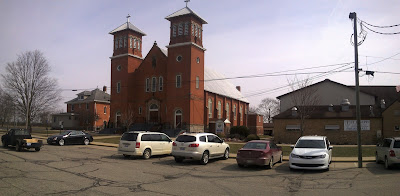 |
| rectory (left), St. Joseph church, and community center in Pewamo, Michigan |
For a very small farming town in middle Michigan like this one, the ethnic roots of many residents and family habits connect them actively or passively to this space where religious services and events of the passing years take place. Clergy have come and gone who have occupied the rectory building during their time in residence providing services to parishioners. The life cycle of the worship space at the church has gone from dream to plans to construction and consecration to decades of use up to the present and finally, one day in the future, reconstruction or demolition and rebuilding will also take place. However, the rates of participation in mainline churches has declined in the distracted age of Internet. So the amount of cooperation, concentration of money and intention needed to launch any kind of building project seems less and less likely as time goes on. Maybe this existing building will be maintained for generations to come, rather than rebuild in current technology and energy saving improvements. Years ago when large families and economic boom years created larger populations, the need to expand the indoor seating might have led to changes in the building and grounds. But as numbers stagnate or fall, the need for bigger spaces is not a concern. The
nomos perspective on the subject of this stitched panorama scene is centered on the many lives touched by the making and ongoing use of the building and grounds here on formal occasions and for casual uses, too. Things like memories, intentions, credit/blame or accountability, and so on attach to these places and make it meaningful. By contrast, the
physis angle is to see buildings (design, construction methods and materials, uses or functions of each room) and the schedule of weekly or yearly uses, along with the range in participants involved, as things to study: ignore the local meanings and intentions to emphasize instead the presence or absence of certain actions and the changes in behavior caused (or catalyzed) by a person's involvement with others and the teachings that take place under the worldview of Christians attending.
 |
| radio station transmitter tower, west bank of river in Grand Rapids, Michigan |
Like the wind that sometimes whistles through the cables securing the transmission tower the conversations and music coming from this radio station are so ephemeral; they simply exist for an instant and then are quickly followed by something else, leaving little trace in the mind or heart of listeners as the motor down the road, sit in their living room or work desk tuned to the radio station, are busy with dog-walking or dishwashing or house painting, or they are lying awake in bed. And yet the ability to communicate over wide areas offered many benefits over print newspapers when it came to public information, (breaking) news, opinion and entertainment. Nowadays some people are experimenting with home radio stations (ultra low-power signals for neighborhood span of service), and digital radios and signals allow ever more concurrent uses of narrower and narrower wavelengths, even as the wireless spectrum of wavelengths is crowded more and more by cellphone transmissions. The
nomos interpretation of radio programs, their stations, and their listeners involves content and what it means, why it appeals or irritates, and the kinds of changes it might bring to some listener's lives or, by extension, to the lives of people that listener is engaged with. On the other hand, the
physis view focuses on the technical facts of transmission distance, cost, resilience (able to withstand power loss, etc), and the results to people's lives who tune in: does a song, conversation, or piece of news materially or emotionally alter that person's path in life, or at least in that day or hour?
In summary, all these examples captured in photos can be viewed in many ways. On this page just the contrast of
nomos and
physis are studied. By considering things like
meaning and purpose on the one hand, and things like
material change or effects caused by the subject in the picture on the other hand, it is possible to produce an expanded understanding of the significance of the people, places, and things that occupy one's ordinary environment and the routines taken for granted there.


