Showing posts with label cultural landscape. Show all posts

05 October 2024

From nature's landscape to cultural landscape


four-photo screenshot: lamps in dark, sunset desert southwest geologic feature in Monument Valley, medieval stone church, neon festooned Singapore skyscrapers
Neighboring images for October 4, 2023 flickr.com/explore

When displayed adjacent to each other, these four images suggest a long arc in the changes between people and their environment. At top left is an image of artificial illumination under an ocean of stars (1-Million-Star Hotel). This could stand for human use of fire for light and heat and cooking and to modify bone, stone, ore and other materials. Next is the prominent soaring geological feature spotlighted by evening sun (Desert Drama). This is a large structure, but one not built by human hands. Compared to the first photo, this changes the scale of meaning from the campfire to something much larger to which stories can be attached and events can be referenced. Turning to the bottom right photo (St Cuthbert's), the sturdy place of worship is made of cut stone for wall and rooftiles. This is the work of architectural traditions inherited from the ancient Romans and the Greeks before them and requires not only knowledge but also logistical trains from quarry to cutter to builder, too. Lastly, there is the multi-colored, multi-storied grove of towers that hearkens to ancient trees reaching far above the ground (Singapore - Garden Rhapsody). 

Viewed from 'campfire' to 'grove of towers', there is a long sweep of change in human interaction and control of the natural environment. The scale and technical sophistication grows across the millennia and this serendipitous sequence of photos gives a hint at just how much things have changed, both in the minds of people but also with regard to the habitats affected by extraction, construction, and ongoing operation of such large artifacts with cultural meaning.

In the eyes of the people whose greatest achievement is the use and control of fire, the giant monument could be taken "as is" for a kind of human worship space; a building that involves no construction technology. In their eyes, the idea of shaped blocks of stone to form a church would be mind-boggling; even moreso the multi-colored, multistoried, glassy towers. Looking through the opposite end of the telescope, from the eyes of 2024 people, the stone church would be recognizable but little more than a rectangle where believers meet, teach and preach, and conduct life rituals. And the geological wonder would be something like a postcard; something recognized and briefly enjoyed for its visual novelty, but probably not a site of pilgrimage or object of veneration to most visitors and viewers. As for the idea of 'campfire' and canopy of stars, for many people today that is beautiful and desirable, but hardly comparable to large scale architectural feats of today.

In summary, by chance these four pictures appeared in the Flickr.com editors' daily selection of images to showcase. As it happens, each one seems to stand for a different stage in the development of human powers of construction of artifacts but also of ideas and attitudes to the surrounding space and time. In this one screenshot of the four scenes framed all together there is a hint of the great scale of change from 'campfire' to skyscraper. And while the size of each subject and processes differs greatly, in the end human habits of attaching meaning or significance is a common thread across the centuries: people see meaning not only in what they do in relationship to each other and the things they make, but also in the space and time they inhabit, thus turning a natural landscape into a cultural landscape closely tied to the language they speak and to the assumptions that go along with it.

31 July 2024

Drone lens to see above the treetops


thumbnails (4 rows, 5 columns) of drone photos in downtown Grand Rapids
About 80-100 feet above ground level in downtown Grand Rapids, Michigan on July 31, 2024

After a lifetime of composing pictures and viewing pictures from eye-level and using a viewfinder or digital screen, the experience of flying a sub-250-gram camera drone (not subject to FAA licensing; most places restricted to 400 feet or lower, according to published maps for drones) takes some getting used to. It takes time to gain reliable competence to launch and recover the pocket-sized quadcopter. And it takes time to know how to set the lens angle and the frame before capturing a photo or recording video clips. Although this model (Holystone hs175d) allows software and smartphone screen to show the camera's point of view, by flying blind with just the handheld controller and estimating the heading of the lens, there is less technology to coordinate and to slow down the set up, launch, and return to land. In addition, by not seeing what the lens sees, there is an echo of the roll-film era of photography, when it took a few days (or "1-hour photo processing" while you wait) before the resulting image could be seen.

Learning curve on this hobby drone camera

Being very light-weight with small battery, usable for 15 or so minutes per battery, and with modest lens and small digital sensor to capture the images, best results come from several tips discovered by practicing. (1) Abundant light falling from side or behind the lens puts the scene in best view to record detail and mostly accurate colors. (2) Preflight visualizing the launch site and center of the photo to compose before releasing the shutter gives more deliberate photographic results, and it reduces in-air dithering as the battery runs down. (3) Before launching (checklist): unfold controller grips and antenna, power it on. Unfold drone struts and power the drone on. According to the manufacturer steps: pair the controller to the drone, activate the compass (involves a long-press button, then rotating on two different axes), then wait for lights to change from red to lime-green (signal that GPS signal is found). During this minute or two, decide the lens position (0 to 90 degrees relative to the horizon). Since the full travel from pointing straight ahead to straight down is about 45 presses of the controller button, a landscape is best about 5 or 6 clicks under the horizon (straight ahead) position. For subjects very much in the foreground, maybe 14 to 16 clicks will frame everything best. Then reset the gyro and finally unlock the motors so they can spin and so that the auto-launch button can put the drone at a 6-foot hover position. (4) Tripod in the sky is one way to imagine the drone camera: launch and then, like an elevator, go straight up (rather than traveling laterally to hard to reach spot, say) to take pictures at different altitudes (beginner mode caps the ceiling at 100 feet/30 meters, a distance from the pilot that still allows the drone's lens/heading to be seen). Rotating the drone 2-clicks of the joystick will move the center point of the photo frame about 20 or 25 degrees, thus allowing a sequence of shots that overlap. (5) Limitations are good to know, too: wind that is able to move the treetops is too much to fly in. Rain also is ill advised. Extreme heat or cold diminishes the battery power, too. Even with minimal wind, lots of light, and moderate air temperature, though, being too hasty to pivot the lens and then shoot the picture can give tipped horizons, since it takes a second or two to regain level composure. In other words, whether recording moving or still images, it is important to turn the drone and then wait a few moments before pressing the record button on the controller. (6) Landing (checklist): Normally, the GPS launch point is faithfully homed in on, but sometimes unexpected puffs of wind, or a particularly hazard-filled site calls for extra care to ground or to catch the drone - being ready to make micro-adjustments before finally pressing the Auto-land button and then after reaching the ground and props no longer spinning, turning off controller and turning off drone, folding the four struts of the propellers and then returning to the storage/carrying bag.

Seen all together: the drone photographer arrives at preferred launch site, free of overhanging branches and wires, and so on. The person unpacks controller and drone to prepare for (auto) launch. Once in the air, the pilot quickly presses the altitude stick to elevate straight upward. Once at the chosen height and pointing the lens at the center of the composition, the photographer waits for two seconds so the drone settles relative to the horizon, rather than tipping to one side or the other. Snap a photo, then 2-clicks of the joystick to rotate away from the first center point. Wait 2-counts to settle and then snap the next photo. After enough shots are recorded, then the drone comes down the way it rose: straight down the invisible elevator shaft. At eye-level, press the auto-landing button to make a soft landing and turn off controller and drone. Elapsed time to unpack, launch, ascend, snap a series of shots and/or video clips, descend and reach the land could be 8 to 10 minutes all together.
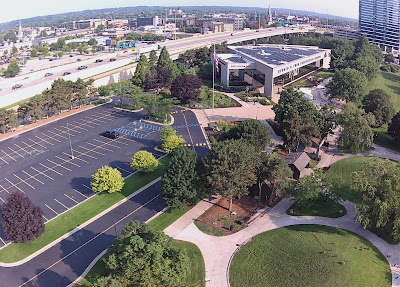
90 feet up to show US-131, Ford Presidential Museum, and Indian mound park in forground
looking north near the Grand River, Ah-Nab-Awen Park & the Ford Presidential Museum

Reasons to record the land and people from above the treetops

Before the invention, proliferation, and interest in pictures and video from the air, it was only airplanes and helicopters (and hot-air balloons) that made this birdseye perspective possible, limited to those with a big budget or good connections with pilots and photographers. But in 2024 there are now many tiers in quality of drone camera available new or used, suited to a variety of purposes and abilities. Some are made to be fool-proof with pre-programmed menus of pictures to take. Others allow the pilot to make most control decisions, just automating the orientation to horizon (remaining level) and the launch/landing phases of flight. The camera itself often is similar to a "point and shoot," leaving the composition frame and altitude to the flyer, but the exposure and shutter and ISO (sensor responsiveness to light values) are auto-determined. In this article the camera is on a hobby drone of around $200 new and weighing less than the FAA license limit of 250 grams. For the purpose of learning to fly and to visualize things to photograph from the birds' point of view, this UAV (unmanned aerial vehicle) is entirely satisfactory. For profession filmmakers, though, it falls short in many ways.

Unlike the visual frame at ground level, being now up in the air the context suddenly is many times wider and deeper. So the pictures taken at 30 or 60 or 100 feet put the horizon farther away than the ground-level or rooftop window height. For face-to-face subjects or macro details, there is no benefit from a drone camera. But for big cultural terrain, large patterns and relationships, and "establishing shot" introductions to a place, the viewpoint above ground level is superior. Even large indoor spaces can sometimes benefit from a lens that is 20 or 40 feet above the activity, below.

Besides the content recorded from the air, another benefit is the comparative one: the viewer may already have on-the-ground experience of a place or a subject matter, but by layering this new perspective onto that first-hand, up-close knowledge, the person now gains a point of comparison, thus making the earlier vision become a comparative one: knowing it in stereo instead of in mono.

Some aspects of a subject or a place may simply be invisible or too big to appreciate in the eye-level scale of encounter. Only by having the (aerial) distance can the scale of a thing be understood. For example, some things can best be grasped from the air, such as a massive factory complex, port facility, campus, or site of natural (or human-caused) disaster.

Finally, there is freshness and novelty that comes from seeing something from an unaccustomed standpoint. Even if it is something as well-known as one's home or workplace, that deep familiarity can make the thing uninteresting, ordinary, and rarely perceived objectively. But by seeing it from the air, now it becomes unfamiliar and some of the contours and connections to adjacent things come to life.

In conclusion, whether it is a hobbyist keen on flying or one keen on photography (or both) or it is someone with professional interest in drone photography (city engineer, military corps, land surveyor, social scientist, historian, novelist or journalist), the practicality of having an "eye in the sky" now makes uses for drone photography relevant in day-to-day operations and routines. It can answer old questions and lead to new questions. It can be the instrumental knowledge for decisions today, but also be of value when future generations look back to explore our moment by using UAV archives like these. So, more and more drone photography should be encouraged and supported for immediate benefit and for future uses, too. 

CAVEAT: like anything else human-created, this visual tool can be used not just for good, but can also be abused for bad purposes. So, infrastructure that a terrorist or far-away government may want to scrutinize with a view to harm should have special protections so that imagery is not online readily findable.

04 December 2023

Mingling popular, commercial, national, and personal Christmas meanings


front lawn of business on busy street of big city with Christmas decorations: inflatable and lighted, cutout colorful shapes, and life-size santa figure
Around the time of Thanksgiving the Christmas lawn art goes up
The colorful and large pieces of store-bought lawn art attract some attention of passing traffic in mid-day, but at night the accompanying lights attached or internal to the inflatable figure stand out especially vividly. This business benefits from visibility on a main road in the city so they rotate the themes of lawn displays four or five times in the annual cycle: Halloween, Thanksgiving, Christmas, maybe Easter, possibly something patriotic from Memorial Day (end of May) weekend and into Independence Day (start of July). Without asking the proprietors it is hard to say what may be the mix of motivations or to estimate which of them is strongest: business name recognition/visibility, community spiritedness, tradition of the earlier proprietors or family memories, creative impulse to express publicly, and so on.

The figures in the photo include the 1966 cartoon adaptation of Dr. Seuss' (1957) How the Grinch Stole Christmas (reindeer dog and green Grinch), the Snowman from the 1964 stop-action animation of Rudolf the Red-nosed Reindeer, and at the right edge of the frame, partly protected by the roof overhang, is the standard Santa Claus (or Saint Nicolas) figure in costume. Both of the Christmas TV special productions concern gift giving, cold weather, community spirit, and wishes fulfilled in spite of obstacles faced by the protagonist(s). And the Santa (or British and colonial Father Christmas) also has roots in the church calendar and stories, too. None of the figures quotes Bible scripture or sings church hymns, though. But this ensemble has a cultural logic that makes this mix of figures coherent.

There are many ways to view the scene, depending on one's own interests and beliefs about the best way to kindle a Christmas spirit and acknowledge the holiday's original and its present-day meanings. Some will foreground the happy, fun, and spendy feeling of the weeks before and maybe a few days after the December 25 calendar date. Others will mainly feel a communal and nation-sized synchronicity with fellow citizens all doing something along the lines of celebrating good things in life (or grieving the absence of those things due to recent losses, change in fortune or health, and nostalgia for not achieving remembered and imagined heights of Christmas celebrating). Worshipers organized into religious bodies will celebrate congregationally with seasonal food and music and orders-of-worship to retell the story of Jesus' birth and its lead up, too. A few may resist the headlong consumerist compulsory gift-giving and disengage from the swirling mass media, pop culture, and annual merry-making; not disrespecting all those others enjoying themselves, but withdrawing from the general busyness of the season and clinging to the somber theme of the shortest days and weeks of the Earth's rotation around the Sun at winter solstice. None of this approaches is mutually exclusive of the others since a person can feeling all of these things to some degree in sequence or at the same time. Many others have religious life other than the Christian calendar at the end of the year (or none at all). So all the special efforts present a prominent, dominant, but otherwise low-relevance repeat each year.

Compared to 50 or 100 years ago, some dimensions of the Christmas season remain the same, while others bear little resemblance to what came before. As a young child the whole transformation of routines at home and out in public is wondrous and seems effortless: it just happens, like a force of nature. As an older child there is less magic and more active participation in the making of Christmas decoration, food, atmosphere and socializing. As an adult with or without children there is much more involvement in producing Christmas for others to see, to participate, and to reflect on prior experiences, too. So those life-cycle perspectives probably are similar in 2023, 1973, or 1923. But the scale, expense, and excesses of the business cycle of today surely dwarf the way things went in those earlier lifetimes.

Seeing this photo in daylight, or again against the darkness of short days, the first spark of meaning from the season's figures brings a smile of recognition and the associated positive memories when having first seen the stories they belong to. But by thinking beyond that initial reaction, it turns out that there are many layers of meaning, depending on a person's age, formative years (decade), budget, social obligations and network, primary connection to the holiday (religious or not, businessperson or not, USA born or newly immigrated) and so on.


20 January 2023

Cultural landscapes - local knowledge versus outsiders' fresh eyes


Downtown Menomonee Falls, Wisconsin 1/2023

Thinking about cultural landscapes as I walked to my nearby grocery store, I imagined myself in a month or two immersed in my Japan project - biking and walking, on the lookout for features that attract my eye. The photos of traces from the past will serve as writing prompts so that I can explore the past (1875-1925) when infrastructure and modernization of mass-everything got going; and to appreciate what the society is now by contrast to then. Being able to "read" the landscape implies many things, things which set apart the people with local knowledge (deep or shallow) from those who have little or no way to fasten onto/tune into the surroundings.

This photo shows the old commercial district of the town, a place attracting buyers before the big box era of shopping centers at the outskirts of a town. For a first-time visitor one impression is the scale: this is comfortable to walk, possibly able to fit under the roof and footprint of a very large big-box store of today. A long-time local resident might know some of the shopkeepers and staff and may have purchased things over the years from some of the merchants. The cycle of annual events such as parades, debates and speeches, contests, seasonal decorations and entertainment will provide some memories of growing up in the area or the times as a parent with children of one's own. And even if not ready to spend money, being able to talk informally with a store owner about how to solve a problem is another way of making meaning here. Doubtless, a person of modest means will have a different set of relationships and memories in this scene than a person never wanting for money. And there could be patterns of difference in experiences by gender, age, ethnicity, religion, and so on, too.


What is called "local knowledge" has at least two dimensions. One is the ancient Greek distinction of Nomos/Physis (glossed as culture/nature, or perhaps subjective/objective). In the same way that Berlin and Kay did their famous color-chip sorting piles to discover where people of various language/cultures would make distinctions in the rainbow of the color palette (one calls it 'green' but another classifies it as 'blue'), so too of cultural vision of a place --one's own, or a place visited far from one's frame of reference, assumptions, meanings. That is to say, people local to a place are accustomed to labeling the cultural elements with familiar terms and distinctions. But outsiders may project their own understanding of what a thing is and how it could have value or else lack meaning. Or consider the metaphor of "Head Up Display" (HUD) used on fighter planes and now airlines, too: pilots looking through the front glass can also see useful and consequential information layered on top of what is outside in view. This is something like the way that terrain of infinite shades of gradation can be neatly labeled and divided into types or categories drawn from language or culture.

The other dimension of seeing the cultural landscape is based on meaning; not the labeling/projection phenomenon, above, but meaning in the sense of memories and personal involvement (not a spectator to a terrain, but an active agent with intention, purpose, meaning, expectation, precedents). A person who "knows" the place [important semantic play of Conocer (know personally) vs. Saber (know facts, analytics)  --Spanish example of separate "know" words that English lumps together] is able to see cultural capital (status level, past and present value, aesthetic degree of depth), and social capital (knowing names and relationships past and current of various residences, services, businesses; and knowing who to ask when solving any given problem), financial capital (past and potential/future sources of gain or risks of loss), and maybe linguistic capital (powers of verbal expression by voice or by writing). By contrast, a foreigner or even a citizen of the country who is unfamiliar with the locale, will lack almost all of the foregoing meanings that blanket the land, turning it from meaningless space to meaningful place.

Since I am an outsider to my Japan destinations planned for April and May 2023, but with some language and cultural experience and professional anthropology expertise of a general kind along with lived experiences gained by age, these many kinds of meaning will mostly be invisible to me. So, perhaps, I will have to imagine: granting the meanings to be all around and filling the terrain, even though I am practically blind and deaf to this local knowledge at the start.

In conclusion, locals with insider knowledge and layers of memory probably know their way around the physical plane and also the invisible terrain of events, personalities, and situations that are good or bad for one's own condition. Outsiders will faintly perceive only a fraction of all of those things. But a person who is looking out for the many meanings and sources of significance in a place is perhaps best positioned to see and to appreciate the worth of the many elements distributed around the terrain. For in-between the familiar and the taken-for-granted viewpoint of locals on the one hand, and the distant spectator stance of outsiders on the other, there is a flickering middle ground where some of the local meaning is hinted at and can be scrutinized to understand it more. In this middle perspective some of the meanings and lives, as well as possible futures and pasts of the place, come to mind. The beautiful complexity of cultural significance, social connections, linguistic play, and financial patterns all comes alive, together with the awareness that human meaning (nomos) neatly imposes itself on the much larger and more basic reality (physis), a system of meanings that is preoccupied with certain distinctions but oblivious of other ones.

Cultural landscapes accommodate all these viewpoints: locals, outsiders, and those with an inquiring mind who occupy the in-between space in order to see a bit of the outsider standpoint and the perspective of the local residents, too.

08 December 2021

Cultural landscape at bus stop - Forensic Brainstorming

edge of busy city street dusted with fresh snow at bus stop
mid-morning heap of possessions at bus stop (8 Dec. 2021)

At first "brainstorming" and "forensic interpretation" appear to be opposite in purpose. One is meant to open up possibilities, unrestrained by ordinary habits of perception. The other is meant to eliminate all except the (single-most) probable explanation. But upon seeing this collection of clothing, backpack, and other personal items, the pool of possible meanings began to come into mind (brainstorming). But more than idle interpretation, instead I proceed with a view to turning up something close to the true significance of this sight (forensic scrutiny). However, in the end, this is an exercise in social commentary, so no DNA samples are going to the lab; no missing persons reports will be consulted; and no enhanced magnification of the contents will be inventoried. Instead, an initial pool of meanings will be offered in order to turn up some or all of the actual interpretation for this strange sight.

Brainstorming some lines of interpretation, in no particular order. (1) Donation deposited halfheartedly (casual, careless, anonymous versus carefully calculated to fit a particular person frequently at this location). (2) Discarding unwanted items in halfhearted attempt to donate to another person. (3) Dropped in haste by a person carrying too many pieces of luggage to board the bus. (4) Discovered by a passer-by who noticed a bus rider losing the things en route to this location. The good Samaritan picked up the things and brought them to that bus stop supposing that the rider may well return at some point. (5) Demonstration of interpersonal malice or ill will: dumping the possessions of the person diminished in the eyes of the person depositing the things in a pile here. (6) Dithering by the person who received these donated things. At first they carry the things to the bus stop, then studying them more carefully, the person discards unwanted parts there and then, keeping only the items desired. (7) Distress by the person fleeing a person or vehicle: drop these things and run. (8) Dumped items stolen from nearby laundromat's washer or dryer.

Each of these initial interpretations of the heap of clothing is a self-contained story, but very often the true sequence of events is not simple or single cause, single effect. Instead there could be a set of events or sequence of circumstances that intersect at the moment of decision that produces the sight in view here. In other words, while there may be some truth in one or more of the string of imagined self-contained situations leading to the heap of clothing, above, it may well be that there is some combination of the interpretations here, along with other factors not yet imagined in the list. The habit of overthinking and projecting meanings where none were originally present is well known. Less well known, though, is "underthinking" a problem or a general lack of imagination to solve the case. And yet, it is somewhere between thinking too much and too little that the most progress can be made with "forensic brainstorming."

In summary, are these possessions "single-use" (disposable), a person's entire stock of worldly goods, or maybe somewhere in-between? Beyond the relationship of the items to the person or persons, though, what is the social condition of the person(s): unhoused and bereft of supporting social fabric, homeless but migrating from one hosting friend or family member to the next, a traveler who is in the city only long enough to get to the other side, someone is distress from alcohol/drug use disorder, or a person who is unable to secure and maintain a fixed residence where personal belongings like these can be kept? Without investigating further or actually meeting the person last touching the things when they were abandoned, it is impossible to compose a complete picture of the meaning of these belongings at the bus stop.