Showing posts with label grand rapids. Show all posts

19 October 2025

Impressions of the "No Kings" Protest, October 18, 2025


protest crowd in front of grand rapids art museum; sign says "resist" in ALL CAPS on puppet frog figure
View at Rosa Parks circle near the art museum, 18 Oct. 2025
Around the USA, and maybe among expatriates outside the USA, there were about 2600 rallies and demonstrations planned. Estimates put the June "no kings" protestors at five million. First estimates for the next "no kings" protest of October 18 at seven million. That works out to just over 4% of the 174 registered voters in the country, more than the critical mass of public dissent declared of 3%. What all this means in the short, medium, and long term is hard to know in the moment, but future observers of USA political and social life will be able to trace a line from this, the avowed largest single public protest in the almost 250 years of national history, to the course of events that follow.

What was it like to attend the protest? In the case of Grand Rapids, Michigan the Saturday morning began with rain showers, but was drying up around the start time of the festival event at Riverside Park from 11 a.m. to 1 p.m. inviting young people and families, in particular, but open to all ages. Then the rally of speeches and songs, followed by a downtown circuit of chants, began just before 1 p.m. in the city center at the Rosa Parks open space and stage. The above sign was among the fancier ones. Many others were hand-drawn on cardboard or poster board. Maybe 1 in 10 people had some form of sign, many with a message taken from a common pool of two or three dozen phrases, but others straight from the marcher's own mind. Impressionistically, over 1000 people participated at the morning event and three times as many came for parts or the whole of the afternoon proceedings. Both were well organized, thought through, and had contingency plans for weather, health difficulties, or attacks by agitators. Technical difficulties with sound, documenting, featured acts, speeches, and so on did not appear. All went smoothly in the end.

"The revolution will not be televised" is a famous phrase during the Vietnam War protest years from two generations earlier [attributed to Gil Scott-Heron]. The idea is that you cannot sit in your living room to be a spectator to events taking place around you. So get up and join your neighbors in protest. And yet, now that social media is becoming familiar to young and old alike, it seemed like every other person was taking photos and video at one moment or another, some more than others. Maybe 1 in 20 or 30 carried equipment more professional-looking than a cellphone: enthusiast or professional camera, or rigs to transform their cellphone into something capable of high production values (gimbal to avoid shakiness, tripod, external microphone). In other words, recording self and others, seeing how others dressed, protested (singing in loud or soft voices, joining the call-and-response, dancing, dressing in costumes) and behaved, including how others were snapping photos and capturing video, all this was integral to being present and participating - presumably then to share selected parts online for friends and also for strangers to see and hear, too.

protest stage at Rosa Parks circle with foreground crowd
Vietnam Vet (left hat band) snaps protest stage photo

There were several audiences and intended recipients of these demonstrations of disapproval for #TrumpConvictedFelon destroying the social infrastructure for healthcare, supports of vulnerable people, slowing down research and the production of knowledge and criticism, and enrichment of cronies, for example. Protestors both active and passive were there for each other: showing interest in each other's signs and/or costumes, bearing witness to the occasion by paying attention to speakers and entertainers, and watching out for each other so that no one put themselves in a precarious position (breaking property, laws, etc). But attendees also demonstrated solidarity for the hosting organizations such as #IGGR (Indivisible.org in the chapter for Greater Grand Rapids) and for the representatives of like-minded organizations and institutions that contributed expertise, promotional efforts, volunteers, and so on: area churches and non-profit organizations that serve the various demographic segments around the city and county, and so on. Then, too, the legacy news media were identifiable and were welcomed: TV camera person and accompanying Live Reporter, but also people from radio and from print media. City police were also part of the equation: would they interfere with lawful exercise of public protest described in the U.S. Constitution or not. A squadron of officers on sturdy bikes were visible at the edges a few times, but otherwise they could monitor things from overhead surveillance cameras on permanent venue poles downtown; maybe others were watching incognito (undercover). Fellow citizens were also meant to see and hear the protestors, either in person when driving by or later on social media. For every person who showed up, maybe another 5 were interested but lacked the motivation or circumstances allowing them to attend. Speculatively, for each attendee maybe another 20 or 30 were generally sympathetic, but perhaps also were ambivalent about the connection between political office holders and the role of constituents in making change, expressing approval, or demonstrating disapproval. A large bulk of citizens had no particular awareness, interest, or inclination for or against the sequence of slow-motion killing of U.S. traditions of democratic process. Also among the fellow citizens in the intended audience for protesters are those holding the diametrically opposite opinion of the world and the trail of destruction presided over by the "executive order" POTUS. All of these various neighbors were intended audiences of the solidarity being abundantly expressed.

Ultimately, though, the chief audience of the "no kings" events are the henchmen of the POTUS who abet and enable his offenses, crimes, and infringements of the letter and the spirit of the system of federal government: showing them that nationwide there are a lot of displeased people prepared to judge the failures and harms by voting the scoundrels out of office and then prosecuting them for their crimes of commission and crimes of omission - failures to discharge the duties of their office according to the laws of the land. The natives are restless and those pretenders, playing at leadership, but too incompetent to perform basic functions of government, should be afraid of what awaits them.

From the time of the January 20, 2025 swearing in of POTUS #47 to now on October 18, there is nothing but obstruction of government function; destruction instead of creation. By the time of January 20, 2026 no doubt there will be fresh crimes and harm caused. It seems unlikely that the wrongs will slow down or be reversed, and there are absolute limits to the abuse that the voters and citizens of the land will withstand. One sequence of events is impeachment, criminal charges proven, and prison time. Then the business of building the housing, healthcare, and energy infrastructure of the future (not the past) can begin. The decades of litigation for liabilities of the Trump Disaster owed to claimants will also begin. Once full operation of the federal governance resumes, destruction is repaired, and new initiatives have begun, then an accounting for the lost generation of opportunity costs wasted by the nitwits will be documented and published.  

12 January 2024

City 2024 budget for social fabric mending and extending


screenshot of 55 funded city events for 2024; author color-codes each category
from city of Grand Rapids, MI newsletter, January 12, 2024

This morning the city council's newsletter came by email and included the following text.

55 special events on tap now through mid-summer

The City Commission approved $209,085 in General Fund sponsorships for 55 events planned in Grand Rapids now through June 30. The special events sponsorship awards are allocated from budgeted event support/reactivation dollars made available through the American Rescue Plan Act (ARPA). These 55 events are being put on by not-for-profit, non-governmental organizations or people who have applied for funding through the Special Events Sponsorship Program and confirmed their dedication to holding open, free, and accessible events on public property in Grand Rapids that support the City’s mission, vision and strategic priorities.

By making a screenshot and then color-coding the kinds of things worth city financial support, a sort-of mirror shows the aspirations of the elected officials and the perspiration of the community organizations and businesses dedicated to bringing residents and visitors together. Although this typology of events is based purely on imagined content, based on the title of each, it may not be entirely accurate, but does distill some of the ways that modern society can still bring fragmented attention spans and unbalanced work-life conditions temporarily in repair through face-to-face mingling and meeting of others seen in the neighborhood or in other city contexts.

TYPOLOGY OF CITY-FUNDED EVENTS IN 2024

visual, performing art
charity, fund-raising
physical activity
mental wellness
food-centric
parade, visibility
neighbor/community gathering
ethic celebration
market/crafts

One way to appreciate the value of these many kinds of happenings is to imagine a city lacking such semi-structured public opportunities to interact with others in civil society: not work pals nor kin folk, but strangers who share a few basic facts of common environment and shared geography of cultural landmarks and annual cycle of events around the city.

Social observers and commentators describe "social fabric" usually in the sense of wearing thin, breaking or tearing. This metaphor is close to people's skin; it is personal and tangible. But as a metaphor, it points to the intangible layers of recognition, admiration, blame or praise - tacit or outspoken among people of a particular place and time. Social fabric that is strong or well woven can withstand stress and sudden shock, but weaker stuff unravels or breaks altogether. In this sense, the budget allocated for these 55 public happenings encourages participation and spectating by the great and the ordinary. It is a way to expand, deepen, and add detail to previous relationships to add conversations and possibly names to what previously might only consist of passing visual recognition of some of the people around the city. Although difficult to measure or even to give indirect indicators of the net effect of public events like these, surely there is more gained than lost by hosting so many kinds of things in and around the city.

03 November 2023

Living high and living low near the Grand River

cityscape of multistory, glassy high-rise overlooking the downtown river and closer to the camera is bridge with tents pitched under it
Lighted north-south passage under the bridge protects campers from prevailing west wind

 Fall colors point to the winter nights ahead for the many downtown residents living outside of traditional housing for private or for group residence. Shelters may not always be full, but some prefer their own company no matter what the weather may bring. Day centers allow warming up, as do public places like the bus terminal and library. When the problem is heat of summer, not cold of winter, then the same public places and a few dedicated "cooling centers" also are open in the heat of the day.

This photo is from October 2023 in downtown Grand Rapids, Michigan. The juxtaposition of one of the multi-story condominiums or apartment rental buildings puts the thin fabric of 21st century tents in stark contrast. With many gaping cracks in the USA system of social, medical, mental health, financial and educational support, even relatively secure members of society can go through a series of unfortunate events and have no fixed abode; sometimes sleeping in car or truck and other times losing even that piece of personal property. Perhaps some segments of the city dwellers in ancient Roman also went through loss of means, of property, of dignity, too. But for 2023's "richest" country it seems impossible that cities and also rural areas across the continental USA and indeed in all states and territories count among their residents so many who are visibly unhouses; and many others who "pass" (not visibly unhoused).

Described in the language of computer studies, this problem of no roof over one's head is the result of at least three categories of failure. One is "hardware"; that is, places and physical standards of minimum care, wellness checks, and so on. Another is "software"; that is, policies and organized groups of people, but also social institutions both religious and secular to serve those lacking an address. Finally, there is "heart-ware"; that is the often unwritten rules, expectations, reward and punishments woven into the relationships, attitudes and ideals of the society. In 2023 USA the overpowering celebration of youth, consumerism, and rugged individualism all contribute to "making invisible" people who do not fulfill these models. A person who is no longer youthful, who has no discretionary income to spend, and who does not strive to be some kind of Epic Hero does not attract praise or even validation of their identity and place in life. 


30 April 2022

Millstone of 1834 is silent witness to early years

Coarse millstone at bottom center testifies to long Grand Rapids

Year after year, in cold weather or hot, people brought their grain to the mill near this location on the Grand River to run it through the rough surface of the rotating millstones to produce flour suitable for baking bread and other skillet or oven-made treats. Doubtless there is a full story about how the stones came to be (quarried locally, or transported ready made from another location) and how builders harnessed the river before its flow was controlled and it rose and fell with weather and seasons of the year. As well as stones and building, there is probably an interesting story about how a miller or millers gained training and experience before arriving on the scene. Once all the elements were in place, there remained only the matter of spreading the word among settlers and travelers passing this way that milling services were now in operation. Then with bags or bins of grain for the milling to produce flour, the farmer or merchant had to protect the grain in some sort of container before making use of it, day after day.

Looking at the silent stones in their present location near the east wall of the Grand Rapids Public Museum, overlooking the once untamed, unharnessed river, it is hard to imagine all the years these stones rotated while tons and tons of grain passed through to be transformed into flour. Countless souls were raised on the flour from these stones, from earliest solid food until the person's deathbed and the last morsel of bread tasted on this side of mortality. This one piece of technology was a common denominator for a majority of  local residents and those who bought the ready-ground flour that was distributed to stores in the surrounding county or counties. The sound of grinding stones and associated waterwheel machinery will have been the soundtrack to many people living nearby. Some of the particular facts are recorded on a bronze plaque attached to the stones on display.

FIRST MILL STONES (transcribed text, below)

 ...brought to Grand Rapids and placed in mill on Indian Mill Creek about 1834, removed by John Ball for a horse block in 1867 and donated by his heirs to the Kent Scientific Museum. Tablet placed by the Daughters of the American Revolution.

In the age of gas-powered automobiles transitioning reluctantly to electric vehicles, the mention of Horse Block may be baffling. Judging from the height of the mill stones, Mr. Ball took the decommissioned geological mass as a convenience to step from ground level up to a position closer the the horse's saddle, hence the name 'horse block'.

In this artifact intersects so many features of modern and ancient life. The connection to grain hearkens back to the Fertile Crescent where wild forms of wheat and barley trace their origins and the association of calorific surplus with permanent settlements, law codes and armed forces under the command of religious, political, and/or military heads. Hand in hand with grain cutting is grain grinding, first at the household, "as needed" scale, but later in organized and mechanized scale. Thousands of years later, the lessons of best grinding stone, best sources of power, and best varieties of grain for a given soil and temperature condition all came together in these stones at this place at this time. Prayers for [Lord God, may thou] "give us our daily bread" may be far less often spoken in 2022 than in 1822, but bread still does figure in to many city residents' routine variety of foods eaten throughout the year, although almost all of the flour is baked in factories and a few local bakeries, rather than by hand at home.

Even when the service life of these gritty stones ended, they were still useful to Mr. Ball and his horse for many years. By looking at traces of long-ago times like these mill stones some of the people and the lives they lived comes back to life. In this way the material culture that lingers long after the original makers and users have gone can accompany later generations into years to come. Not only does a little of the past live now in the present, but the reverse may be true, too: some of today was already existing when those long-ago people went about their business, following their routines, adapting to innovations that appeared, and dreaming of some indefinite time ahead that they themselves would not live to see but which their efforts - whether wise or foolish - would have consequences among people alive now in 2022.


04 February 2022

Fiber-optic Internet service coming soon

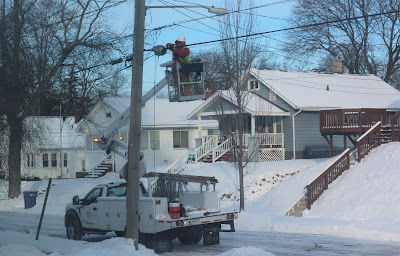
winter scene of bucket truck with man working on overhead cable-internet wires
Swapping copper wires for fiber-optic lines 4 Feb. 2022 ZIP 49505

Despite the cold temperature the workers steadily string the surprisingly narrow gauge spools of fiber-optic cable along the path of existing copper lines. Rolling the clock back 10 years to 2012, smartphones were increasingly appearing in pockets and handbags around the country and wider world. The earlier transition from 2G (2nd generation) to 3G had been completed and the first rumors of 4G were described here and there. Currently on sale in stores and websites are the widespread availability of 5G handsets, despite fragmented operation of the towers and transmitters/receivers inside and outside of the USA. The past week or two the risk of 5G wavelengths interfering with airport flight operations has been in the news since one federal agency sells the use of certain frequencies of the radio spectrum (FCC) and another is concerned with safe flight operations (FAA). Little or no coordination between these parts of the government seems to have taken place. The sale of the 5G frequencies took place at the end of President Trump's term of office and only now when the wireless system near major airports is ready to start to fill the airwaves is the FAA raising concern with conflict to cockpit equipment that reports altitude above ground surface.

The photo shows residential service improvements to the pace of Internet data flowing in and out of household wifi hotspots. The existing provision via copper lines has more friction or restrictions on the amount of information flowing to and fro. As a result the experience of using the Internet during the prime time entertainment hours (from 7 to 10 p.m.) after residents return from work sometimes is frustrating when streaming video or audio is less than free-flowing.

On the biggest junctions and sites of Internet use at corporate, university, and government centers there has been an exclusive "Internet2" that is dedicated to the biggest bandwidth requirements of virtual reality, 3-D engagement, and real-time performing surgery at a distance. But for residential customers paying monthly for service at differing tiers (datarate and caps on cumulative bits of data up or downloaded), the advent of fiber-optic broadband in place of copper-based cables may well give a taste of the extreme speeds of the Internet2.

Much like museum visitors staring at an early vacuum tube radio mutely on display, or seeing an early retail TV with its screen blank, people who visit a future museum and see a PC or section of copper cable or one made with fiber-optic stands will understand only the surface of the artifacts, not the programming that entertained, informed, challenged, or created worldviews of (social media) citizens immersed for large parts of their waking hours in the bright and dark corners of the Internet. As for teaching future museum-goers about the Dark Web, that is even a bigger stretch of the imagination.

At first look, this photos seems to show a straight-forward job of upgrading the on-ramp to the Information Superhighway, as Vice-President Al Gore phrased the Internet for a generation unequipped to imagine such a thing, But acknowledging that "the medium IS the message," as Marshall McLuhan described the effects of endless advertising and consumer appeals, the increase in Internet speed, capacity, and reliability is much, much more than swapping copper cable and connectors for the fiber-optic kind. By many orders of magnitude, this in-reach to householders and out-reach from residential and business locations makes the world much smaller and immediate. What once seemed far away now is just a few clicks or bookmarked websites away. Time zones still exist, but with prerecorded content, it is possible to engage with someone or something asynchronously, rather than "live" only. As a result, events of a fixed date and time, and taking place far from the online participants can form extended dialogues not limited to synchronous, "real time" experiences. And once archived or hosted online in recorded, transcript form, people also far into the future can revisit the conversation or presentation, too. And so, this photo of the warmly dressed workers putting all the pieces together for an even freer flow of data is bound to lead to unexpected good and bad things, unintended (and perhaps unknowable) consequences that maybe will only be seen in hindsight.

27 December 2021

Well stocked grocery-super store after Christmas holiday


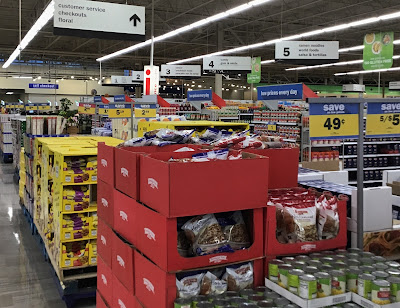
palettes of food and drink fill the extra-wide space at the end of the normal aisles
Monday after 2021 Christmas on Saturday - so much in stock
When compared to the inventory size and variety at a convenience store or old-time "mom and pop" grocery store before the 1950s, the massive scale of the Superstore - combining general merchandise (department store) AND grocery store, along with pharmacy, automotive center, garden products - is really astounding for sheer abundance. This photo shows the extra-wide space for rapidly changing seasonal and specially priced goods at the end of the numbered aisles to the right and the non-grocery (department store) aisles left of this photo. For example, the stacks of packing boxes in yellow reaching from ankle to chest height offer bags of chocolate chips that are essential to the many variations on chocolate chip cookies. A shopper need only reach into the opening at the side of the carton to pull out as many bags as the wish. Not far away are 5# bags of all-purpose baking flour. Behind the lens is an ever shifting inventory of regionally brewed (craft) beer varieties. The numbered aisle to the right still add prominent display of featured items on the "end cap," but these massive pallet loads amplify the idea of "end cap" greatly, insisting on attention by shoppers since the cubes of product reach eye-level or higher and require care when navigating with one's giant shopping cart.

With so much space occupied, so much color, so much quantity of any given item in the grocery inventory, the general impression is one of abundance. If this is a feast for the eyes, then the visual effect can quickly lead to indigestion: Too Much Inventory. Projecting the full life-cycle of a foodstuff: it goes from source (field, ocean) to manufacture or processing and packaging and palletizing. Then truckers go from factory to depot distribution site before local delivery vehicles stock the retail level shelves. Once the consumer selects things for the shopping cart and either whiles away the time at checkout lane by browsing magazines and impulse purchases of candy and savory snacks, or else lines up for a turn at the self-checkout corral with one or two staff ready to trouble-shoot some of the scanning problems (alcohol sales requiring ID verification, mislabel/prices item, coupons not valid or not machine readable, double-counting of an item incorrectly swiped across the laser field, etc). Then, once consumed in whole or in part, the package is discarded and hauled away for solid waste (landfill) deposit, or sometimes it goes into the single-stream recycle curbside service in the city or town or countryside. In other words, looking back at this photo of such masses of products concentrated here, eventually each packet of chocolate chips will end up in a household within a 5 or 10-mile radius, then all these bags -once emptied- will end up during these next weeks and months scattered through the stream of solid waste carted away to the towering landfill ziggurat.

In summary, the scale and diversity of grocery (and department store) inventory today is astounding. Carts are scaled accordingly (the reverse of portion control: go big to encourage more buying). First-time shoppers can be intimidated as they gawk and wonder at the choices and the packaging volumes. Even long-time shoppers can sometimes express a slightly weary look, knowing how many steps their personal exercise calculator will record between arrival and checkout and exiting into the sea of cars filling the parking lot. Perhaps this kind of supply chain, display method, and business transaction is here to stay, forcing out of business almost all except the biggest regional and national stores.

09 December 2021

National flag and personal life intersect at funeral

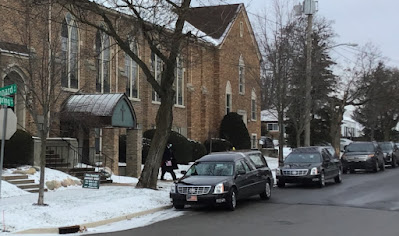
line of black funeral cars parked at church entrance
many meanings of the USA flag on the funeral hearse's front bumper

Late Wednesday morning, December 8, 2021, a funeral was getting underway. In the parking lot behind the church and the one across the street there were about 50 cars waiting to take people home or to the cemetery, if burial ceremonies were planned after the church service. In the context of 22 months of Covid-19 there is some chance that this life (or lives - since 2 hearses are positioned at curbside) was cut short directly by the virus, or indirectly that the hospital services were strained by the burden of unvaccinated people filling the hospital rooms and taking up the services there. But without stopping to talk to those present or searching for a published obituary, the cause of death is only guesswork.

The funeral hearse nearest to the camera displays the U.S. flag on the front bumper. Thinking of funeral customs for the other 200 national states, or for the many human societies that comprise the almost 7,000 languages that are spoken, surely this use of a national symbol on a personal and family-level matter is not common unless the deceased represents political leadership, national fame, or died in armed service (or veteran of military service). Without interviewing the owner of the hearse, its driver, or the company managers, along with the people attending the funeral, it is only speculation about possible significance (or more likely, multiple meanings) coming from the use of the national flag in connection with the dignified undertaking of funeral ceremonies and the safe conduct to and from the burial ground.

-Propriety (official, above-board, dignified, customary): This thread of meaning connects the person or business displaying the national flag to the country's wealth, fame, and all the life-affirming values that come with it. The darker chapters tend to fall into the shadows when the spotlight is fixed on the good things, though. In this photo, then, prominently exhibiting the flag (but not shouted loudly in oversize or multiplicity) assures like-minded people that the funeral company values and perhaps feels pride in belonging together with the present and the history associated with this banner. And for others who feel ambivalence about the mixed record of harm and healing carried out in the name of this flag, by displaying it out front, those who feel doubt will be put on notice that this vehicle and all those trailing behind it stand on the side of a positive accounting of the symbol and people connected to it.

-Authorized (halo-effect from close-association with the power of law and force): Seeing a flag in public as well as private spaces is a signifier that the proceedings are implicitly protected by the full faith and the rule of law of the land. In this photo, the presence of a national flag picture (or one made of cloth) seems to suggest that all procedures have been followed, duties fulfilled, and debts paid. No corruption should be suspected or expected or allowed.

-Conservative, button-down, standard-issue, government-conforming: Another meaning some will feel upon encountering a (USA; other countries have a different relationship of flag to citizens, no doubt) national flag is one of status quo; a sense that things will proceed as they have in the past.  No erratic, strange, or outlandish behavior is likely.

-Vocation (former government work for local, state, or federal employer): Before the funeral owner opened the business, perhaps he or she was a federal worker and/or a member of the military. In that case the flag signals the person's (or the company's) organic roots with Old Glory. The flag is part of their past work.

-Avocational (proud of team USA, symbols, popularly imagined history): Even when a person or organization has no direct connection to federal or national services and products, perhaps they feel strongly about expressing allegiance to this "one country, under God, indivisible, with liberty and justice for all" (quoting the school child's Pledge of Allegiance recited many times). In that case, showing the national colors discretely in the panel reserved for a license plate in some states is an affirmation or aspirational statement.

-Personal history (recent immigrant or else a genealogy enthusiast with long roots in USA): The flag display on lapel, desk, office wall, or raised on a pole could also signify something particular for that person. For example, a "new" American may have come via career path and advanced studies, as an asylum seeker or refugee of disaster, or as family member of someone previously establishing American citizenship by birth or marriage, for instance. In that case, a sense of ownership and belonging and gratitude, among many other possible mixed feelings could be carried by the visual presence of the banner. In a related but different way, someone who has looked deeply into family histories may feel a multi-generational sort of loyalty or allegiance to the many people, places, and things symbolized by the flag.

-Personal identity (define and view oneself by the category of flag and anthem more than by local ties): Some people see themselves, and are regarded by others, as a patriot and outspoken supporter of the things that the flag stands for in that person's mind. Others downplay their national citizenship and the source of their passport and build their identity instead on a foundation of the wider planet, or conversely, on a foundation of the immediate surroundings of their town or county. However, for the person who wants to be known, and feels most satisfied in seeing herself or himself, in national terms, then displaying the flag is a particularly personal statement; a sort of credo for who they are.

This list of possible meanings conveyed by a public display of the United States flag is not exhaustive; there are probably other sorts of significance being purposefully or subconsciously expressed when making a decision to put a flag on view. Realistically, the uppermost meaning in the eye of the beholder, the eye of the one displaying, or in the mind of others just passing by will be a combination of factors rather than a single dominant meaning. And for complicated, context-dependent meanings, it may well be that much lies underwater, like the bulk of an iceberg: part can be seen and discussed, but the greater part is unseen and is hard to put into words. So, directly asking a person what comes to mind when they see the flag might only turn up a few meanings or hints of meanings rather than a fully formed verbal response.

In any case, though, for the funeral company staff their minds are focused on providing professional and personal care for the people in mourning. The attention of the family and friends participating in the ceremonies is occupied with the events as they unfold minute by minute, the feelings that come up in themselves and in those nearby. It is probably only in the mind and lens of a passer-by that such considerations about the meanings of the national flag are studied in reflection. And yet, even for the funeral workers and the mourners, at least a little of the flag's presence and the meanings it triggers will be present, whether or not they stop to imagine the many kinds of meanings that arise when personal life and national symbols meet each other.

08 December 2021

Cultural landscape at bus stop - Forensic Brainstorming

edge of busy city street dusted with fresh snow at bus stop
mid-morning heap of possessions at bus stop (8 Dec. 2021)

At first "brainstorming" and "forensic interpretation" appear to be opposite in purpose. One is meant to open up possibilities, unrestrained by ordinary habits of perception. The other is meant to eliminate all except the (single-most) probable explanation. But upon seeing this collection of clothing, backpack, and other personal items, the pool of possible meanings began to come into mind (brainstorming). But more than idle interpretation, instead I proceed with a view to turning up something close to the true significance of this sight (forensic scrutiny). However, in the end, this is an exercise in social commentary, so no DNA samples are going to the lab; no missing persons reports will be consulted; and no enhanced magnification of the contents will be inventoried. Instead, an initial pool of meanings will be offered in order to turn up some or all of the actual interpretation for this strange sight.

Brainstorming some lines of interpretation, in no particular order. (1) Donation deposited halfheartedly (casual, careless, anonymous versus carefully calculated to fit a particular person frequently at this location). (2) Discarding unwanted items in halfhearted attempt to donate to another person. (3) Dropped in haste by a person carrying too many pieces of luggage to board the bus. (4) Discovered by a passer-by who noticed a bus rider losing the things en route to this location. The good Samaritan picked up the things and brought them to that bus stop supposing that the rider may well return at some point. (5) Demonstration of interpersonal malice or ill will: dumping the possessions of the person diminished in the eyes of the person depositing the things in a pile here. (6) Dithering by the person who received these donated things. At first they carry the things to the bus stop, then studying them more carefully, the person discards unwanted parts there and then, keeping only the items desired. (7) Distress by the person fleeing a person or vehicle: drop these things and run. (8) Dumped items stolen from nearby laundromat's washer or dryer.

Each of these initial interpretations of the heap of clothing is a self-contained story, but very often the true sequence of events is not simple or single cause, single effect. Instead there could be a set of events or sequence of circumstances that intersect at the moment of decision that produces the sight in view here. In other words, while there may be some truth in one or more of the string of imagined self-contained situations leading to the heap of clothing, above, it may well be that there is some combination of the interpretations here, along with other factors not yet imagined in the list. The habit of overthinking and projecting meanings where none were originally present is well known. Less well known, though, is "underthinking" a problem or a general lack of imagination to solve the case. And yet, it is somewhere between thinking too much and too little that the most progress can be made with "forensic brainstorming."

In summary, are these possessions "single-use" (disposable), a person's entire stock of worldly goods, or maybe somewhere in-between? Beyond the relationship of the items to the person or persons, though, what is the social condition of the person(s): unhoused and bereft of supporting social fabric, homeless but migrating from one hosting friend or family member to the next, a traveler who is in the city only long enough to get to the other side, someone is distress from alcohol/drug use disorder, or a person who is unable to secure and maintain a fixed residence where personal belongings like these can be kept? Without investigating further or actually meeting the person last touching the things when they were abandoned, it is impossible to compose a complete picture of the meaning of these belongings at the bus stop.

14 July 2021

Inside-out museum of city and society

stitched panorama shows museum interior and scene through the large wall windows
Left is "Blue Bridge" over the Grand River; right museum

The bright summer day pouring through the UV-protected picture windows of the Grand Rapids Public Museum in this photo prompted this question: how might it be possible to turn the lived-in downtown environment into something like a museum, complete with label text (e.g. GPS points to link an item's physical identifier to a paragraph of text, audio, and/or embedded links or imagery). That way the walls that separate inside from outside would disappear and the same expectations that visitors bring to poking around the permanent and temporary exhibitions could also accompany them outdoors on their way to and from school, work, shopping, or other occasion that brings the person into the cultural landscape. In fact this relationship between inside (glass cases, informative text, eye-catching artifacts, and thought-provoking references) and outside (hustle and bustle, preoccupied with schedules, and using minimal imagination or energy to engage with routine objects and subjects repeatedly passed by unexamined or reflected upon) could complement each other so that something of the museum visit attitudes apply to the everyday habits and repeated places and activities; but also the reverse, something of the "regular life" could also be applied in the museum setting to make the artifacts part of another time and another place, but still viewed now as "unremarkable, functional" parts of one's day, not as glass-encased specimens worthy of special scrutiny. 

By "de-exoticizing" the exhibit elements (putting the artifacts back into the flow of normal life) and simultaneously "de-familiarizing" the world of consumer calculations, popular culture topics trending, and considerations about one's next meal or time commitment to honor, then the result is to make the museum more life-like to one's own time and place at the same time also making the places outside the walls of the museum a bit more interesting and museum-like; worth stopping to examine close up and learning the context of when and how the particular element in one's landscape of cultural meanings and background infrastructure came to be as it is now. In summary, with the help of prominent QR codes tagged to outdoor features big or small, curious gawkers and walkers could wander and wonder as they explore the city streets with a portable Internet device (phone or tablet or maybe a wristwatch or supercharge Internet glasses) and get to know their cultural landscape as an endless outdoor museum without walls, whether they be local residents or out-of-towners.

07 May 2021

A life put into words - histories and memoirs on the library shelf


library titles for history (Dewey 940s) rotated to make titles easy to read
At the branch library there is a bookcase filled with a variety of histories and memoirs to browse. Considering that each title is a self-contained work of one or more authors, almost always drawing on published work of others and interviews and other primary source material, as well, the true scope of page counts implicated in this modest collection is staggering, representing a volume of writings maybe 20 or 50 times as big as the space of this one bookcase.

The relationship of a book to its subject matter is similar to the classic illustration of an iceberg: the part that is visible (the individual book) is only a small fraction of the whole thing (cumulative mass of all the books and research sources used to create the one book that is visible on the shelf). Besides this compressed form of knowledge that the photo displays, there are other ways that the set of printed pages bound into book form are remarkable.

Asking a fish to describe the sea that it swims in leaves many important dimensions untold, since so much is taken for granted. The same is true in certain ways for a historian writing about the present day and the historical antecedents to it. Unlike the fish, though, a trained reader and writer of history can consult outside perspectives, cite documents, and study records for clues to bias and omissions. The books in this photo each represent many hours of drafting, then editing the books (not forgetting the shoulders that an author stands on and those many hours to author the earlier books on which the present-day books depend). Each title gives a representation of earlier people, places, and events. Necessarily, the process of telling about events requires "selective memory," leaving aside some parts in order to focus on other parts. That filtering effect probably owes something to the writer's personality and experiences, training and area of expertise, and current events and preoccupations around the time of composing the first draft. Having access to certain sources, but not to others, will play a part in the resulting book, too.

So much for the remarkable things going into this line-up of printed pages and the topics present (and by contrast the many other subjects that are absent). Another dimension of this library bookcase photo is the readership. It would be interesting to know what the lending patterns pre-pandemic and during the pandemic have been, either matched to demographic segments (male vs. female, retiree v. teen v. working age) or simply in the aggregate to discover which books are most and least circulated during their service life (until relegated to storage or sold). After all, the books in this photo appeal to certain sorts of people but not to others. Some readers are voracious in their appetite for the printed word (leaving aside the universe of ebooks offered to borrowers, too, as well as downloaded audio books or the audio CDs on a separate shelf), but others just read one book at a time and only a few per year. However, the usage patterns and sociological profiles may turn out, though, it is remarkable that busy residents of the city, surrounded by the "too much information" of 100s of cable TV shows, and the bottomless reserves ancient and modern discoverable online, still hunger for the people and places and events found on the books classified under the Dewey Decimal System under the history label.

Thanks to the Internet, such things as     archives of images, moving pictures, primary sources, and public domain books and music are only a few clicks away. It is getting easier than ever to travel in time or place by using these traces of earlier times and places. And yet, some readers eagerly browse the authors on this shelf to discover those worlds glimpsed through the mists of time in the words of delightful authors in well-organized chapters and paragraphs. It is hard to know exactly, according to the person or more generally for most readers of histories, what reasons attract people to the ink on these pages. Perhaps it is a desire to fill in hazy outlines of a particular time or place in the reader's mind; maybe there are personal or genealogical connections to the subject matter; or possibly the reader is hungry for escape from modern times and finds a sense of order and certainty that hindsight projects onto things. In any case, the books on these shelves - indeed on the shelves for all the other categories of publications recognized by the library system of classification - speak to certain readers and not to others, they reveal truths, and teach those searching for answers a few of the pieces to the puzzle that forms in the person's mind, one book at a time. Generations from now some of the same motivations will be there to write and to read history, although in that time maybe the idea of printing with ink on paper will be antiquated.

25 February 2021

Rethinking "back to normal" when Covid-19 dwindles

At all levels of governance, United Nations, USA President Biden, many governors among the 50 USA states and perhaps among the territories, as well as from the mouths of (big city) mayors there is recognition of value in and pledging to "build back better" with a minimum wage that lifts a worker with a family above the statutory annual income poverty line (definition). Examples are the policing habits and mandatory sentencing (social justice), higher education and health care as a basic right (regardless of ability to pay), unequal access to clean air and water (environmental justice), and obstacles to building generational wealth ---burdens touching all lives, but proportionally more costly for those starting with fewest financial, informational, and social resources to drawn upon. In other words, using pre-Covid standards as the benchmark for restoring a state of 'normal' is not sufficient, not desireable, and not right.


In the video clip the carillon that plays at noon and again at 6 p.m. on weekdays at this church evokes many things about the pre-pandemic routines of the week that formerly comprised normal, proper, and generally pleasing parts of the social landscape. For example, the church annual cycle of events was one set of calendar markers that structured many residents' year. Dining out, vacation or business travel, and the many functions of consumer society all filled people's imaginations, budgets, and schedules. Focusing on the front end of those processes --- choosing what to eat, where to go, what to buy for self or as a gift for others --- there used to be an element of hunter/gatherer thrill of the chase: spotting the thing to satisfy one's goal. To complete the circuit from idea to pursuit to purchase to consumption there used to be a set of conditions (pre-coronavirus) that were taken for granted and now (during the pandemic) have been either prohibited, ill-advised, or otherwise abandoned. There was the fuel burned in driving from retail place to place (in Covid times substituted to some extent by online browsing, wishlists, and deliveries). There was the recycle or landfill burden of transport packaging and retail boxing that is discarded. And psychologically there was the imaginary land of endless purchase, use, disposal; as if one's individual indiscretions and feelings of wanting, deserving, or feeling obligated to go out and get something was disconnected from carbon footprint, energy consumption, food waste, and all the other components adding up to the USA 5% of the world's humans using up 20 or 25% of the planet's energy.


So what might this "build back better" look like? The list of issues, above, touches on some examples that may be engaged with seriously to find local expressions for attaining the goals and addressing wrongs of present and future (maybe even compensating for past wrongs, too). But from the experiential level of individual "life chances" or dreams and realities of people in all points along the social and economic status spectrum there will be other changes to look for; things that translate from the slogan level to the lived-in level.

For the sake of this argument and skipping over all the conflicts, obstacles, excuses, and special interest lobbying, suppose that minimum wage does go up and working hours go down. That could lead to more consumer activity - in direct contradiction to the Green Economy recognition that the carbon footprint must be reversed for this generation and for the burgeoning human populations on all continents that are yet to come. Not reining in the consuming of fossil fuels only worsens the extreme weather, expands the destruction of habitat --including water and air for humans, too--, and accelerates the extinction of diverse plants and animals of air, land, and sea (and non-salty waters, too). So from the experiential, first-person point-of-view, better laws and enforcement, along with income levels improving, results in individuals having greater social, economic, and aspirational reserves to face good times and bad, normal life and the times of disaster from natural source or human cause.

Supposing, further, that big consumers of the G-20 societies where much of the global energy and resources are used up (not just to survive, but for discretionary uses) were now to cultivate a mindset of conserving water, air, species, and material wealth (make it last, right to repair, barter and down-cycling before recycling). Then the limited resources and the renewable resources will be consumed at their HABU (highest and best use), rather than to be squandered in unsystematic, careless ways. At the personal level as well as at the organizational scale this new mentality would translate into amplified mindfulness about disposition of resource and its final disposal, and before that, careful use of the things one is in charge of using. Much more of the economy's services and products, and leisure pursuits will leverage the savings of time, knowledge/expertise, and fuel by using Internet for communication and engagement in a subject virtually instead of in-person, face to face.

Finally, if it were so that health care and higher/further education were guaranteed rights obtained in one's citizenship and in one's active contribution to society (paid or unpaid work, building rather than breaking the social fabric), then people from all walks of life could imagine bigger and better futures for self and others. The possibility of pursuing one's dreams would be actually within reach, unhindered by matters of net worth or generational wealth/poverty and social capital in the names and interpersonal debts and credits among the constellation of one's own contacts.

Taken all together, "building back better" instead of "back to normal" is exciting to think about. Some parts may actually take initial or even final form, but other elements will remain talking points to aspire to in the next generation of people participating in "the art of the possible," as the political arena has been characterized over the years.


27 December 2020

Special LEGO exhibition at Grand Rapids Public Museum in 2020


The giant LEGO honey bee suspended overhead in the foyer of the Grand Rapids Public Museum is a vivid example of the wondrous sculptures and dioramas created for display in the special exhibition starting in fall 2020. This video clip starts with the scale model of the hosting museum itself, adjacent to the (LEGO) Grand River, made from more than 4,000 pieces of the colorful plastic building materials. Then the camera turns to show the larger-than-life bee above.

Seeing both the miniature LEGO museum in its plexiglass case and the honey bee brings to mind several thoughts: the creative impulse to make such things, the faint whiff of irony that the honey bee representation is made from the petroleum product that modern life depends on but which also has led to habitat degradation and destruction that accelerates loss of bee populations, the nature of public engagement and awareness, including the role that museums play for sparking interest in the natural world and forming relationships between humans and all the other creatures sharing the planet. Not everyone coming to the museum will pay the separate admission to the LEGO exhibition, but for those who do browse the sculptures and dioramas, the intricacy of the models and creativeness of the makers will make an impression. But it is an open question with unclear answers to know whether new curiosity will arise, new respect will develop for non-human creatures and their habitats, and by extension an increase in awareness for the consequence of personal consumption assumptions and expectations will occur.

While the pandemic rages in Michigan the museum controls the number of visitors by online (or telephone) reservation of admission tickets and member passes accepted each day. In this video clip some of the visitors queued at the admission desk show their face masks. Perhaps this heightened microbe consciousness from the sustained health mandates from the Michigan health department will contribute slightly to greater public curiosity of the natural world, scientific tools and logic, and renewed respect for facts supported by data instead of 'gut feeling' or the hubris of bald claims made in loud, politically motivated performances that Donal J. Trump incarnates.

 An album of G.R.P.M. photos and video clips can be seen at https://www.flickr.com/photos/anthroview/albums/72157717510759343

04 November 2020

Notes from polling precinct 3 November 2020 USA General Election


scenes early morning and later afternoon in Grand Rapids, Michigan 49505
Pandemic and relatively recent voting law changes in this state to allow "no reason absentee voting" resulted in something like 3 million ballots around Michigan's 83 counties being voted by mail, drop off at the respective county clerk office or its designated dropbox(es), or in some cases "early voting" at the counter of the clerk's office. So even after the in-person, conventional voting period from 7 a.m. to 8 p.m. ended and each of the 76 precincts in the city of Grand Rapids transmitted their results electronically (and by paper and duplicating SD card delivery to the tabulating headquarters), still the results could not be concluded while the many mail-in and absentee votes were being tabulated by an army of workers. While states like Florida allowed early votes to be processed in the days ahead of the precinct in-person voting, the Republican-controlled legislation in Michigan refused to allow any processing ahead of time with the exception of jurisdictions of 25,000 or more residents. In that case the outer envelope could be opened 24 hours before the voting day.

These photos show a few of the scenes at a 1928 neighborhood elementary school vacated by the pandemic so that children are relegated to online connection to teachers and peers. The day begins with crews delivering the voting equipment the day before and then the poll worker chairperson opening the door to fellow workers at 5:45 a.m. to begin setting up the gymnasium polling place starting at 6 a.m. and then declaring "The polling place is now open" at 7:00 a.m. In this case about 5 voters keen to be at the head of the line had arrived a hour before that official start time. But very soon the line ran from the first station (writing name, address, date of birth) for application to vote, all along the hallway and out the door, over the sidewalk leading the roadside and all along that streetside sidewalk for a total length of perhaps 80-90 yards.

There are 2594 voters in this precinct (maximum of 2999 per precinct by law): on this day at this precinct 763 voted in person, of which 1 man did not accept the mask offered him; another had a health condition precluding mask-wearing. All others waited in mask, mostly silently. Some people engaged with their smartphone in texting, reading, gaming, or with earbuds connected for music, recorded book, news, or podcast. The first 2 hours were long, long, long lines socially spaced, requiring about 90 minutes from lining up to leaving the polling place. By noon there was just a 10-minute wait thanks to a helpful "challenger" (party-appointed and registered observer) who called in 6 cardboard booths to supplement the 7 that had been assigned. From noon to 8 p.m. things faded away until just 200 or so arrived in dribs and drabs in those final 6-7 hours. Impressionistically, it seemed like many women under the age of 35 showed up in person and a certain proportion of retired people, too. One of the young women sported a Trump-branded face mask, which is disallowed on the polling premises. So she was politely asked to reverse it, which she did. The seven assigned poll workers never flagged during the 14 hours. When all was tidied up and signatures showing full-day work, certifying all steps fulfilled, and so on, then the chairperson and 1 of the others made the drive downtown to the headquarters to deliver the data and supplies. So their day was even longer than for the others.

In the 2016 vote when there was no pandemic and before Michigan's "no reason absentee" voting, the election DJ Trump brought 800+ voters to this same precinct in person. For the 2020 General Election maybe half the votes (still being counted at DeVos Hall downtown) were early or dropbox or mailed in. So the total number of ballots seems to be more than in 2016. For poll workers 14 hours makes for a long day. When greeted or directed to the entry door, several voters remarked "this is my first time to vote." In some ways the shiny hallway, silent lines, solemn context stirred by in the frenzy of mass media and online-targeted user campaign advertising contributed to the whole experience being quasi-religious or civic ritualistic.

01 November 2020

Intersections of religion and government of society

A week or two before the November 3, 2020 General Election in USA


Most yard signs in the month or two before a national election are concerned with supporting one party or the other, with a few in support of neither Republican or Democratic parties and instead promoting the names and websites of third-party candidates such as Libertarians, Green Party, and so on. And for the Trump versus Biden campaign season, a few pun-worthy signs use text or visual jokes to make the point in support of one side or the other: Biden spelled "Bye Don" (as in Donald J. Trump), or the one showing a swoosh of dyed orangey-blonde hair to stand for Trump in which the word NOPE is spelled out in large letters and the "O" stands for the head of the President and the colored swoosh adorns the top to stand for trademark hair. A variation on this negation of Trump substitutes NOPE with NAH.

This photo, though, takes a completely different approach. It does not identify either the candidate for the Democratic Party or the Republican one. Instead it uses the symbol-colors of both main parties (red =Republican; blue =Democratic), which coincidentally signal the USA national flag (rectangular and with red, white, and blue as bars and a sprinkling of stars, as well). The this sign puts forward the candidate that rises above either Biden or Trump. It is Jesus of Nazareth, crucified about 1990 years ago and said to have risen from the dead, according to believers. 

Without asking the owner of the yard sign about the reasons to obtain and plant it here, it is hard to know exactly what it asserts, but it does seem to be a way that is partly humorous (suggesting that Jesus could be a write-in presidential candidate) and partly serious about seeking to overcome divisiveness from demonizing and dehumanizing people who do not support your own candidate. News commentators have talked about casting a vote for the person who seeks to unite the many communities: choose the country, not the (cult of) personality. "Choose country loyalty over party loyalty," as the commentators have phrased the matter of voting this week.

addendum: One writer looks into the origins of the message in Alabama and concludes this is a veiled message of Trump brutalism, https://gen.medium.com/the-story-behind-those-jesus-2020-signs-76e620bf2a52

02 August 2020

Grocery patriotism a month after Independence Day

Sunday afternoon grocery shopping in the peanuts, dried fruit, snack section.
Although the waist-level grab shot makes the Star-spangled Banner look very large, in fact this is the normal retail size that homeowners display on poles attached to the front of their house. Since this instance is indoors and cannot flutter in the breeze, the supporting structure holds the full rectangular shape rigidly unfurled.

The range of possible intentions by the grocery-store corporate headquarters, or the local branch store manager could be one or more meanings. Without probing in conversation, though, here are a few ways to interpret this public display on private property indoors, listed in no particular order of significance.
  1. Initiated around the time of the July 4th national holiday in celebration of the Declaration of Independence from the colonial powers in London, this show of The Colors is a traditional sight, albeit normally outdoors instead of in the food rows.
  2. Ever since the pandemic arrived at the end of winter season, little by little the small and large impositions on people of all ages and social circumstances has led to tension and irritability, tribal outbursts and blaming one another. So perhaps this national unity statement is a reminder that all citizens (and tacitly, too, the undocumented non-citizens) are members of the same team.
  3. At the risk of overthinking the possible primary or secondary meaning, maybe what began as traditional July 4 exhibition has slowly taken on a new meaning as the federal government, starting with the POTUS, has failed to lead a response to Covid-19, including the Black Lives Matter movement, and will soon face the November election, preceded by the August Primary Election. Thus this flag might be a visual reminder to shoppers that times are bad for life expectancy, for social interaction, and for economic livelihoods and therefore it is time to elect fellow citizens who actually do have leadership credentials, plans, and results demonstrated in their careers.
  4. Lastly, and not particularly compelling as a purpose for displaying the national flag, it could well be that this one location in all of the vast store, at shoulder height or higher to most shoppers, is meant as nothing more than a cheerful, comforting, decorative and status-quo declaration: "we were here before, we are here now, and we will be open for business tomorrow, too."

29 July 2020

Seasonal foods for sale - neighborhood grocery store

In most parts of the USA it is the large national chains of food-plus-general merchandise "super" markets that attract most buyers as a one-stop solution to products for sale. Particularly in urban centers there are "food deserts" where there is no place to buy edibles not processed or ready-to-eat. Things designed for human consumption can be bought at convenience stores and gas stations. Fast food restaurants proliferate since profits can be had in urban centers with commuters and other temporary consumers on the ground during the day. But for residents, it is common to find no full service grocery store.

By contrast, this photo shows a store operating for generations in the city of Grand Rapids where shoppers can buy a wide range of fresh foods, knowing that the store's buying team constantly seeks local businesses to source the foods. The price is higher than the mass scale, low-margin business model for the national and regional huge floor plans of supermarkets. But enough people nearby this store are willing to pay for the flavor from freshly harvested produce and locally raised meat animals that this business is sustained.
locally sourced fruit, vegetables, and meat is part of the business model here
The weekly sign changes first thing every Sunday to advertise what is promoted with special pricing for the coming seven days. At the end of July the list includes Michigan cherries, blueberries, tomatoes, leaf lettuce varieties, in addition to chicken (breast). A smaller sign in the corner of the parking lot in the distance can be seen between the uprights of the big sign. It lists sweet corn for sale at 2 ears for $1.

The brick building in the background is one of the fire stations in the city of Grand Rapids. Sometimes the navy blue uniformed fire-fighters can be seen in the checkout line after they walk across the parking lot to buy a sandwich or other things to eat or drink. During the 2020 pandemic most customers readily began wearing masks early on, when trips indoors were recommended to include face-masks. Now there is a statewide order for all retail customers and workers to wear face coverings of some kind, so compliance is 100% by casual survey, looking around the premises.

17 July 2020

Covid-19 dramatics for (backyard) cabaret

part of "backyard cabaret" hosted by Grand Rapids residents for friends or neighbors
A dozen or two cars lined the quiet residential street to enjoy outdoor, socially distanced snacks and b.y.o.b. drinks ahead of the evening's contracted performance with some of the city's local theater production company actors. Before the pandemic the Grand Rapids Civic Theater performed downtown regularly throughout the year to season subscribers and to one-time ticket buyers. As well, the city had at least one stand-up comedy location. But with public indoor gatherings of more than a handful of people no longer allowed because of the risk of transmitting the virus between asymptomatic spreaders in particular, some of the thespians launched "backyard cabaret" with brief sketches, song, and commentary for private performance at the host's house. Apart from the novelty of professionals appearing at one's home and repurposing the deck as a stage, there is the great satisfaction that comes from supporting the arts locally and engaging peers invited for the evening, too. Perhaps from the performer's point of view, as well, there is some degree of satisfaction in performing on the "small stage," after all. It would be interesting to know how widely this (business) model is happening around the country and indeed around the world.

06 July 2020

Star-spangled (blue) banner

National USA flag imitated with no red stripes (downtown Grand Rapids, MI 7/2020)
The black and white U.S. flag with a single blue line in the middle of the field appears in front of people's houses here and there. An early June essay at The Marshall Project discusses this version of the flag with reference to the intensified scrutiny and protest over police abuse of black and brown-skinned people since late May 2020. What originally was imagined as a visual expression of police solidarity is being seen by others as symbol of White Supremacy agitators.

The reason to snap this photo, though, is not to mull over the specific case of the monochrome banner containing a thin blue line, but to reflect on the more general practice of co-opting this national symbol for narrow, sometimes personal, uses. During the 1970s and around the time of the bi-centennial in 1976 , especially, there was a lot of pop art and commercial use of the readily recognized combination of red and white stripes and the white stars that comprise the Star-spangled Banner. Motorcycle helmets, knickknacks, wallpaper, paint schemes on muscle cars, badges, cake decoration, and underwear like this could be bought or made. Now more than 40 years later the splintering of TV channels and (online) news sources and alternative schools has led to the tribal divisions that group people into communities sometimes defined by what they are not and emphasizing difference to others instead of being concerned with commonalities and common cause that everyone shares a stake in.

This black and blue likeness of the USA national flag seems to say that the "thin blue line" (uniformed members of local police departments) is what connects and holds together the halves (and the "haves" and have nots) of the displayed flag and by symbolic extension also the halves of the whole country itself: social order that comes from firmly enforcing laws, no matter if those codes are written well or poorly. Taking a similar approach of appropriating this national (and thus diversely shared and experienced) symbol for public display, school teachers could claim a key role in the life and future of the society. So could tax collectors, farmers, truck drivers, and car repair professionals. Taking a different theme from the occupational one, political factions might want to claim that only their way of seeing the world can be good for the country. A riff on the national flag could then express their own self-appreciation. Maybe most foundational of all, as William Ross Wallace put it in his 1865 poem, "the hand that rocks the cradle rules the world." By that estimation, the national flag should be interpreted to express the abiding presence of mothers and the very most formative child development years.

Seeing the flag in this photo displayed on the top of a pole in downtown residential Grand Rapids could be a private statement of support for friends, family, or neighbors who devote their working lives to the various roles within the police department in this city or elsewhere. Or maybe it is a larger statement about Law and Order as the basis for human relationships in the public arenas of commerce, communication, and cultural expression. Without talking at length with the person displaying the flag it is hard to know the shape and size of the meaning that the flag holds in this one instance. Perhaps it is most of all a reflection of this generational moment or historical intersection of events, ideas, and personalities that has no parallel in other societies or even around the USA at other points in history. But one thing is certain, because that flag has appeared in domestic and foreign places in private gatherings and public occasions, the meanings are many and the image is readily recognizable.

It is a rich source of meanings which can be harnessed for individual, organizational, or (inter)national purposes. Seeing it on this morning brings to mind a distant recognition: ah, that looks  familiar, except that this flag has drained away the full-color form to give only black and white, along with one stripe of blue. It may express a truth or the lived experience among past, present, and future employees of police departments, but for people without this direct connection, the original red stripes and blue field for the 50 stars to represent all citizens somehow is muted into black and white. Only the blue stands out in that flag; all else is diminished by comparison.

18 June 2020

We Are One - so says the sign, but one what?

About 7 weeks on display: since pandemic week 4 in Michigan [17 June 2020]
Both sides of the sandwich board give the same bold assertion. Such a short, direct statement is powerful and unambiguous. And yet there may well be several interpretations carried by the message at the same time, depending on the state of mind when a person notices the streetside note. The location is about 2 miles north of Grand Rapids city center in west Michigan on a major traffic route for local travel. So even when most people obeyed the Governor's directive to "stay home, stay safe" there were still cars traveling up and down this route. And people on foot or bike who complied with the guidance on social distancing also pass this way from time to time.

The ALL CAPS is a typographic emphasis similar to shouting or speaking in a loud enough voice for people far away to be able to hear the message. The choice of this shade of blue may signify something, too: neither is this color a somber dark navy or official looking tone, nor is it cheerfully light-hearted sky blue. Instead the color is somewhat light (not taking itself too seriously or self-righteously) while still displaying a slightly muted aspect (in respect for those harmed by the Covid-19 disease directly, or by harm to their livelihoods and social/psychological vitality).

As for the text itself, "one" implies shared destiny and shared present conditions and shared past experiences. It does not insist that everyone is alike or should be uniform in their lives; only that unity in relation to the threat posed by the pandemic is a unifier. "We" is inclusive, like "one," as well. Unlike "me and you and they over there," the subject "we" encompasses one and all together, no matter the deep or the surface differences. "Are" is a state of being; the present moment; the state of existing in time and place. Taken all together the intent seems to be encouraging one another with a message of the present and a promise of the future. By extension the message suggests, therefore, that each person should express responsiveness and bear responsibility for one's fellows in need of small or big help now (and extending indefinitely into the future). "Be your brother's keeper," is the message, to reference a Bible passage.

People with friendly, optimistic, or trusting disposition may accept the message at face value: yes, OK, we all will manage to sustain our economy and social and spiritual life during and after the pandemic. On the other hand, people who have not been sustained or rewarded or respected by The System of social services, attitudes, abuses, and injustices may take a different interpretation of "WE are ONE" (but excluding selected categories of people who do not fit our preferences, ideals, or mental image of belonging together). In other words, whereas many readers see the message as hopeful and encouraging; a proclamation or permission to go out of one's habits and way of doing things in order to care for others, in the eyes of other readers the message repeats a set of exclusions so that only certain people who meet particular conditions can be included in the declaration. Such is the flexibility of meaning, rationalization, and us/them distinctions reproduced one relationship at a time. Even if the sign-painter authored a statement intended to be inclusive, some readers may take exception and define "we" in their own image alone. Other readers, accustomed to being excluded or cut-off from some relationships, social capital, and other opportunities in the community may well see the message as yet another assertion of moral superiority or otherwise exclusionary movement. In the end, each instance of noticing another person's distress and responding (or ignoring) will make the full meaning of the signboard apparent.