Showing posts with label social media. Show all posts

21 July 2023

Telecommunication by voice first and then all the rest


ensemble of 4 smartphones 2009 to 2020
from about 1999 to 2024 voice calls seem now to be secondary
When cellphones began to reach ordinary people, not just high-powered government and business people who needed to be just a phone call away from their office or clients, it was imagined as a cordless phone of unlimited mobility, no longer limited to the device's cradle transmission distance. Physical shape ('candybar' and later 'flip' or slide-open design) and presence of dedicated keypad had some likeness to landline phones and cordless ones, too.

With the addition of a crude camera,  people were puzzled: why add a camera when film and even the start of point-and-shoot digital cameras give better results as a dedicated device. But as cellphone cameras became better and even offered short video with synchronized sound, more and more people started to see the device as equally important for visual recording as it was for making and receiving phone calls. One result was the rise of photo sharing sites, increasing use of pictures in online communication, news gathering, publication and other professional purposes, as well as hobby uses.

The processing power and improving screen display (size and resolution, too) ramped up and makers of dedicated specialty apps attracted more and more interest, too. So what started as a new form of telephoning on the go, now became a (video) camera with the secondary use to make voice calls. As more and more people experienced the convenience of SMS text messaging, they substituted short messages for what used to be open-ended, sometimes meandering voice calls. That way the interaction was brief and the timing of the question or comment was less intrusive and less all-demanding of the person's attention. Sometimes even people on a date could be seen texting across the table instead of looking eye to eye in spoken dialog. State governments began to acknowledge the attention stolen by texting while driving and the deaths caused as a result of driver and sometimes also the victim struck who were staring at the screen of their portable device - whether it was cellphone (or smartphone) or tablet.

Now in summer 2023, there are people from all walks of life and in all sorts of locations intently gazing into their screens. Sometimes they are swiping, scrolling, using navigation gestures. Other times they are putting in text by thumb-typing or by using the dictation feature that often works. A few people may plug their ears with bluetooth earbuds as they playback a podcast, or listen to streamed radio stations for music or talk shows. And very occasionally they seem to be talking to themselves, but in fact are engaged in an old-fashioned voice call. In summary, what began as new-fangled way to carry a phone far beyond the range of cordless phones, now has made telephoning almost incidental or insignificant on a daily basis or cumulatively in the life-time of a cellphone. 

People pay a heftier price every couple of years, sometimes spending more money than they do for a full-size laptop or desktop computer of much larger capacity. But when more and more of your business and pleasure is mediated by the battery-powered device in your pocket or purse, then such prices can be rationalized in various ways. It is worth considering what may come next in this shift away from landlines at fixed locations and the diminution of voice communication even as other forms gain more and more use and attention (and expectation).

04 February 2022

Fiber-optic Internet service coming soon

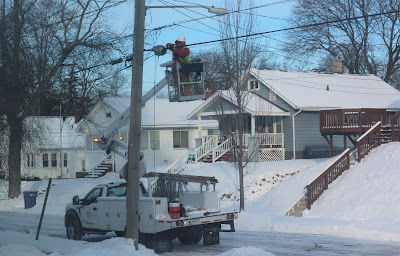
winter scene of bucket truck with man working on overhead cable-internet wires
Swapping copper wires for fiber-optic lines 4 Feb. 2022 ZIP 49505

Despite the cold temperature the workers steadily string the surprisingly narrow gauge spools of fiber-optic cable along the path of existing copper lines. Rolling the clock back 10 years to 2012, smartphones were increasingly appearing in pockets and handbags around the country and wider world. The earlier transition from 2G (2nd generation) to 3G had been completed and the first rumors of 4G were described here and there. Currently on sale in stores and websites are the widespread availability of 5G handsets, despite fragmented operation of the towers and transmitters/receivers inside and outside of the USA. The past week or two the risk of 5G wavelengths interfering with airport flight operations has been in the news since one federal agency sells the use of certain frequencies of the radio spectrum (FCC) and another is concerned with safe flight operations (FAA). Little or no coordination between these parts of the government seems to have taken place. The sale of the 5G frequencies took place at the end of President Trump's term of office and only now when the wireless system near major airports is ready to start to fill the airwaves is the FAA raising concern with conflict to cockpit equipment that reports altitude above ground surface.

The photo shows residential service improvements to the pace of Internet data flowing in and out of household wifi hotspots. The existing provision via copper lines has more friction or restrictions on the amount of information flowing to and fro. As a result the experience of using the Internet during the prime time entertainment hours (from 7 to 10 p.m.) after residents return from work sometimes is frustrating when streaming video or audio is less than free-flowing.

On the biggest junctions and sites of Internet use at corporate, university, and government centers there has been an exclusive "Internet2" that is dedicated to the biggest bandwidth requirements of virtual reality, 3-D engagement, and real-time performing surgery at a distance. But for residential customers paying monthly for service at differing tiers (datarate and caps on cumulative bits of data up or downloaded), the advent of fiber-optic broadband in place of copper-based cables may well give a taste of the extreme speeds of the Internet2.

Much like museum visitors staring at an early vacuum tube radio mutely on display, or seeing an early retail TV with its screen blank, people who visit a future museum and see a PC or section of copper cable or one made with fiber-optic stands will understand only the surface of the artifacts, not the programming that entertained, informed, challenged, or created worldviews of (social media) citizens immersed for large parts of their waking hours in the bright and dark corners of the Internet. As for teaching future museum-goers about the Dark Web, that is even a bigger stretch of the imagination.

At first look, this photos seems to show a straight-forward job of upgrading the on-ramp to the Information Superhighway, as Vice-President Al Gore phrased the Internet for a generation unequipped to imagine such a thing, But acknowledging that "the medium IS the message," as Marshall McLuhan described the effects of endless advertising and consumer appeals, the increase in Internet speed, capacity, and reliability is much, much more than swapping copper cable and connectors for the fiber-optic kind. By many orders of magnitude, this in-reach to householders and out-reach from residential and business locations makes the world much smaller and immediate. What once seemed far away now is just a few clicks or bookmarked websites away. Time zones still exist, but with prerecorded content, it is possible to engage with someone or something asynchronously, rather than "live" only. As a result, events of a fixed date and time, and taking place far from the online participants can form extended dialogues not limited to synchronous, "real time" experiences. And once archived or hosted online in recorded, transcript form, people also far into the future can revisit the conversation or presentation, too. And so, this photo of the warmly dressed workers putting all the pieces together for an even freer flow of data is bound to lead to unexpected good and bad things, unintended (and perhaps unknowable) consequences that maybe will only be seen in hindsight.

11 March 2019

Polluting the public discourse - "Don't Pee in the Pool"

After naively supposing that the myriad of fragmented arenas for discussion online in Facebook would go well for everybody, it has become clear that abuse is easy and harmful. For a few people it is a source of entertainment or heady facsimile of (fake) power, too. Witness the genocide of Rohinga Muslims near the Myanmar - Bangladesh border state; witness the student to student bullying in many countries via FB and the several other prominent forms of social media.

At present there is a built-in way for people who are offended themselves, or who foresee harm to others they care about, to flag a posted message or article so that the human reviewers at Facebook can scrutinize the instance. This screenshot shows the most frequent types of offense to flag.
pop-up menu item available for any given Facebook posting: reader warns FB team
Stepping back to an analytic viewpoint, this typology is a kind of mirror that reflects the historical moment that our societies occupy during times of change in the environment and our relationship to the ecosystem and to each other; indeed each person's relationship to the sense of self also may be subjected to changing foundational assumptions and scope of imagination for dreaming a future self.

NUDITY is an invasion of private/intimate/bodily space.
VIOLENCE is an excess that also concentrates on a body; ditto SUICIDE or SELF-INJURY.
HARASSMENT can be words or deeds, again a body-centric infringement of boundaries.
HATE SPEECH and TERRORISM may differ in degree, but have a family resemblance; pertaining to individual persons/bodies, but also with a mass or communal scale of consequence, too.
FALSE NEWS has some commonalities to HATE SPEECH, but normally is less personally specific.
SPAM and UNAUTHORIZED SALES have a falseness about them, too.

In the most abstract sense, all of these types of violation consist of breaking boundaries that separate and define one person or group or truth from another. Perhaps this stems directly from the catch-phrase for the ever greater connection of people, ideas, records, and locations through the Internet, "Information Wants to be Free." However, by providing answers to any search engine for the Internet, no matter how poorly formed the question or statement, the searcher is given a facsimile of expert knowledge, mastery, or confidence that they have solved a problem, simple or complex, with the touch of a few thumb-buttons on a portable screen or a keyboard or voice dictation. When all information is reduced to a uniform sameness, the distinction of reliability or accountability is ignored in the rush to arrive at an answer. The knowledge landscape is collapsed from 3 or 4 dimensions into just a flat 2-dimensional world, making all answers look and sound the same.

By this logic of sameness that makes information the same thing as knowledge, or its long-distilled form of wisdom, then the traditional boundaries between bodies of knowledge, experts, and institutions gradually erode. This typology of Facebook offenses therefore presents itself as each infraction flares up. Thankfully there are people who refuse to accept the normalization and bland sameness to make all things (falsely) equivalent to each other - truth as just another alternative to the other imagined or hallucinatory realities in a person's mind.

From another standpoint, in the eyes of a person never part of the Internet Age, these warning types perhaps seem odd, or as something belonging to shared propriety, community standards, and their customary Common Sense. Since everyone knows these boundaries, there is no reason for breaking them and no cause for offense. So Facebook has brought forth many things, both good and bad. This set of Feedback Flags is a rich country problem; it only belongs to societies riven with the social media juggernauts.