Showing posts with label 49505. Show all posts

18 May 2024

Unneighborly verbal altercation - leaf blower sends grass cuttings onto parked car


residential street with lawn service man talking to 2 police about shouting with nextdoor person
Past the yellow fire hydrant two city police leave defendant to speak with plaintiff at nearby house

A little before 10 a.m. on Friday the lawn mowing service had mown the client's grass, cut the edges, and was just about finished with the noisy, gas-powered leaf blower to dissipate the cuttings off the client's sidewalk and driveway. That is when the adjacent homeowner came striding with purpose to confront the man with the blower to express his offense at cuttings blown onto his car and driveway. The confrontation began at full volume: both the decibels and the choice of fighting words, rather than less accusatory word choice and tone of voice. So the worker being verbally attacked replied in kind, adding lewd gestures and posturing to amplify his replies. Back and forth the temperature of the verbal wrestling proceeded until the nextdoor man pulled out his cellphone to video record the worker and his vehicle before then warning him that the police would soon arrive, presumably to adjudicate the plaintiff point of view and perceived injury by lack of respect from the worker that he was aggravating verbally by assault.

This photo shows the two officers after hearing the worker's perspective. They already heard the plaintiff in his phone call to the dispatcher. It took perhaps 10 or 15 minutes from first threat from the plaintiff about bringing the police into the matter until the car arrived. First one uniform approached the worker slowly, in case the situation was explosive. Since the man was relatively calm, the second officer joined the first to listen to the account from the worker's point of view. What happened next is the two policemen went to the house of the plaintiff for further discussion. After a total of maybe 10 minutes they left the scene, the worker in his truck and trailer departing before that, having been told there was no more for the moment and therefore that he could leave for the next client's lawn.

Since the verbal bout could be heard at a distance, the experience as a spectator was worrisome. Since so many people have applied for "concealed carrying" of pistols, it is not impossible for one or both men to have been trigger happy. Nothing did happen with guns, although verbally there was gun banter. The whole episode illustrates something about city living, leaving aside its paperwork, communication snafus, and any additional procedural consequences. 

In villages there are layers of family-to-family history, interrelationship, and shared stake holding. So conflict resolution by individuals or representatives for each side can typically come to some arrangement involving apology and restorative justice so that the offender makes whole the injured party or parties. But in larger urban settings the social fabric is held together by rules and ordinances and is enforced by professional law-keepers. Since most person-to-person intersections involve strangers, these formal systems and infrastructure is how problems are solved.

In the history of societies and their civilizations and languages, new words and rituals and titles and rights/responsibilities are created. In urban environments since the density of ambitions, greed, and dependence is much higher than in villages or tribes, there is a concentration of boundaries, differing opinions, and levels of experience in handling difficult topics and injuries - verbal or physical or financial. In the case featured above, one middle-aged or elder man felt injured when his property (car) was affected by the grass cuttings landing on his side of the property line. Due to this offence, he felt entitled to shout abuse at the one blowing the cuttings. Since the verbal attack was unaccustomed and unexpected, the worker's hackles were raised and he replied in mirror image by heaping abuse on the offended homeowner and then amplifying the venom for good measure. The next step escalated to requesting the services of the armed police. How the matter ultimately ended is not obvious, except that the police did indeed arrive in a timely manner and speak respectfully in word and by nonverbal communication (posture, eye contact, tone of voice and so on). Then the worker was released from waiting and the police drove away.

17 May 2024

National flag variations on a theme - speculatively


late spring evening front yard with USA flag waving on front porch with blue-black field for the stars
What looks black in this flag*could* be political expression, or maybe is simply a very new flag 5/2024

Without talking to the owner of this house and looking closely at the fabric, it is hard to be sure if the dark field for the 50 stars that represent the 50 states (though not territories or Washington, DC) is regulation navy blue, or instead is specially created with inky black to make some sort of statement about light-pollution and a love of skygazing, for example. For the purpose of essaying the many meanings and uses (and abuses) of the national flag, though, let us speculate with the assumption that, yes, this flag is made in red, white, and black. What are some of the possible meanings the homeowner wishes to show publicly?

From the October 7, 2023 terror assault from Gaza and continuing more than seven months to today, there is the plight of the Palestinian civilians (about 35,000 killed by Israel Defense Force activity, mainly women and children). Since college campuses in many parts of the U.S. have student demonstrations against USA contributions of weapons and intelligence and money to the I.D.F. there are also private property owners who express solidarity for (or against) Palestinian abuses in Gaza. Then there are also USA flag variations ever since the Coivd-19 lockdowns early in 2020: the monochrome flag with just one band of blue through the other white stripes to signify support and importance of (armed) police to the overall social stability. Another version swaps the blue line for a red one to signify firefighters and paramedics responding to emergencies. Once in a while a porch flies a 13-star, colonial era flag (stars in a circle, Betsy Ross design) to signify "getting back to purest, original principles of the Declaration of Independence, article of confederation and the U.S. Constitution" (implying that 2024 conditions and amendments and legal wrangling, federal budget size, etc are wrong). Much rarer are the "don't tread on me" yellow flag with the serpent made of 13 segments to show the power of the united colonies against outside forces. Also rare: flying the USA modern flag upside down as a signal of distress - not of the householder, but that person's interpretation of international headlines and domestic events. 

Looking at the photo in this case, though, it is very likely to be a particularly dark fabric dye for navy blue; not a political statement or outburst of barbaric yawp that paints a dark picture against which the stars shine especially brightly. Playing with colors and symbols makes possible multiple interpretations; more than one meaning at the same time, depending on the standpoint of the viewer. This flag's condition could mean a range of figurative or symbolic meanings and also be nothing more than the buyer seeking out the deepest blue they could find for no other reason than to withstand fading of the sun in summer and winter, day after day. Still, there is some use in speculating untethered from the house owner's perspective. That is because the ocean of Internet, print, and broadcast information and entertainment intersects with education and personal reflection in any given moment's particular Public Discourse; a sea of meanings that exist simultaneously in the eyes of those expressing the matter and those reading or responding to the matter. By probing the many kinds of possible meaning, not just confined to the specific case of the particular person, the larger pool of images and words also can be joined.

08 May 2024

Strange cult of (false) power - gunshot sounds


plug-in earbuds of black silicon earpiece and brass colored, bullet case-shaped body lying on cast-iron manhole cover
bullet-looking private listening to block out the world
Even though most people seem to move about on rubber tires in 2 or 3,000 pound vehicles of glass and steel, a few can be seen on foot. That is the pace that allows one to gather up recycling litter and other debris like this pair of earbuds that seem to have a damaged wire. Many listeners have switched to bluetooth, wireless earbuds, prone to falling out of the ear. But others continue to use plug-in miniature speakers like these. However, most designs are sleek and futuristic; not shaped like things seen elsewhere around the society like the bullet shaped (and sized) design in the above photo.

Leaving aside the audio specifications and listening experience contained in this electronic gear, the fact that listeners would pay for this design; and that manufacturers (and retailers) would see a market to pitch to brings several thoughts to mind. One is about the attraction of gun references in popular culture: on lunch boxes, bumper stickers and T-shirts, car window decals, social media #meme art, and so on. How can it be that something causing so much harm by accident, self-harm, and used in the commission of property and personal crime also is so prominent, seemingly normal and even desirable. Perhaps there is allure in the old idea that by holding something just a trigger-pull away from murder, there comes projected threat and power in one's own control, despite the statistics that show the one pulling the trigger many times is the one wounded or worse. 

Since this pair of earbuds was discarded near a combined high school and middle school a few weeks before the school year ends, maybe the already uncertain nature of rapid social change in-person and online is compounded through the lens of individual change of puberty and high-stakes social status and personhood that comes in the hallways, classrooms, cafeterias and locker rooms of teenage school years. In other words (leaving aside the subset of pressures for gangs and territory and violence), when the society leaves a person feeling disempowered and the music or podcast listener also is in a life phase of low-agency (parents, teachers, bosses, police and judges dictating the rules), then the symbolism of wearing bullet-shaped earbuds says something like, "keep your hands and your rules and your scrutiny off me" or else I'll resort to bullets.

Second, the plastic body to which the black silicon earpieces are attached has been shaped and colored in facsimile to .45 caliber bullets, short and fat. In this case the dimple where the firing pin hits the primer to fire the projectile indicates the shot has been fired. Is that detail meant to amplify the authentic look; or is it part of product narrative - as if the old brass has been repurposed to hold electronics, making a kind of pun: now powerful sound comes from the brass where there once came a powerful kinetic blast.

Third, maybe there is a baked-in ambivalence expressed in visual, non-verbal communication. By showing others you are not afraid of bullets and that you routinely handle them, in a kind of (anti) halo effect, you insinuate yourself with an aura of danger and of skirting the law in willful exertion of individual, ego-centered celebration of self: unfettered by polite (civil) society, trust, courtesy, and rules of status quo that seem only to support and extend the life chances of people with knowledge, (inherited wealth) money, authority and power.

Probably there are still more standpoints to take when interpreting the attraction of accessories to wear for others to see, while also functioning as musical and spoken word devices. But the fields of meaning that are connected to imagined power to affect the attitudes and actions of others, in the context of social changes and uncertainties of status, and the weekly news events of gun violence at mass or at personal scale, does indeed shed light on why such designs are manufactured, retailed, and are then purchased by (young) people in 2024 in the city of Grand Rapids, Michigan.


16 May 2022

Book power and the things that it makes possible

Assorted books on view from this "little free library" at street corner 

The city planners who build and repair water and sewer lines depend on reading and writing for their own design, record-keeping, and follow-up monitoring of projects. Likewise, the people who operate the heavy equipment rely on the written language, as do the creators of the tools and vehicles being used in this photo. All of this attention to written English starts with an ability to identify a relevant source book, open it and find the right page, then to read and retain what is there. This photo nicely juxtaposes books on the left and the infrastructure project on the right that printed words make possible.

The extended history of little sidewalk free books protected from the weather is probably chronicled on Wikipedia or another place online, but anecdotally in Michigan it was around 2014 that the first ones began to sprout here and there. It is impossible to know the change in book behavior as a result of free books positioned for "impulse reading" (unplanned, emotionally sparked appetite to hold and to own a book of one's own). Perhaps the total pages or number of titles being read across all demographic segments increased. Perhaps interest in print books, new or used, also increased.

In any case, although the relationship is not direct between the pages in this little library and the habits of reading and the day to day writing on-the-job by workmen, still the connection is there: once literacy is established, then a person can make use of it for personal or professional purposes. Perhaps there is an inverse expression of these outdoor book spots, a project not based on literacy but instead centered on orality; that is, appreciating and refining the spoken word. A few cities have experimented with "living books" in which volunteers show up for the appointed place and time to make themselves available to be "borrowed" and "opened up" by the library patrons. The volunteer invites listeners to hear the person's life story or episodes to pass down to the next generation.

This photo is a reminder of the importance of reading and the printed word, even in a time of online videos and text messages, where attention spans are limited to a screenful or two of letters and numbers. Without a system of written notation to capture knowledge and then distill wisdom, the oral-only life of many people would be much narrower than it is today, thanks to books and the ability to read and write them.


04 February 2022

Fiber-optic Internet service coming soon

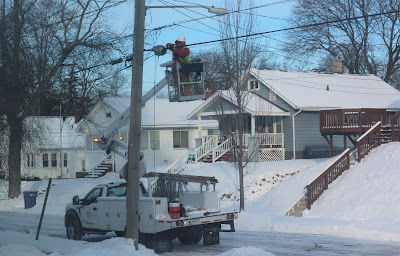
winter scene of bucket truck with man working on overhead cable-internet wires
Swapping copper wires for fiber-optic lines 4 Feb. 2022 ZIP 49505

Despite the cold temperature the workers steadily string the surprisingly narrow gauge spools of fiber-optic cable along the path of existing copper lines. Rolling the clock back 10 years to 2012, smartphones were increasingly appearing in pockets and handbags around the country and wider world. The earlier transition from 2G (2nd generation) to 3G had been completed and the first rumors of 4G were described here and there. Currently on sale in stores and websites are the widespread availability of 5G handsets, despite fragmented operation of the towers and transmitters/receivers inside and outside of the USA. The past week or two the risk of 5G wavelengths interfering with airport flight operations has been in the news since one federal agency sells the use of certain frequencies of the radio spectrum (FCC) and another is concerned with safe flight operations (FAA). Little or no coordination between these parts of the government seems to have taken place. The sale of the 5G frequencies took place at the end of President Trump's term of office and only now when the wireless system near major airports is ready to start to fill the airwaves is the FAA raising concern with conflict to cockpit equipment that reports altitude above ground surface.

The photo shows residential service improvements to the pace of Internet data flowing in and out of household wifi hotspots. The existing provision via copper lines has more friction or restrictions on the amount of information flowing to and fro. As a result the experience of using the Internet during the prime time entertainment hours (from 7 to 10 p.m.) after residents return from work sometimes is frustrating when streaming video or audio is less than free-flowing.

On the biggest junctions and sites of Internet use at corporate, university, and government centers there has been an exclusive "Internet2" that is dedicated to the biggest bandwidth requirements of virtual reality, 3-D engagement, and real-time performing surgery at a distance. But for residential customers paying monthly for service at differing tiers (datarate and caps on cumulative bits of data up or downloaded), the advent of fiber-optic broadband in place of copper-based cables may well give a taste of the extreme speeds of the Internet2.

Much like museum visitors staring at an early vacuum tube radio mutely on display, or seeing an early retail TV with its screen blank, people who visit a future museum and see a PC or section of copper cable or one made with fiber-optic stands will understand only the surface of the artifacts, not the programming that entertained, informed, challenged, or created worldviews of (social media) citizens immersed for large parts of their waking hours in the bright and dark corners of the Internet. As for teaching future museum-goers about the Dark Web, that is even a bigger stretch of the imagination.

At first look, this photos seems to show a straight-forward job of upgrading the on-ramp to the Information Superhighway, as Vice-President Al Gore phrased the Internet for a generation unequipped to imagine such a thing, But acknowledging that "the medium IS the message," as Marshall McLuhan described the effects of endless advertising and consumer appeals, the increase in Internet speed, capacity, and reliability is much, much more than swapping copper cable and connectors for the fiber-optic kind. By many orders of magnitude, this in-reach to householders and out-reach from residential and business locations makes the world much smaller and immediate. What once seemed far away now is just a few clicks or bookmarked websites away. Time zones still exist, but with prerecorded content, it is possible to engage with someone or something asynchronously, rather than "live" only. As a result, events of a fixed date and time, and taking place far from the online participants can form extended dialogues not limited to synchronous, "real time" experiences. And once archived or hosted online in recorded, transcript form, people also far into the future can revisit the conversation or presentation, too. And so, this photo of the warmly dressed workers putting all the pieces together for an even freer flow of data is bound to lead to unexpected good and bad things, unintended (and perhaps unknowable) consequences that maybe will only be seen in hindsight.

09 December 2021

National flag and personal life intersect at funeral

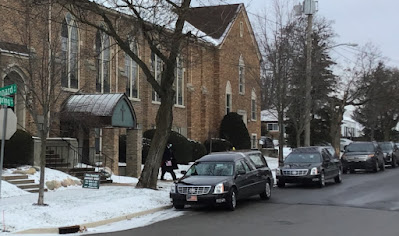
line of black funeral cars parked at church entrance
many meanings of the USA flag on the funeral hearse's front bumper

Late Wednesday morning, December 8, 2021, a funeral was getting underway. In the parking lot behind the church and the one across the street there were about 50 cars waiting to take people home or to the cemetery, if burial ceremonies were planned after the church service. In the context of 22 months of Covid-19 there is some chance that this life (or lives - since 2 hearses are positioned at curbside) was cut short directly by the virus, or indirectly that the hospital services were strained by the burden of unvaccinated people filling the hospital rooms and taking up the services there. But without stopping to talk to those present or searching for a published obituary, the cause of death is only guesswork.

The funeral hearse nearest to the camera displays the U.S. flag on the front bumper. Thinking of funeral customs for the other 200 national states, or for the many human societies that comprise the almost 7,000 languages that are spoken, surely this use of a national symbol on a personal and family-level matter is not common unless the deceased represents political leadership, national fame, or died in armed service (or veteran of military service). Without interviewing the owner of the hearse, its driver, or the company managers, along with the people attending the funeral, it is only speculation about possible significance (or more likely, multiple meanings) coming from the use of the national flag in connection with the dignified undertaking of funeral ceremonies and the safe conduct to and from the burial ground.

-Propriety (official, above-board, dignified, customary): This thread of meaning connects the person or business displaying the national flag to the country's wealth, fame, and all the life-affirming values that come with it. The darker chapters tend to fall into the shadows when the spotlight is fixed on the good things, though. In this photo, then, prominently exhibiting the flag (but not shouted loudly in oversize or multiplicity) assures like-minded people that the funeral company values and perhaps feels pride in belonging together with the present and the history associated with this banner. And for others who feel ambivalence about the mixed record of harm and healing carried out in the name of this flag, by displaying it out front, those who feel doubt will be put on notice that this vehicle and all those trailing behind it stand on the side of a positive accounting of the symbol and people connected to it.

-Authorized (halo-effect from close-association with the power of law and force): Seeing a flag in public as well as private spaces is a signifier that the proceedings are implicitly protected by the full faith and the rule of law of the land. In this photo, the presence of a national flag picture (or one made of cloth) seems to suggest that all procedures have been followed, duties fulfilled, and debts paid. No corruption should be suspected or expected or allowed.

-Conservative, button-down, standard-issue, government-conforming: Another meaning some will feel upon encountering a (USA; other countries have a different relationship of flag to citizens, no doubt) national flag is one of status quo; a sense that things will proceed as they have in the past.  No erratic, strange, or outlandish behavior is likely.

-Vocation (former government work for local, state, or federal employer): Before the funeral owner opened the business, perhaps he or she was a federal worker and/or a member of the military. In that case the flag signals the person's (or the company's) organic roots with Old Glory. The flag is part of their past work.

-Avocational (proud of team USA, symbols, popularly imagined history): Even when a person or organization has no direct connection to federal or national services and products, perhaps they feel strongly about expressing allegiance to this "one country, under God, indivisible, with liberty and justice for all" (quoting the school child's Pledge of Allegiance recited many times). In that case, showing the national colors discretely in the panel reserved for a license plate in some states is an affirmation or aspirational statement.

-Personal history (recent immigrant or else a genealogy enthusiast with long roots in USA): The flag display on lapel, desk, office wall, or raised on a pole could also signify something particular for that person. For example, a "new" American may have come via career path and advanced studies, as an asylum seeker or refugee of disaster, or as family member of someone previously establishing American citizenship by birth or marriage, for instance. In that case, a sense of ownership and belonging and gratitude, among many other possible mixed feelings could be carried by the visual presence of the banner. In a related but different way, someone who has looked deeply into family histories may feel a multi-generational sort of loyalty or allegiance to the many people, places, and things symbolized by the flag.

-Personal identity (define and view oneself by the category of flag and anthem more than by local ties): Some people see themselves, and are regarded by others, as a patriot and outspoken supporter of the things that the flag stands for in that person's mind. Others downplay their national citizenship and the source of their passport and build their identity instead on a foundation of the wider planet, or conversely, on a foundation of the immediate surroundings of their town or county. However, for the person who wants to be known, and feels most satisfied in seeing herself or himself, in national terms, then displaying the flag is a particularly personal statement; a sort of credo for who they are.

This list of possible meanings conveyed by a public display of the United States flag is not exhaustive; there are probably other sorts of significance being purposefully or subconsciously expressed when making a decision to put a flag on view. Realistically, the uppermost meaning in the eye of the beholder, the eye of the one displaying, or in the mind of others just passing by will be a combination of factors rather than a single dominant meaning. And for complicated, context-dependent meanings, it may well be that much lies underwater, like the bulk of an iceberg: part can be seen and discussed, but the greater part is unseen and is hard to put into words. So, directly asking a person what comes to mind when they see the flag might only turn up a few meanings or hints of meanings rather than a fully formed verbal response.

In any case, though, for the funeral company staff their minds are focused on providing professional and personal care for the people in mourning. The attention of the family and friends participating in the ceremonies is occupied with the events as they unfold minute by minute, the feelings that come up in themselves and in those nearby. It is probably only in the mind and lens of a passer-by that such considerations about the meanings of the national flag are studied in reflection. And yet, even for the funeral workers and the mourners, at least a little of the flag's presence and the meanings it triggers will be present, whether or not they stop to imagine the many kinds of meanings that arise when personal life and national symbols meet each other.

08 December 2021

Cultural landscape at bus stop - Forensic Brainstorming

edge of busy city street dusted with fresh snow at bus stop
mid-morning heap of possessions at bus stop (8 Dec. 2021)

At first "brainstorming" and "forensic interpretation" appear to be opposite in purpose. One is meant to open up possibilities, unrestrained by ordinary habits of perception. The other is meant to eliminate all except the (single-most) probable explanation. But upon seeing this collection of clothing, backpack, and other personal items, the pool of possible meanings began to come into mind (brainstorming). But more than idle interpretation, instead I proceed with a view to turning up something close to the true significance of this sight (forensic scrutiny). However, in the end, this is an exercise in social commentary, so no DNA samples are going to the lab; no missing persons reports will be consulted; and no enhanced magnification of the contents will be inventoried. Instead, an initial pool of meanings will be offered in order to turn up some or all of the actual interpretation for this strange sight.

Brainstorming some lines of interpretation, in no particular order. (1) Donation deposited halfheartedly (casual, careless, anonymous versus carefully calculated to fit a particular person frequently at this location). (2) Discarding unwanted items in halfhearted attempt to donate to another person. (3) Dropped in haste by a person carrying too many pieces of luggage to board the bus. (4) Discovered by a passer-by who noticed a bus rider losing the things en route to this location. The good Samaritan picked up the things and brought them to that bus stop supposing that the rider may well return at some point. (5) Demonstration of interpersonal malice or ill will: dumping the possessions of the person diminished in the eyes of the person depositing the things in a pile here. (6) Dithering by the person who received these donated things. At first they carry the things to the bus stop, then studying them more carefully, the person discards unwanted parts there and then, keeping only the items desired. (7) Distress by the person fleeing a person or vehicle: drop these things and run. (8) Dumped items stolen from nearby laundromat's washer or dryer.

Each of these initial interpretations of the heap of clothing is a self-contained story, but very often the true sequence of events is not simple or single cause, single effect. Instead there could be a set of events or sequence of circumstances that intersect at the moment of decision that produces the sight in view here. In other words, while there may be some truth in one or more of the string of imagined self-contained situations leading to the heap of clothing, above, it may well be that there is some combination of the interpretations here, along with other factors not yet imagined in the list. The habit of overthinking and projecting meanings where none were originally present is well known. Less well known, though, is "underthinking" a problem or a general lack of imagination to solve the case. And yet, it is somewhere between thinking too much and too little that the most progress can be made with "forensic brainstorming."

In summary, are these possessions "single-use" (disposable), a person's entire stock of worldly goods, or maybe somewhere in-between? Beyond the relationship of the items to the person or persons, though, what is the social condition of the person(s): unhoused and bereft of supporting social fabric, homeless but migrating from one hosting friend or family member to the next, a traveler who is in the city only long enough to get to the other side, someone is distress from alcohol/drug use disorder, or a person who is unable to secure and maintain a fixed residence where personal belongings like these can be kept? Without investigating further or actually meeting the person last touching the things when they were abandoned, it is impossible to compose a complete picture of the meaning of these belongings at the bus stop.

07 May 2021

A life put into words - histories and memoirs on the library shelf


library titles for history (Dewey 940s) rotated to make titles easy to read
At the branch library there is a bookcase filled with a variety of histories and memoirs to browse. Considering that each title is a self-contained work of one or more authors, almost always drawing on published work of others and interviews and other primary source material, as well, the true scope of page counts implicated in this modest collection is staggering, representing a volume of writings maybe 20 or 50 times as big as the space of this one bookcase.

The relationship of a book to its subject matter is similar to the classic illustration of an iceberg: the part that is visible (the individual book) is only a small fraction of the whole thing (cumulative mass of all the books and research sources used to create the one book that is visible on the shelf). Besides this compressed form of knowledge that the photo displays, there are other ways that the set of printed pages bound into book form are remarkable.

Asking a fish to describe the sea that it swims in leaves many important dimensions untold, since so much is taken for granted. The same is true in certain ways for a historian writing about the present day and the historical antecedents to it. Unlike the fish, though, a trained reader and writer of history can consult outside perspectives, cite documents, and study records for clues to bias and omissions. The books in this photo each represent many hours of drafting, then editing the books (not forgetting the shoulders that an author stands on and those many hours to author the earlier books on which the present-day books depend). Each title gives a representation of earlier people, places, and events. Necessarily, the process of telling about events requires "selective memory," leaving aside some parts in order to focus on other parts. That filtering effect probably owes something to the writer's personality and experiences, training and area of expertise, and current events and preoccupations around the time of composing the first draft. Having access to certain sources, but not to others, will play a part in the resulting book, too.

So much for the remarkable things going into this line-up of printed pages and the topics present (and by contrast the many other subjects that are absent). Another dimension of this library bookcase photo is the readership. It would be interesting to know what the lending patterns pre-pandemic and during the pandemic have been, either matched to demographic segments (male vs. female, retiree v. teen v. working age) or simply in the aggregate to discover which books are most and least circulated during their service life (until relegated to storage or sold). After all, the books in this photo appeal to certain sorts of people but not to others. Some readers are voracious in their appetite for the printed word (leaving aside the universe of ebooks offered to borrowers, too, as well as downloaded audio books or the audio CDs on a separate shelf), but others just read one book at a time and only a few per year. However, the usage patterns and sociological profiles may turn out, though, it is remarkable that busy residents of the city, surrounded by the "too much information" of 100s of cable TV shows, and the bottomless reserves ancient and modern discoverable online, still hunger for the people and places and events found on the books classified under the Dewey Decimal System under the history label.

Thanks to the Internet, such things as     archives of images, moving pictures, primary sources, and public domain books and music are only a few clicks away. It is getting easier than ever to travel in time or place by using these traces of earlier times and places. And yet, some readers eagerly browse the authors on this shelf to discover those worlds glimpsed through the mists of time in the words of delightful authors in well-organized chapters and paragraphs. It is hard to know exactly, according to the person or more generally for most readers of histories, what reasons attract people to the ink on these pages. Perhaps it is a desire to fill in hazy outlines of a particular time or place in the reader's mind; maybe there are personal or genealogical connections to the subject matter; or possibly the reader is hungry for escape from modern times and finds a sense of order and certainty that hindsight projects onto things. In any case, the books on these shelves - indeed on the shelves for all the other categories of publications recognized by the library system of classification - speak to certain readers and not to others, they reveal truths, and teach those searching for answers a few of the pieces to the puzzle that forms in the person's mind, one book at a time. Generations from now some of the same motivations will be there to write and to read history, although in that time maybe the idea of printing with ink on paper will be antiquated.

15 March 2021

Buy Nothing online group redistributes goods locally


Front porch items deposited with names of recipients attached
Somehow related to the success of the "Nextdoor" email franchise that invites local residents to pool questions, answers, observations, complaints, friendly reminders, and sometimes rants, someone in this neighborhood of Grand Rapids, Michigan created "Buy Nothing" as a way for local residents to announce things being given away at no cost. Whereas Nextdoor is national or international and includes a commercial sponsorship (paid advertising) layer, Buy Nothing seems to have no reference to gainful private enterprise. Perhaps "social capital" does accrue to the most frequent commenters and givers-away of unwanted gear and clothing, extra batches of edibles, and so on. In any case, the rapid pace of posting items requested or offered and subsequent pick-up by the person who is selected by the owner is a good way to redistribute material goods directly, mediated only by the electrons flitting onto Internet-connected devices. When several responses come in for a particular item, the owner must decide whom to choose; sometimes by first-come, first-served logic, or else by lottery (random choice). But other times it is based on the case made for why the person is the most eligible.

H.A.B.U. (Highest and Best Use) of the disused freebies is achieved by this simple and valuable activity between local residents who otherwise do not know one another, despite living on the same street or in the same district neighborhood association within the larger city boundaries. Rather than putting something with value still remaining into the solid-waste stream bound for "long term storage" in a sanitary landfill, this method of redistribution finds a new owner to make use of the thing. As a by-product of the flurry of activity with residents picking up things from strangers' porches and others bagging up things with a name tag to leave on their own porch, a little of the social fabric is strengthened. For those on a tight budget this kind of "yard sale prices on demand" (put out a call for an item that is seldom or never used anymore and see if there is one to borrow or to get at no cost) is a boon. Equally for those eager to clear their cupboards, basement or attic or garage clutter, or wanting to empty a rented storage unit, this service is handy.

Whereas some societies are accustomed to scavenging perfectly good items discarded in junkyards or roadsides, in other (materially wealthy) societies there is some degree of social pressure to buy new things and to avoid used ones. In USA around the time of the Great Depression (1929 onward) and to a lesser extent during the Great Recession (2008 onward), necessity led more and more people to "make a virtue of necessity" and swallow any pride about always buying new. Instead they began to visit thrift shops, yard sales, estate sales, and word-of-mouth asking around to borrow or take possession of unused, unwanted things from others. Now due to the forced under- and unemployment of so many in USA due to the corona Trump virus the unconsumerism and rising concern about landfill waste is leading more city residents to give and take via the online hyper-local system of Buy Nothing. For the ancient brainstem legacy of hunter-gatherer ancestors, there is a certain thrill in finding ways to dispose of unwanted things; of obtaining things, and indeed lending a helping hand to others in the area who one does not personally know.

So the next time you see someone approach a porch and come away with a parcel, it may not be a Fedex or Amazon porch pirate. Instead, it could be the person named on the package being given away via the Buy Nothing service.

04 November 2020

Notes from polling precinct 3 November 2020 USA General Election


scenes early morning and later afternoon in Grand Rapids, Michigan 49505
Pandemic and relatively recent voting law changes in this state to allow "no reason absentee voting" resulted in something like 3 million ballots around Michigan's 83 counties being voted by mail, drop off at the respective county clerk office or its designated dropbox(es), or in some cases "early voting" at the counter of the clerk's office. So even after the in-person, conventional voting period from 7 a.m. to 8 p.m. ended and each of the 76 precincts in the city of Grand Rapids transmitted their results electronically (and by paper and duplicating SD card delivery to the tabulating headquarters), still the results could not be concluded while the many mail-in and absentee votes were being tabulated by an army of workers. While states like Florida allowed early votes to be processed in the days ahead of the precinct in-person voting, the Republican-controlled legislation in Michigan refused to allow any processing ahead of time with the exception of jurisdictions of 25,000 or more residents. In that case the outer envelope could be opened 24 hours before the voting day.

These photos show a few of the scenes at a 1928 neighborhood elementary school vacated by the pandemic so that children are relegated to online connection to teachers and peers. The day begins with crews delivering the voting equipment the day before and then the poll worker chairperson opening the door to fellow workers at 5:45 a.m. to begin setting up the gymnasium polling place starting at 6 a.m. and then declaring "The polling place is now open" at 7:00 a.m. In this case about 5 voters keen to be at the head of the line had arrived a hour before that official start time. But very soon the line ran from the first station (writing name, address, date of birth) for application to vote, all along the hallway and out the door, over the sidewalk leading the roadside and all along that streetside sidewalk for a total length of perhaps 80-90 yards.

There are 2594 voters in this precinct (maximum of 2999 per precinct by law): on this day at this precinct 763 voted in person, of which 1 man did not accept the mask offered him; another had a health condition precluding mask-wearing. All others waited in mask, mostly silently. Some people engaged with their smartphone in texting, reading, gaming, or with earbuds connected for music, recorded book, news, or podcast. The first 2 hours were long, long, long lines socially spaced, requiring about 90 minutes from lining up to leaving the polling place. By noon there was just a 10-minute wait thanks to a helpful "challenger" (party-appointed and registered observer) who called in 6 cardboard booths to supplement the 7 that had been assigned. From noon to 8 p.m. things faded away until just 200 or so arrived in dribs and drabs in those final 6-7 hours. Impressionistically, it seemed like many women under the age of 35 showed up in person and a certain proportion of retired people, too. One of the young women sported a Trump-branded face mask, which is disallowed on the polling premises. So she was politely asked to reverse it, which she did. The seven assigned poll workers never flagged during the 14 hours. When all was tidied up and signatures showing full-day work, certifying all steps fulfilled, and so on, then the chairperson and 1 of the others made the drive downtown to the headquarters to deliver the data and supplies. So their day was even longer than for the others.

In the 2016 vote when there was no pandemic and before Michigan's "no reason absentee" voting, the election DJ Trump brought 800+ voters to this same precinct in person. For the 2020 General Election maybe half the votes (still being counted at DeVos Hall downtown) were early or dropbox or mailed in. So the total number of ballots seems to be more than in 2016. For poll workers 14 hours makes for a long day. When greeted or directed to the entry door, several voters remarked "this is my first time to vote." In some ways the shiny hallway, silent lines, solemn context stirred by in the frenzy of mass media and online-targeted user campaign advertising contributed to the whole experience being quasi-religious or civic ritualistic.

01 November 2020

Intersections of religion and government of society

A week or two before the November 3, 2020 General Election in USA


Most yard signs in the month or two before a national election are concerned with supporting one party or the other, with a few in support of neither Republican or Democratic parties and instead promoting the names and websites of third-party candidates such as Libertarians, Green Party, and so on. And for the Trump versus Biden campaign season, a few pun-worthy signs use text or visual jokes to make the point in support of one side or the other: Biden spelled "Bye Don" (as in Donald J. Trump), or the one showing a swoosh of dyed orangey-blonde hair to stand for Trump in which the word NOPE is spelled out in large letters and the "O" stands for the head of the President and the colored swoosh adorns the top to stand for trademark hair. A variation on this negation of Trump substitutes NOPE with NAH.

This photo, though, takes a completely different approach. It does not identify either the candidate for the Democratic Party or the Republican one. Instead it uses the symbol-colors of both main parties (red =Republican; blue =Democratic), which coincidentally signal the USA national flag (rectangular and with red, white, and blue as bars and a sprinkling of stars, as well). The this sign puts forward the candidate that rises above either Biden or Trump. It is Jesus of Nazareth, crucified about 1990 years ago and said to have risen from the dead, according to believers. 

Without asking the owner of the yard sign about the reasons to obtain and plant it here, it is hard to know exactly what it asserts, but it does seem to be a way that is partly humorous (suggesting that Jesus could be a write-in presidential candidate) and partly serious about seeking to overcome divisiveness from demonizing and dehumanizing people who do not support your own candidate. News commentators have talked about casting a vote for the person who seeks to unite the many communities: choose the country, not the (cult of) personality. "Choose country loyalty over party loyalty," as the commentators have phrased the matter of voting this week.

addendum: One writer looks into the origins of the message in Alabama and concludes this is a veiled message of Trump brutalism, https://gen.medium.com/the-story-behind-those-jesus-2020-signs-76e620bf2a52

29 July 2020

Seasonal foods for sale - neighborhood grocery store

In most parts of the USA it is the large national chains of food-plus-general merchandise "super" markets that attract most buyers as a one-stop solution to products for sale. Particularly in urban centers there are "food deserts" where there is no place to buy edibles not processed or ready-to-eat. Things designed for human consumption can be bought at convenience stores and gas stations. Fast food restaurants proliferate since profits can be had in urban centers with commuters and other temporary consumers on the ground during the day. But for residents, it is common to find no full service grocery store.

By contrast, this photo shows a store operating for generations in the city of Grand Rapids where shoppers can buy a wide range of fresh foods, knowing that the store's buying team constantly seeks local businesses to source the foods. The price is higher than the mass scale, low-margin business model for the national and regional huge floor plans of supermarkets. But enough people nearby this store are willing to pay for the flavor from freshly harvested produce and locally raised meat animals that this business is sustained.
locally sourced fruit, vegetables, and meat is part of the business model here
The weekly sign changes first thing every Sunday to advertise what is promoted with special pricing for the coming seven days. At the end of July the list includes Michigan cherries, blueberries, tomatoes, leaf lettuce varieties, in addition to chicken (breast). A smaller sign in the corner of the parking lot in the distance can be seen between the uprights of the big sign. It lists sweet corn for sale at 2 ears for $1.

The brick building in the background is one of the fire stations in the city of Grand Rapids. Sometimes the navy blue uniformed fire-fighters can be seen in the checkout line after they walk across the parking lot to buy a sandwich or other things to eat or drink. During the 2020 pandemic most customers readily began wearing masks early on, when trips indoors were recommended to include face-masks. Now there is a statewide order for all retail customers and workers to wear face coverings of some kind, so compliance is 100% by casual survey, looking around the premises.

18 June 2020

We Are One - so says the sign, but one what?

About 7 weeks on display: since pandemic week 4 in Michigan [17 June 2020]
Both sides of the sandwich board give the same bold assertion. Such a short, direct statement is powerful and unambiguous. And yet there may well be several interpretations carried by the message at the same time, depending on the state of mind when a person notices the streetside note. The location is about 2 miles north of Grand Rapids city center in west Michigan on a major traffic route for local travel. So even when most people obeyed the Governor's directive to "stay home, stay safe" there were still cars traveling up and down this route. And people on foot or bike who complied with the guidance on social distancing also pass this way from time to time.

The ALL CAPS is a typographic emphasis similar to shouting or speaking in a loud enough voice for people far away to be able to hear the message. The choice of this shade of blue may signify something, too: neither is this color a somber dark navy or official looking tone, nor is it cheerfully light-hearted sky blue. Instead the color is somewhat light (not taking itself too seriously or self-righteously) while still displaying a slightly muted aspect (in respect for those harmed by the Covid-19 disease directly, or by harm to their livelihoods and social/psychological vitality).

As for the text itself, "one" implies shared destiny and shared present conditions and shared past experiences. It does not insist that everyone is alike or should be uniform in their lives; only that unity in relation to the threat posed by the pandemic is a unifier. "We" is inclusive, like "one," as well. Unlike "me and you and they over there," the subject "we" encompasses one and all together, no matter the deep or the surface differences. "Are" is a state of being; the present moment; the state of existing in time and place. Taken all together the intent seems to be encouraging one another with a message of the present and a promise of the future. By extension the message suggests, therefore, that each person should express responsiveness and bear responsibility for one's fellows in need of small or big help now (and extending indefinitely into the future). "Be your brother's keeper," is the message, to reference a Bible passage.

People with friendly, optimistic, or trusting disposition may accept the message at face value: yes, OK, we all will manage to sustain our economy and social and spiritual life during and after the pandemic. On the other hand, people who have not been sustained or rewarded or respected by The System of social services, attitudes, abuses, and injustices may take a different interpretation of "WE are ONE" (but excluding selected categories of people who do not fit our preferences, ideals, or mental image of belonging together). In other words, whereas many readers see the message as hopeful and encouraging; a proclamation or permission to go out of one's habits and way of doing things in order to care for others, in the eyes of other readers the message repeats a set of exclusions so that only certain people who meet particular conditions can be included in the declaration. Such is the flexibility of meaning, rationalization, and us/them distinctions reproduced one relationship at a time. Even if the sign-painter authored a statement intended to be inclusive, some readers may take exception and define "we" in their own image alone. Other readers, accustomed to being excluded or cut-off from some relationships, social capital, and other opportunities in the community may well see the message as yet another assertion of moral superiority or otherwise exclusionary movement. In the end, each instance of noticing another person's distress and responding (or ignoring) will make the full meaning of the signboard apparent.


01 June 2020

Drive-by birthday recognition to thwart Covid-19 transmission

friends and relatives make this little girl's 4th birthday memorable at a distance
Wearing a tutu and tiara, and accompanied by a pink chariot bearing "princess" on it, this little girl and her family waved and shouted as each of the cars in queue rolled up to the house, rolled down their windows (some wearing face/nose masks), and voiced their appreciation of this special day to focus on the star attraction, the Birthday Girl.

This was at 1 p.m. on a Saturday when the chirping birds and distant hum of lawnmower sound was shattered by a few mega-decibel police patrol cars with flashing lights leading the procession. The participating parade cars staged themselves a block away in the parking lot of an empty elementary school, closed since middle March by order of the Governor, along with the rest of the state of Michigan. Then one by one each car approached, one with a disco-beat version of the Happy Birthday theme or melody, and some held out cards or packages for the parents to collect (maybe to sanitize or quarantine for 72 hours to keep the coronavirus from transmitting). One or two cars parked after making their pass so that the riders could get a little closer to the family, while maintaining the 6 foot cordon from each other.

This photo shows one car with a helium balloon in the shape of a Happy Face sticking out from the rear passenger window. Other cars displayed hand-made posters and other signage to wave out the window or attach to the glass. A display table holds some of the gifts and what looks to be an older sibling enjoys the day, as well, knowing that each member of the family gets special attention in their turn.

Some commentators and interviewees on the radio programs have pointed out the possible bad effect from keeping school children cooped up, at a distance from peers. A touchless, socially distant "normal" non-verbal communication, and the heightened germ awareness of all surfaces will play out in the developmental cycle of young lives in many unexpected ways, no doubt. And the huge disparity between rich, middle, and poor countries; as well as within a single society, will also present a range of Covid-19 habits and expectations, too.

All this mayhem from a micro-organism! But then yeast is a small creature that affects life vastly, too. And then there was the vast swatch of death and economic collapse from the waves of Black Death pestilence, blood-borne or the aerosol, pneumonial type from 1348 onward.

15 May 2020

Funerial social distance, May 13 west Michigan

Late afternoon Wednesday more than a dozen people gathered at the burial ground next to the hole in the ground that had been prepared for interment. Most were wearing masks to keep from transmitting the water droplets of their breath or talking or praying or singing or crying. A line of personal automobiles lined the access lane to the left of this picture taken at the streetside western boundary to the cemetery. The graveyard appears to be city owned, since the municipal symbol appears at the entrance road and the bright yellow vehicles in this photo belong to the city: backhoe to excavate the sandy ground, and the hydraulic liftbed truck to hold the sand to be returned to the grave after the body of the deceased is laid to rest.
click image for larger display: black hearse bearing the casket at left (5/2020)

At the end of the ceremony the bereaved family and friends stepped to the side to allow the liftbed truck to line up and the workers to guide the stream of backfill into the grave, burying the casket for all time. Then the mourners arranged some hanging baskets (on the ground for now and later to be retrieved as memory of the occasion to be cared for and displayed at home), as well as wreath stand. Each of the attendees left a single cut spring flower to dress the grave.

With the precautions to minimize transmission of the coronavirus during this pandemic, in addition to most people wearing masks, for the most part everybody kept their distance from each other (social distancing) - about six feet. At least one group photo was taken, though, in which some of the people pushed together to fit into the composition frame. According to radio reporting, funeral parlors have allowed visitors to pay their last respects at set intervals to keep physical distance and time gaps between each person. And in churches, too, funeral attendees have been limited to remote viewing (online streaming or recorded view) and/or physical spacing in the worship hall by blocking some of the pews to create buffers between those seated.

The full-size photo is online at https://www.flickr.com/photos/anthroview/49897923666 and the grave photo is at https://www.flickr.com/photos/anthroview/49898233317

13 April 2020

Covid-19 pandemic, new waste streams

latex glove near city street in Grand Rapids, April 13, 2020
Five months after the Wuhan outbreak of coronavirus SARS-CoV-2 and four weeks after the State of Michigan lockdown of all private enterprise, except food and medicine and car fueling, there are a few signs of the pandemic here in west Michigan's biggest city. Confirmed cases of Covid-19 now in Michigan top 24,000, but many more are contagious and showing few or no symptoms. That same number happens to be the nation-wide death count so far. Half of the known cases in Michigan are Detroit and surrounding counties. So far 1400 people in the state have died from c-19 complications.

Here are some signs of the pandemic. Schools are closed, along with all non-essential business operations. People sometimes park at stores by leaving an interval from the next nearest car. Maybe 1/3 or 1/2 of customers don masks of some kind (commercially produced or homemade or jerry-rigged scarfs, etc) to trap their own breath (inhaling others' water droplets is reduced, too; but one's own expelled droplets are trapped most of all). Recommendations for social distancing at 6 feet apart are expanded for runners and bikers, who create a slipstream of water droplets when they exhale. The above photo shows the wide-spread use of vinyl or latex disposable gloves to use when selecting purchases at retail store, or when grabbing the handle to fill one's gas tank. With so many people unemployed or working from home, few cars fill the streets and highways; wildlife has been observed venturing out more widely than before, too. Those who walk their dogs or exercise do seem to follow the social distancing guidance, having to leave the sidewalk to create distance from oncoming people. Families, friends, book clubs, churches and their small groups, as well as businesses have been using some of the video meeting services to communicate by way of home Internet connections or using cellphone data services. Zoom Meetings have been particularly used a lot for their "one click" ease of use: 40 minute session free, or one person can pay the monthly $15 to obtain "host" credentials (up to 100 simultaneous users and 24 hours of uninterrupted connection per session). Food stores and perhaps other retail operations have installed plexiglass barriers to separate the breath of cashier from customer. Curbside pick-up of recycling and yard trimmings (official yard-waste bags) has been suspended, too.

Imagining the steps leading to more and more restrictions eventually going the other way, loosening up as Covid cases decline, it is hard to know precisely how all these precautions will carefully be dismantled. One radio commentator summarizes the "3 T's" as (1) testing, (2) tracing any flare-ups, (3) treatment that is effective and proven. Only when that infrastructure is in place can the free movement of people and their exhaled water droplets resume; not just in the orbit of the local economy, but also to go longer distances and between countries, too. The whole thing in the aggregate will be uneven, since hotspots differ from the areas most lightly affected. That is true within a particular nation-state, but also globally, with some societies better organized and supplied and informed than others. So long as the virus has a reservoir to reproduce, the risk of pandemic will always be on the horizon. The disruption to the status quo of transporting capital, ideas, people, raw resources and value-added products could lead to new ways of regionalizing or evaluating the things capable of conveying viruses. Recession or sustained recession that results in shrinking the economic pie (depression) may be another multi-faceted legacy of these months now.

16 March 2019

Largest neighborhood association in the city of Grand Rapids - Pancakes

The annual community pancake breakfast was organized by the Creston Neighborhood Association, CNA, covering almost 2 miles east-west by 2 miles north-south, a couple of miles north of the city's downtown center. Volunteers collected $7 per adult unless that household pays the annual $25 membership fee, in which case there was no cost for the breakfast of scrambled eggs, sausage, bacon, blueberry and plain pancakes, french toast, and beverages (water, apple or orange juice, coffee).
This video clip was soon after the 9:30 a.m. brief presentations were made to introduce the exhibitors at the edges of the large dining hall in the lower level of the Second Congregational Church, the venue hosting the event. Things started at 8:30 and went on for about 3 hours. Table covers were paper and boxes of crayons encouraged children and everyone else to doodle directly on the table tops.
In the age of Internet, fragmented lives and overscheduled children in multiple activities, it is heartening to see people get out of their speeding cars and away from their ubiquitous portable electronic devices to meet one another face to face, exchange small talk, and find out about opportunities to get involved in a few of the common interests in keeping the area safe and satisfying. This is a pretty good glimpse of Civil Society in 2019 in West Michigan, although the neighborhood email bulletin board is a living tissue that contributes an important layer to community sense of place and problem solving. It has many viewers and posters who ask or answer questions for newcomers and old-timers.
Exhibitors included the county solid waste and recycling program, the medical services for uninsured and underinsured residents, fire-fighters and a uniformed policeman, the low-income housing agency, the neighborhood association itself, among others. As the biggest of the city's neighborhood associations perhaps it also is among the most vigorous in supporting and encouraging innovations and business successes. There were breakfasters of all ages around the tables, so it looked to be a success for volunteers and visitors.


13 December 2018

Michigan historical commission marks this farmhouse

Farmhouse at former city outskirts of Grand Rapids-(click image for full-size view)
Farms operated for 100 years by the same family (3 or 4 generations, in most cases) are marked with plaques, usually not much bigger than a sheet of letter-size paper on a post within sight of the road edge. But this one gives a more detailed recounting of the significance of the location and its residents. In other parts of the world with far longer records of occupation, probably 150 years would not be of special interest or meaning, by comparison.

Immigrant countries like USA, South Africa, Canada, New Zealand, Australia, Brazil, and so on view the connections to the land and history differently to the societies where relationships to the past, to ancestors, and the land worked by those people is long-standing or perhaps taken for granted; not worthy of plaques or other official recognition by the local government. A major theme among immigrants is economic advantage; bettering your economic (and possibly social) status in the new country in exchange for giving up claims, meanings, and connections to the old country. As a result of this strong urge to succeed in material terms, many immigrants move from place to place to seize better work opportunities, rather than to commit to the community and social relations of just one locale. So the number of farms with many generations holding ownership is rare enough to acknowledge the fact with "Centennial Farm" plaques (100 years of ownership and active agricultural production) or this one telling the story of an early resident on this rural land that now has been surrounded by the expanding city boundaries and house-building of WWII and afterward to accommodate the Baby Boom generation.

Update: current owner removed this marker in 2020

Comparing pop vs. commercial culture: holiday lawn decorations during December

commercial versus popular culture (click image for full size view)
Maybe in in 20 or 25 houses put Christmas scenes, accent lights, or ornaments in front of the building for public display that goes beyond hanging a wreath on the front door. Most of the scenes or figures have to be plugged in for operating the lights (occasionally soundtrack, too) and, for inflatables like these, for running the fan or blower to hold the internal pressure steady. There figures from popular (TV the first two, film for the right-hand figure) are from left to right: Frosty the Snowman (c.1969), The Grinch who Stole Christmas (c. 1966), and Chewbacca of Star Wars (c. 1977). At the front door a green bulb has replaced the normal white illumination, since green and its opposite no the color wheel, red, are prominent colors for the dark nights of Christmas season (evergreens betoken life, even in the dead of winter; red for the berries of some wintertime plants). The red painted planks standing next to the door give one of the seasonal greetings.

A few things come to mind when thinking about the overlapping meanings of commercial culture (significance is mostly instrumental, occupying public space and imaginations thanks to mass creation and distribution) and popular culture (things connected to stories in the society or linked to themes of the language/culture). Popular culture has exited long before industrialization and mass production or consumption. Things like folk songs, folk stories, folk costumes and characters of the stories circulate widely among people and form a shared currency or pool of imagery and words. On the other hand, commercial culture only took the place of, or overshadowed and dominated, things made by hand --one's own or another person specializing in making the thing-- with the rise of factories and mass production and selling.

Another difference is that commercial culture extends beyond what the average person recognizes by brand name or product appearances. This culture includes the people, places, and lore concerning the making of the particular product. By contrast the pop culture, too, extends to places that have no connection or correspondence to commercial operations and experiences. As an example, there are customs that are widely know and practiced (like Christmas stockings hung near a fireplace for the convenience of Santa Claus (or St. Nicolas). To the degree that uniformly sold stockings are widely used, there is a commercial culture layer. And to the degree that home-made, making do, or craft-fair, individually distinct stockings are used in a family's Christmas customs, then it is popular culture that is being referenced and expressed.

Symbolism? Old glory in tatters 2018 December 13

Shredded USA flag hanging together by a thread (click image for full-size view)
As a visual representation of the abuses to USA democracy during the campaign, election, and first 23 months of DJ Trump's occupation of the White House, this flag seems to sum up the situation. The red and white are meant to symbolize the initial 13 colonies that joined together to declare independence from the United Kingdom, while the blue field carries one star to symbolize each of the present-day 50 states. Translating the scene into words, it could be read as "distraction and distress are tearing apart the union; what is more this economic and social fabric of the society is only hanging on by a thread."

A recent news story tells about the 44 former US senators who signed an open letter that appeared in the Washington Post in early December 2018 to urge the current national leaders to stand up to the abuses and illegal acts of the disgraceful occupant of the White House. See https://www.npr.org/2018/12/13/676346772/former-sen-william-cohen-among-those-who-urge-current-leaders-to-defend-democrac

Thanks to technology of mass communication and social media, as well as mass participation in public discourse and decision-making, it is increasingly possible, practical, and expected that citizens can scrutinize the words and deeds of elected officials and civil servants, and to hold them accountable for their words and deeds. Perhaps that oversight and pressure will lead to better governance in the future, but for now the fragmentation and chatter of so many people seems to result in the opposite to oversight and accountability; rather, we see divisiveness and distractedness.

see also https://www.atlasobscura.com/articles/flag-desecration-laws