As an expedient to catch up and display some scenes that drew my camera, several topics will comprise this digest of early February 2019.
Click images for full-size view.
 |
| "Beer City" is one nickname for Grand Rapids, MI (microbrewries) |
Full 16 oz. pints of beer from the menu of maybe 20 varieties locally made are reduced in price during the 3pm to 6pm Happy Hour from Monday to Friday to attract patrons who are free then, or for whom the list prices are too dear. Along with tasty food that fits in with the range of beer flavors (spicy or fatty or salty or deep fried) the business encourages and enables local community events, including performing arts (music nights, mainly). James and Deborah Fallows,
Our Towns, observe that microbrewries are a sign of urban vigor in US regional cities now.
 |
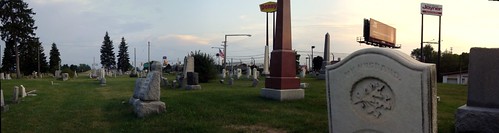
| afternoon thaw at Fairplains cemetery after last week's days of snow and sub-zero weather - history in (head) stones |
In the distance the straight rows of gravestones stands out against the blanket of snow. Each name carved onto the polished stone face tells a story and is rooted to a span of years, in this case mostly from the tumults of the 20th century. Back in the 1980s in Japan there arose an amateur history that can be translated as "Self as History" (自分史) in which a small group of family members become the lens to view the larger events of the decades at the national, regional, and sometimes international scale. In the same way, the mortal remains resting here can be regarded as a library of stories. In principle there should be enough documentary information to form the outlines of a life course for each person here.
 |
| Currently engaged in 5 sister-cities on 3 continents |
A very great proportion of all active exchanges and interactions between municipalities date back to the time of global conflict ending in 1945. Many of the origin stories have to do with specific individuals who felt particularly motivated to initiate the process that resulted in formal acknowledgement of each other's cities and societies. From that acceptance and honoring of one city by the other comes a variety of activities, much of which is volunteer-driven, or otherwise requires little capital expense by the local governments. The most active partnerships might involve annual visits by students or city officials or citizens. In other cases there is a commercial or corporate or cultural component to the communications and ongoing conversations about promoting the relationship and making it better known among the residents of each other's city. Seen in the aggregate, the many individual stories created and lives touched contributes to the social fabric between languages and societies. It is hard to know the tangible and intangible effects of these ongoing efforts that ebb and flow, according to interest level, ambition, and personalities driving things forward. Hopefully, curiosity expands and ignorance diminishes in the process, though.
 |
| state of the art dentistry has come a long way since... |
A visit to the dentistry gear and office from 100 years ago in the upstairs of the
Paine-Gillam-Scott local history museum shows the changes and the continuities from then until now in this view. In the days before electrically powered highspeed and precision-tipped drills and other implements, dentistry sometimes was an ordeal - in the original meaning from the days of witch trials and tests of physical endurance. Now there are x-rays that are all digital, never using chemicals or film to produce the view of dental decay. Special wavelength lighting illuminates cracks in teeth and dental work, too. Software like the one on the screen show the status of each tooth, with room to add notes or pictures that document the changes and recommended dental treatments. However, then as it is still today, this profession is a highly personal service, with hygienists and dental docs working inside one's mouth with sharp instruments and powerful, industrial strength bonding agents, etc. What historically may have been a side-job for a barber (pulling teeth rather than to repair, restore, or replace) now is something very different.
 |
| front yard declaration at a time of voices that protest the fake truth value of news and similar "ALT" (alternative) claims |
This black sign with brightly lettered writing can be seen here and there from time to time around the city since early 2018 or maybe before that. In the time since DJ Trump's presidential inauguration the tone of the commander in chief has cast aspersions on things like fact, science, peer-reviewed publication, thoughtful analysis, public debate, and the transparency and civility and accountability that has been customary during the previous 44 presidents of the USA. One result is this sign this several direct contradictions to Trump's imaginary vision of reality: "Science is real," for instance. Click the image to see full size image and read all of the text on this yard sign.
 |
annual orchid show in the coldest part of winter
|
Every winter the Frederik Meijer Gardens hosts the orchid fanciers' organization and their exhibition and sales of the warm weather plants in their diverse shapes, sizes, colors, and habitats. This photo with orchid in foreground and fancier bending down for closer look in the middle distance. At the top left is someone with flowers bundled up to take home, perhaps. A sign in the hall said that due to the abnormally cold temperature that new purchases would be delivered to the address of the buyer. The video clip, below, documents the tide of visitors moving in and around the hall, panning from left to right across the hall just before lunchtime on Saturday, January 26.
 |
| the many lives of this section of land: pre-contact, oil, leisure |
On this cold bright day a few of the oil pumps were in motion, but most were idle since crude oil prices are low and don't cover the costs of producing the fossil fuel at the moment. Since around 2000 all this land that had been mined for sand and gravel left by the glaciers 10,000 years earlier was repurposed for area residents to park and enjoy the beach, water, boating, bike riding along multiple paved pathways, jogging or walking with or without dogs. Before its life as Millennium Park to the west of Grand Rapids, Michigan, this gravel pit supplied the many road-building projects around the west part of the state Before that traces of farm buildings show that early land owners tried to make a living in this region along the Grand River on the sandy ground.
Going back in time pre-1830s, when Joseph Campau and other trappers and traders began settling in the river vicinity, the cultural landscape was dotted with place names, memories, and significant locations for seasonal harvest of foods and animals and medicines, as well as for trading and for ceremonies to mark life events of birth, marriage, (alliances) and death among the resident Odawa (Ottawa) Indians. Before them, perhaps a different mix of people - resident or mobile/itinerant knew the land. Still today there are spots respected by descendants of those Native Americans of 250 years ago and before.
 |
| opening morning of the 32nd annual Worship Symposium, hosted at Calvin College in Grand Rapids, Michigan USA |
At the end of this morning's worship service in the College Chapel one of the event organizers gave a thumbnail sketch of the proceedings: more than 30 countries represented, over 1400 registered participants, and themed tracks for the workshops and seminars of interest to church musicians, preachers and teachers, lay leaders, and all other followers of Christ's Way of the heart.
By clicking the photo, the full-size image file displays and some of the details of the focal point in the middle of the worship space can be seen now in the 15 minutes before things begin: there is a lectern for the preacher's notes, the installed bank of organ pipes, as well as seats and music stands, including piano to the back of the lectern and raised dais. The long table and chairs to the front of the lectern hearkens to the Last Supper of Jesus and his disciples, made famous in various paintings. It is used in some of the dramatizations with worship leaders silently acting out the scenes read from the Bible passages at a few points. Out of view to the right at the back wall is the bank of sound engineering controls to allow optimum balances of voice and music, including the various mic'ed speakers. The worship is live-streamed for those unable to attend, and is recorded for online release 3 weeks later. The black ball suspended in the air above the lectern has a dozen lens to allow video editors to cut between the various angles of view during recording.
 |
| entryway to worship venue on Thursday morning |
The entryway to the college chapel 20 minutes before the morning worship begins shows the wide and welcoming space that greets people coming in from the cold. The artificial light renders a warm tone, making the outdoor natural light appear bluish by contrast.
For a person attending a Christian worship service for the first time, perhaps there are many first impressions that stand out. The architecture, interior details of decoration, and effect of lighting and sound design all make some sort of impression. An electronic kiosk in the distance above most people's height gives scrolling set of messages and announcements. Probably 99% or more of the worshipers are very experienced in the Order of Service and no printed program or bulletin guides the congregation in when to stand, sit, sing, or verbally respond. It all seems to happen telepathically with only the slightest direction given by the worship leaders by gesture or brief verbal direction. To an outsider, perhaps, that mass experience in synchronization may seem strange; a sort of tide of mass emotion ebbing out or flooding in all together. The mix of music, dramatization, reiteration of Bible passages translated into modern day English, and commentary or teaching interpretations touch various parts of the worshiper: head, heart, spirit, and body. It is a social-public experience and also a personal-private one at the same time; something to which all can agree and affirm to some extent, but also permitting vigilance or critical distance from blindly accepting a view.