Showing posts with label stars and stripes. Show all posts

05 February 2026

Many meanings of the USA national flag - veteran's funeral preparations


open casket draped in USA flag to be unfolded after the lid is closed
Detail from funeral home visitation before tomorrow's ceremonies.
Nearly all military veterans from the World War II era are gone now in 2026, and many from the Korean War have died, too. Even those serving in armed conflicts in the decades to follow in many cases have died. Not all of them opt for the guaranteed death benefit of steel casket, honor guard with USA flag. But many do wish to acknowledge their time serving the USA, as in this example from middle Michigan for a 93-year-old man who had served in uniform, beloved in his community as well as among friends and family.

Symbols like the USA flag (Old Glory, Stars and Stripes, Stars and Bars) can convey several layers of meaning at the same time. This flag is multivalent as national and international identifier for sports, for diplomacy and military, for law enforcement, for official ceremonies and occasions and holidays. It can have more personal connections and meanings at the regional or state-by-state level, and also for people, places, and things seen in cities and villages, as well as the household or company level. In popular culture, too, famous artists and ordinary people can easily fly a flag (or in protest invert the flag) or modify in new colors to suit less patriotic purposes; even in the service of commercial sales.

overview of the open casket viewing (detail magnified, above)
Without talking to the stream of friends coming to greet the bereaved family members it is hard to know which of the many layers of meanings of the flag on the coffin are uppermost in their minds. Is it window dressing of an official nature with nationwide currency and value? Or is it part of the man's self-image and the way that others viewed him in life, too? Certainly during the time in uniform it fully occupied his waking hours and shaped his personal habits, standards, and expectations as a young man and for a few years after being honorably discharged, too, no doubt. But from his early 20s (completion of military service) to his early 90s there were many other concerns and guiding principles. So, on balance, the couple of years during the Korean War only took up a small part of a very long and full life. And yet, in all those years he demonstrated his commitment to order and ethical behavior, public service and duty, loyalty and justice equal for the great and the small. So, in that abstract sense of goodness and mercy, his own life and the positive facets of USA nationwide ideals were coherent and maybe sometimes overlapped his own ideals, too. In that case, the national flag is less about politics and history and more about his personal standards and values.

In any case, speculating about the mix of personal and the many other layers of meaning will be difficult to untangle or document without in-depth and wide-ranging observations and conversations with those who knew him best. But for the purposes of this article, it is enough to acknowledge the many meanings - even contradictory ones - that a symbol like the American flag can stand for, gliding easily from one meaning to another; or expressing all the meanings simultaneously.

After the funeral ceremony is completed and the group of mourners reassemble at the graveside to bury the flag-draped casket, then an honor guard of veterans (occasionally there are ones in uniform who are currently in service, too) will carefully fold the flag to present to a representative for the bereaved family as a memento of the occasion.


17 May 2024

National flag variations on a theme - speculatively


late spring evening front yard with USA flag waving on front porch with blue-black field for the stars
What looks black in this flag*could* be political expression, or maybe is simply a very new flag 5/2024

Without talking to the owner of this house and looking closely at the fabric, it is hard to be sure if the dark field for the 50 stars that represent the 50 states (though not territories or Washington, DC) is regulation navy blue, or instead is specially created with inky black to make some sort of statement about light-pollution and a love of skygazing, for example. For the purpose of essaying the many meanings and uses (and abuses) of the national flag, though, let us speculate with the assumption that, yes, this flag is made in red, white, and black. What are some of the possible meanings the homeowner wishes to show publicly?

From the October 7, 2023 terror assault from Gaza and continuing more than seven months to today, there is the plight of the Palestinian civilians (about 35,000 killed by Israel Defense Force activity, mainly women and children). Since college campuses in many parts of the U.S. have student demonstrations against USA contributions of weapons and intelligence and money to the I.D.F. there are also private property owners who express solidarity for (or against) Palestinian abuses in Gaza. Then there are also USA flag variations ever since the Coivd-19 lockdowns early in 2020: the monochrome flag with just one band of blue through the other white stripes to signify support and importance of (armed) police to the overall social stability. Another version swaps the blue line for a red one to signify firefighters and paramedics responding to emergencies. Once in a while a porch flies a 13-star, colonial era flag (stars in a circle, Betsy Ross design) to signify "getting back to purest, original principles of the Declaration of Independence, article of confederation and the U.S. Constitution" (implying that 2024 conditions and amendments and legal wrangling, federal budget size, etc are wrong). Much rarer are the "don't tread on me" yellow flag with the serpent made of 13 segments to show the power of the united colonies against outside forces. Also rare: flying the USA modern flag upside down as a signal of distress - not of the householder, but that person's interpretation of international headlines and domestic events. 

Looking at the photo in this case, though, it is very likely to be a particularly dark fabric dye for navy blue; not a political statement or outburst of barbaric yawp that paints a dark picture against which the stars shine especially brightly. Playing with colors and symbols makes possible multiple interpretations; more than one meaning at the same time, depending on the standpoint of the viewer. This flag's condition could mean a range of figurative or symbolic meanings and also be nothing more than the buyer seeking out the deepest blue they could find for no other reason than to withstand fading of the sun in summer and winter, day after day. Still, there is some use in speculating untethered from the house owner's perspective. That is because the ocean of Internet, print, and broadcast information and entertainment intersects with education and personal reflection in any given moment's particular Public Discourse; a sea of meanings that exist simultaneously in the eyes of those expressing the matter and those reading or responding to the matter. By probing the many kinds of possible meaning, not just confined to the specific case of the particular person, the larger pool of images and words also can be joined.

09 December 2021

National flag and personal life intersect at funeral

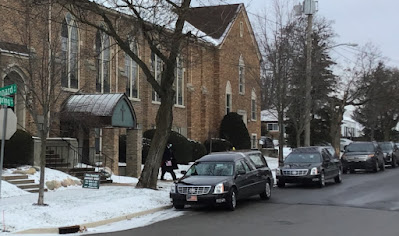
line of black funeral cars parked at church entrance
many meanings of the USA flag on the funeral hearse's front bumper

Late Wednesday morning, December 8, 2021, a funeral was getting underway. In the parking lot behind the church and the one across the street there were about 50 cars waiting to take people home or to the cemetery, if burial ceremonies were planned after the church service. In the context of 22 months of Covid-19 there is some chance that this life (or lives - since 2 hearses are positioned at curbside) was cut short directly by the virus, or indirectly that the hospital services were strained by the burden of unvaccinated people filling the hospital rooms and taking up the services there. But without stopping to talk to those present or searching for a published obituary, the cause of death is only guesswork.

The funeral hearse nearest to the camera displays the U.S. flag on the front bumper. Thinking of funeral customs for the other 200 national states, or for the many human societies that comprise the almost 7,000 languages that are spoken, surely this use of a national symbol on a personal and family-level matter is not common unless the deceased represents political leadership, national fame, or died in armed service (or veteran of military service). Without interviewing the owner of the hearse, its driver, or the company managers, along with the people attending the funeral, it is only speculation about possible significance (or more likely, multiple meanings) coming from the use of the national flag in connection with the dignified undertaking of funeral ceremonies and the safe conduct to and from the burial ground.

-Propriety (official, above-board, dignified, customary): This thread of meaning connects the person or business displaying the national flag to the country's wealth, fame, and all the life-affirming values that come with it. The darker chapters tend to fall into the shadows when the spotlight is fixed on the good things, though. In this photo, then, prominently exhibiting the flag (but not shouted loudly in oversize or multiplicity) assures like-minded people that the funeral company values and perhaps feels pride in belonging together with the present and the history associated with this banner. And for others who feel ambivalence about the mixed record of harm and healing carried out in the name of this flag, by displaying it out front, those who feel doubt will be put on notice that this vehicle and all those trailing behind it stand on the side of a positive accounting of the symbol and people connected to it.

-Authorized (halo-effect from close-association with the power of law and force): Seeing a flag in public as well as private spaces is a signifier that the proceedings are implicitly protected by the full faith and the rule of law of the land. In this photo, the presence of a national flag picture (or one made of cloth) seems to suggest that all procedures have been followed, duties fulfilled, and debts paid. No corruption should be suspected or expected or allowed.

-Conservative, button-down, standard-issue, government-conforming: Another meaning some will feel upon encountering a (USA; other countries have a different relationship of flag to citizens, no doubt) national flag is one of status quo; a sense that things will proceed as they have in the past.  No erratic, strange, or outlandish behavior is likely.

-Vocation (former government work for local, state, or federal employer): Before the funeral owner opened the business, perhaps he or she was a federal worker and/or a member of the military. In that case the flag signals the person's (or the company's) organic roots with Old Glory. The flag is part of their past work.

-Avocational (proud of team USA, symbols, popularly imagined history): Even when a person or organization has no direct connection to federal or national services and products, perhaps they feel strongly about expressing allegiance to this "one country, under God, indivisible, with liberty and justice for all" (quoting the school child's Pledge of Allegiance recited many times). In that case, showing the national colors discretely in the panel reserved for a license plate in some states is an affirmation or aspirational statement.

-Personal history (recent immigrant or else a genealogy enthusiast with long roots in USA): The flag display on lapel, desk, office wall, or raised on a pole could also signify something particular for that person. For example, a "new" American may have come via career path and advanced studies, as an asylum seeker or refugee of disaster, or as family member of someone previously establishing American citizenship by birth or marriage, for instance. In that case, a sense of ownership and belonging and gratitude, among many other possible mixed feelings could be carried by the visual presence of the banner. In a related but different way, someone who has looked deeply into family histories may feel a multi-generational sort of loyalty or allegiance to the many people, places, and things symbolized by the flag.

-Personal identity (define and view oneself by the category of flag and anthem more than by local ties): Some people see themselves, and are regarded by others, as a patriot and outspoken supporter of the things that the flag stands for in that person's mind. Others downplay their national citizenship and the source of their passport and build their identity instead on a foundation of the wider planet, or conversely, on a foundation of the immediate surroundings of their town or county. However, for the person who wants to be known, and feels most satisfied in seeing herself or himself, in national terms, then displaying the flag is a particularly personal statement; a sort of credo for who they are.

This list of possible meanings conveyed by a public display of the United States flag is not exhaustive; there are probably other sorts of significance being purposefully or subconsciously expressed when making a decision to put a flag on view. Realistically, the uppermost meaning in the eye of the beholder, the eye of the one displaying, or in the mind of others just passing by will be a combination of factors rather than a single dominant meaning. And for complicated, context-dependent meanings, it may well be that much lies underwater, like the bulk of an iceberg: part can be seen and discussed, but the greater part is unseen and is hard to put into words. So, directly asking a person what comes to mind when they see the flag might only turn up a few meanings or hints of meanings rather than a fully formed verbal response.

In any case, though, for the funeral company staff their minds are focused on providing professional and personal care for the people in mourning. The attention of the family and friends participating in the ceremonies is occupied with the events as they unfold minute by minute, the feelings that come up in themselves and in those nearby. It is probably only in the mind and lens of a passer-by that such considerations about the meanings of the national flag are studied in reflection. And yet, even for the funeral workers and the mourners, at least a little of the flag's presence and the meanings it triggers will be present, whether or not they stop to imagine the many kinds of meanings that arise when personal life and national symbols meet each other.

11 April 2021

Pop culture - The monkeys who see and hear and speak no evil

Bumper art: See no evil... [post code 49505 on 3/2021]

Popular culture takes many forms but always seems to flow from a prominent status source like religion, celebrity, or governing authorities down to the average consumer of mass-produced, mass-distributed, and mass-consumed iterations. The national flag can turn up on T-shirts, wrapping paper, or coloring books. The crucifix from various traditions of Christianity can be expressed in precious metal and gems as jewelry or it can appear on album art for secular music. And a piece of clothing first seen on Princess Diana in the 1990s could turn up in discount clothing stores a few months later.

This photo shows the space sometimes reserved for license plates in some countries or states being used here to express a point of view with a bit of pop art that may be purchased online, on demand (send your image file for producer to fulfill), or at shops selling automotive accessories. Since Michigan only requires a legally issued and up-to-date license plate on the rear of the car, some drivers attach something referencing the university they support or identify with for sports teams and/or personal schooling experience. Others choose logos for professional sports teams, vacation destinations, ethnic heritage, religious teaching, or a bit of abstract art. This one bears the "3 Wise Monkeys," as Wikipedia in English calls the ensemble.

Screenshot of Wikipedia "3 Wise Monkeys"

Without talking to the driver whose car displays the monkeys, above, it is impossible to say what is being expressed. It could be "whatever happens in my world or the wider world, don't hold me accountable; I did nothing" (deniability). Or maybe it is less about denying involvement and instead a nod and a wink to "live and let live; just about anything is permissible since I don't value a lot of the restrictions asserted as legalities" (give me liberty; don't give me responsibility). Then again, the bumper art could be a reference to a career as art teacher, aficionado of folktales, lover of monkeys, travel souvenir from Japan, or merely a way to honor the person who gave it as a present. In fact, more than one meaning can apply at the same time, layering the significance of putting the scene into public circulation on highways and city streets, wherever the car is parked. 

For the purpose of this article, though, this example illustrates how pop culture can take something from its original setting (mausoleum of centuries-old warlord Ieyasu in Nikko, Japan; and before that, a folk wisdom story from India) and reshape, repurpose, and spread it into wider circulation and new contexts where people can give it new meanings, such as this front bumper of a Japanese car, either imported by ship or put together inside the USA as a joint-venture product for sale.

02 August 2020

Grocery patriotism a month after Independence Day

Sunday afternoon grocery shopping in the peanuts, dried fruit, snack section.
Although the waist-level grab shot makes the Star-spangled Banner look very large, in fact this is the normal retail size that homeowners display on poles attached to the front of their house. Since this instance is indoors and cannot flutter in the breeze, the supporting structure holds the full rectangular shape rigidly unfurled.

The range of possible intentions by the grocery-store corporate headquarters, or the local branch store manager could be one or more meanings. Without probing in conversation, though, here are a few ways to interpret this public display on private property indoors, listed in no particular order of significance.
  1. Initiated around the time of the July 4th national holiday in celebration of the Declaration of Independence from the colonial powers in London, this show of The Colors is a traditional sight, albeit normally outdoors instead of in the food rows.
  2. Ever since the pandemic arrived at the end of winter season, little by little the small and large impositions on people of all ages and social circumstances has led to tension and irritability, tribal outbursts and blaming one another. So perhaps this national unity statement is a reminder that all citizens (and tacitly, too, the undocumented non-citizens) are members of the same team.
  3. At the risk of overthinking the possible primary or secondary meaning, maybe what began as traditional July 4 exhibition has slowly taken on a new meaning as the federal government, starting with the POTUS, has failed to lead a response to Covid-19, including the Black Lives Matter movement, and will soon face the November election, preceded by the August Primary Election. Thus this flag might be a visual reminder to shoppers that times are bad for life expectancy, for social interaction, and for economic livelihoods and therefore it is time to elect fellow citizens who actually do have leadership credentials, plans, and results demonstrated in their careers.
  4. Lastly, and not particularly compelling as a purpose for displaying the national flag, it could well be that this one location in all of the vast store, at shoulder height or higher to most shoppers, is meant as nothing more than a cheerful, comforting, decorative and status-quo declaration: "we were here before, we are here now, and we will be open for business tomorrow, too."

06 July 2020

Star-spangled (blue) banner

National USA flag imitated with no red stripes (downtown Grand Rapids, MI 7/2020)
The black and white U.S. flag with a single blue line in the middle of the field appears in front of people's houses here and there. An early June essay at The Marshall Project discusses this version of the flag with reference to the intensified scrutiny and protest over police abuse of black and brown-skinned people since late May 2020. What originally was imagined as a visual expression of police solidarity is being seen by others as symbol of White Supremacy agitators.

The reason to snap this photo, though, is not to mull over the specific case of the monochrome banner containing a thin blue line, but to reflect on the more general practice of co-opting this national symbol for narrow, sometimes personal, uses. During the 1970s and around the time of the bi-centennial in 1976 , especially, there was a lot of pop art and commercial use of the readily recognized combination of red and white stripes and the white stars that comprise the Star-spangled Banner. Motorcycle helmets, knickknacks, wallpaper, paint schemes on muscle cars, badges, cake decoration, and underwear like this could be bought or made. Now more than 40 years later the splintering of TV channels and (online) news sources and alternative schools has led to the tribal divisions that group people into communities sometimes defined by what they are not and emphasizing difference to others instead of being concerned with commonalities and common cause that everyone shares a stake in.

This black and blue likeness of the USA national flag seems to say that the "thin blue line" (uniformed members of local police departments) is what connects and holds together the halves (and the "haves" and have nots) of the displayed flag and by symbolic extension also the halves of the whole country itself: social order that comes from firmly enforcing laws, no matter if those codes are written well or poorly. Taking a similar approach of appropriating this national (and thus diversely shared and experienced) symbol for public display, school teachers could claim a key role in the life and future of the society. So could tax collectors, farmers, truck drivers, and car repair professionals. Taking a different theme from the occupational one, political factions might want to claim that only their way of seeing the world can be good for the country. A riff on the national flag could then express their own self-appreciation. Maybe most foundational of all, as William Ross Wallace put it in his 1865 poem, "the hand that rocks the cradle rules the world." By that estimation, the national flag should be interpreted to express the abiding presence of mothers and the very most formative child development years.

Seeing the flag in this photo displayed on the top of a pole in downtown residential Grand Rapids could be a private statement of support for friends, family, or neighbors who devote their working lives to the various roles within the police department in this city or elsewhere. Or maybe it is a larger statement about Law and Order as the basis for human relationships in the public arenas of commerce, communication, and cultural expression. Without talking at length with the person displaying the flag it is hard to know the shape and size of the meaning that the flag holds in this one instance. Perhaps it is most of all a reflection of this generational moment or historical intersection of events, ideas, and personalities that has no parallel in other societies or even around the USA at other points in history. But one thing is certain, because that flag has appeared in domestic and foreign places in private gatherings and public occasions, the meanings are many and the image is readily recognizable.

It is a rich source of meanings which can be harnessed for individual, organizational, or (inter)national purposes. Seeing it on this morning brings to mind a distant recognition: ah, that looks  familiar, except that this flag has drained away the full-color form to give only black and white, along with one stripe of blue. It may express a truth or the lived experience among past, present, and future employees of police departments, but for people without this direct connection, the original red stripes and blue field for the 50 stars to represent all citizens somehow is muted into black and white. Only the blue stands out in that flag; all else is diminished by comparison.

13 December 2018

Symbolism? Old glory in tatters 2018 December 13

Shredded USA flag hanging together by a thread (click image for full-size view)
As a visual representation of the abuses to USA democracy during the campaign, election, and first 23 months of DJ Trump's occupation of the White House, this flag seems to sum up the situation. The red and white are meant to symbolize the initial 13 colonies that joined together to declare independence from the United Kingdom, while the blue field carries one star to symbolize each of the present-day 50 states. Translating the scene into words, it could be read as "distraction and distress are tearing apart the union; what is more this economic and social fabric of the society is only hanging on by a thread."

A recent news story tells about the 44 former US senators who signed an open letter that appeared in the Washington Post in early December 2018 to urge the current national leaders to stand up to the abuses and illegal acts of the disgraceful occupant of the White House. See https://www.npr.org/2018/12/13/676346772/former-sen-william-cohen-among-those-who-urge-current-leaders-to-defend-democrac

Thanks to technology of mass communication and social media, as well as mass participation in public discourse and decision-making, it is increasingly possible, practical, and expected that citizens can scrutinize the words and deeds of elected officials and civil servants, and to hold them accountable for their words and deeds. Perhaps that oversight and pressure will lead to better governance in the future, but for now the fragmentation and chatter of so many people seems to result in the opposite to oversight and accountability; rather, we see divisiveness and distractedness.

see also https://www.atlasobscura.com/articles/flag-desecration-laws

01 June 2014

flag avenues

Evening view of Mt. Rest Cemetery on May 30, 2014 in St. Johns, Michigan 48879
So far there are 570 flags at the city cemetery, “Mt. Rest,” in St. Johns, Michigan. Four times a year the poles and flags are unfurled: Memorial Day (not the 3 day weekend that varies its date each year, but rather the May 30 date of the traditional Civil War holiday), Independence Day on July 4, Labor Day (the first Monday of September), and Armistice Day (the World War I cessation of hostilities, November 11). This panorama stitches 2 photos to show the view south and east from the paved road that runs along the west side of the 1919 era mausoleum located at the center of the present grounds, but at its beginning it was near the eastmost edge of the burials made between the early years of the city in 1856 and 1919. Tombstones of that early time often were large, while those of the recent generations are normally more modest. Some burial grounds specify flush to the ground must be made to facilitate easy lawn mowing.
    What will future observers and inquiring minds think about the ceremonial handling of the national flags, the Memorial Day speech-making and frequent references to “freedom” [but whose? and under what terms] and “freedom is not free” (but rather has been paid for in the blood of the draftees and volunteers and career soldiers and sailors and aircrews).
--see also video clips from the remembrance ceremonies

--see also the July 2016 display:
Avenue of Flags - set of cemetery festooned with U.S. flags
[at Memorial Day and again at Independence Day the hundreds of flags are placed]

http://miserybay.usanethosting.com/indylite/archives/3460 =article
https://www.youtube.com/watch?v=lywSMljkiTU =slideshow of scenes

23 October 2009

Flags and feelings

Commemorating public safety workers directly affected by rescue and later recovery from 2001 terrorist attacks of September 21. Pictured here is an oversize US flag on the end of the ladder truck at the front of the town fire station in rural middle Michigan, looking east at the intersection of Main Street.
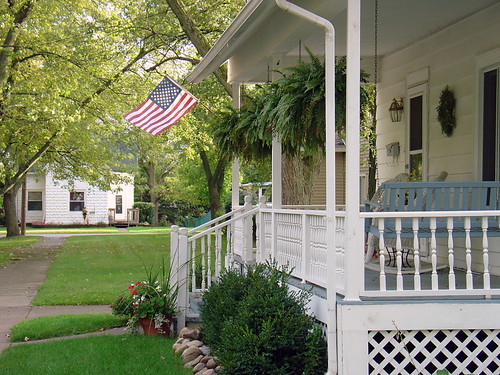
Seeing this prominent public display got me starting to think about all the things the flag can stand for - individual memories, shared experience, layers of historical resonance, abstract national-ness (essence symbolized); as well as the meanings contained by critics of the US present or past actions and way of handling things. Some of these feelings and ideas may be similar in scale or degree for other flags and other peoples, while other elements may be particular to the US experience as an immigrant society of relatively few generations since its foundation.

Another flag display, this time on a private house, got me thinking more about the flag & ways that people use it to stand for one or more expressions.
Here's a first look at a list of possible connected meanings, http://www.flickr.com/photos/gpwitteveen/3985554820/

--see also 2014 video clips from the remembrance ceremonies
--see also 2016, the July 4 display:
Avenue of Flags - set of cemetery festooned with U.S. flags
[at Memorial Day and again at Independence Day the hundreds of flags are placed]

http://miserybay.usanethosting.com/indylite/archives/3460 =article
https://www.youtube.com/watch?v=lywSMljkiTU =slideshow of scenes

see also https://www.atlasobscura.com/articles/flag-desecration-laws