Showing posts with label 49525. Show all posts

27 December 2021

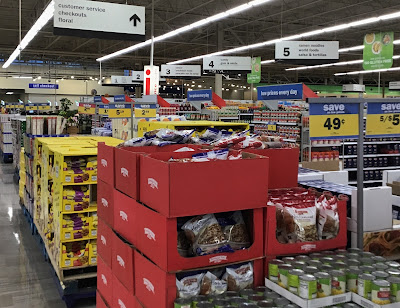
Well stocked grocery-super store after Christmas holiday


palettes of food and drink fill the extra-wide space at the end of the normal aisles
Monday after 2021 Christmas on Saturday - so much in stock
When compared to the inventory size and variety at a convenience store or old-time "mom and pop" grocery store before the 1950s, the massive scale of the Superstore - combining general merchandise (department store) AND grocery store, along with pharmacy, automotive center, garden products - is really astounding for sheer abundance. This photo shows the extra-wide space for rapidly changing seasonal and specially priced goods at the end of the numbered aisles to the right and the non-grocery (department store) aisles left of this photo. For example, the stacks of packing boxes in yellow reaching from ankle to chest height offer bags of chocolate chips that are essential to the many variations on chocolate chip cookies. A shopper need only reach into the opening at the side of the carton to pull out as many bags as the wish. Not far away are 5# bags of all-purpose baking flour. Behind the lens is an ever shifting inventory of regionally brewed (craft) beer varieties. The numbered aisle to the right still add prominent display of featured items on the "end cap," but these massive pallet loads amplify the idea of "end cap" greatly, insisting on attention by shoppers since the cubes of product reach eye-level or higher and require care when navigating with one's giant shopping cart.

With so much space occupied, so much color, so much quantity of any given item in the grocery inventory, the general impression is one of abundance. If this is a feast for the eyes, then the visual effect can quickly lead to indigestion: Too Much Inventory. Projecting the full life-cycle of a foodstuff: it goes from source (field, ocean) to manufacture or processing and packaging and palletizing. Then truckers go from factory to depot distribution site before local delivery vehicles stock the retail level shelves. Once the consumer selects things for the shopping cart and either whiles away the time at checkout lane by browsing magazines and impulse purchases of candy and savory snacks, or else lines up for a turn at the self-checkout corral with one or two staff ready to trouble-shoot some of the scanning problems (alcohol sales requiring ID verification, mislabel/prices item, coupons not valid or not machine readable, double-counting of an item incorrectly swiped across the laser field, etc). Then, once consumed in whole or in part, the package is discarded and hauled away for solid waste (landfill) deposit, or sometimes it goes into the single-stream recycle curbside service in the city or town or countryside. In other words, looking back at this photo of such masses of products concentrated here, eventually each packet of chocolate chips will end up in a household within a 5 or 10-mile radius, then all these bags -once emptied- will end up during these next weeks and months scattered through the stream of solid waste carted away to the towering landfill ziggurat.

In summary, the scale and diversity of grocery (and department store) inventory today is astounding. Carts are scaled accordingly (the reverse of portion control: go big to encourage more buying). First-time shoppers can be intimidated as they gawk and wonder at the choices and the packaging volumes. Even long-time shoppers can sometimes express a slightly weary look, knowing how many steps their personal exercise calculator will record between arrival and checkout and exiting into the sea of cars filling the parking lot. Perhaps this kind of supply chain, display method, and business transaction is here to stay, forcing out of business almost all except the biggest regional and national stores.

02 August 2020

Grocery patriotism a month after Independence Day

Sunday afternoon grocery shopping in the peanuts, dried fruit, snack section.
Although the waist-level grab shot makes the Star-spangled Banner look very large, in fact this is the normal retail size that homeowners display on poles attached to the front of their house. Since this instance is indoors and cannot flutter in the breeze, the supporting structure holds the full rectangular shape rigidly unfurled.

The range of possible intentions by the grocery-store corporate headquarters, or the local branch store manager could be one or more meanings. Without probing in conversation, though, here are a few ways to interpret this public display on private property indoors, listed in no particular order of significance.
  1. Initiated around the time of the July 4th national holiday in celebration of the Declaration of Independence from the colonial powers in London, this show of The Colors is a traditional sight, albeit normally outdoors instead of in the food rows.
  2. Ever since the pandemic arrived at the end of winter season, little by little the small and large impositions on people of all ages and social circumstances has led to tension and irritability, tribal outbursts and blaming one another. So perhaps this national unity statement is a reminder that all citizens (and tacitly, too, the undocumented non-citizens) are members of the same team.
  3. At the risk of overthinking the possible primary or secondary meaning, maybe what began as traditional July 4 exhibition has slowly taken on a new meaning as the federal government, starting with the POTUS, has failed to lead a response to Covid-19, including the Black Lives Matter movement, and will soon face the November election, preceded by the August Primary Election. Thus this flag might be a visual reminder to shoppers that times are bad for life expectancy, for social interaction, and for economic livelihoods and therefore it is time to elect fellow citizens who actually do have leadership credentials, plans, and results demonstrated in their careers.
  4. Lastly, and not particularly compelling as a purpose for displaying the national flag, it could well be that this one location in all of the vast store, at shoulder height or higher to most shoppers, is meant as nothing more than a cheerful, comforting, decorative and status-quo declaration: "we were here before, we are here now, and we will be open for business tomorrow, too."

19 March 2020

Pandemic thoughts - stockpiling food and master narrative

When faced with unknown events, people look for precedent or analogous situations as a ready-made source of how things will play out and where one fits into the sequence of actions and also to know what to be cautious of when seeking to minimize liability and other risk from the situation. The spread of the novel variety of the Corona Virus that causes the disease the experts have named Covid-19 began at the end of 2019 in SW China. As of middle March there are more cases each day in France, Spain, and Italy than in China's epicenter.
Saturday around 6 p.m. on March 14, 2020 in Grand Rapids, MI - bare shelves.
So far in USA the news media has focused on the locations that report confirmed cases; sort of like a weather forecast about where the (known) hot-spots seem to be. Repeated instructions to wash hands and keep them away from eyes, nose, and mouth emphasize the behaviors to break the chain of transmission by water droplets exhaled or coughed onto hard surfaces (72 hours of infection possible; 24 hours on paper or cardboard surfaces). And with the shortage of testing equipment, staff, and infrastructure the message has been that testing to know each region's tally is helpful for administrators who deploy resources efficiently, but whether one's own test is positive or not, the same advice comes into play: avoid contact with other people and treat the symptoms; otherwise just let time heal the infection. If fever is high and breathing difficult, telephone for instructions rather than to arrive and contaminate the clinical settings. But what happens after a person is (confirmed to be) infected? When does a recovered person go  back to "normal life"?

If it is true that children frequently have mild or no symptoms, young and prime-of-life people normally have tolerable symptoms (unless burdened by complicating factors from underlying health condition like high blood pressure, diabetes, asthma, and so on), then why should the entire country public and private sector close any public activity and retreat to dispersed (social distancing) configurations of work space and home life? The officially given reason is not to contain the virus, but to slow the rate of infection so that the life-threatening cases can be handled by hospitals, unburdened by surges in admissions of patients. By playing the inpatients across a slower pace and longer span of time, any surges and resulting loss of life can be minimized; the disaster can be mitigated by collective action and for collective benefit. In other words, the central organizing idea for nation-wide, indeed- cross-national coordination of effort and closures and social distancing is meant to preserve life of the vulnerable, including elders (age 60 and older).

Although the public messaging is aimed at individual self-interest, in fact most people in good health are not at risk to die from contracting the virus and letting the cycle of infection run its course. Instead, the coordinated effort and urgent tone of public news briefings and analysis is about the collective dangers to the whole of society. Without an "all hands on deck" approach, including all the public livelihoods like transportation, education, entertainment, dining, worship, hobbies, and workplace interaction, the virus could very quickly inundate all segments of the population and mortally affect the infirm, weak, vulnerable, and so on. By putting on the brakes to virus transmission, many individual lives will be preserved, and all the accumulated knowledge, social capital, and emotional weight can be protected.

The cost of ceasing most all of the normal movement of people and interactions closer than 6 feet of separation is very big since so many hover at the edge of bankruptcy, debt, and so on. Any interruption in health, working hours, and income rapidly destroys social order. In the USA as of March 19 there is rapid legislative action underway to disburse money from the central government to each tax payer and worker. Precise details are not yet confirmed, but the idea is for 1 round of checks in early April and another in early May. But perhaps there is a silver lining in the dark clouds formed by suddenly idling almost all sectors of the economy for an extended period of unknown duration: more people will acknowledge the inter-relatedness of the world economy and within the US society; and that this collective effort may not directly, personally, and materially affect one's own life, but there are indirect effects that come from preserving the weakest parts of the society and paying attention to each other's needs instead of dreaming utopian escapes of news echo-chambers online and chasing after yet another consumer purchase.
07 June 2019

Lucky penny (wishing well) - pinning hope on a coin

coins offered to the water feature of Meijer Gardens tropical greenhouse, 6/2019

What looks like a child's piggy-bank that spilled onto the rock ledge beneath the walkway bridge is in fact the accumulated coinage of many weeks in the botanical exhibition of tropical plants at Meijer Gardens and Sculpture Park in Grand Rapids on the west side of lower peninsula of the state of Michigan. Wikipedia has articles on Wishing Wells, Superstition, and Folklore regarding the concept of Luck in general and Lucky Penny in particular. Related is the idea of coin as source of power or charm. Other parts of the world have similar beliefs about the life-giving or healing power of a mountain spring, waterfall, or forest pool, for instance. The cenotes of limestone-rich Central America of the Maya heartland contain all sorts of offerings, as do some of the bogs that have filled in with peat in Europe over the centuries. Clearly there is a form of non-verbal communication or interchange between mortals and the rest of creation that lies outside the wakeful world of perception.

If one of the coin donors were interviewed or responded to a survey, perhaps they would shrug or laugh nervously in order to deny any serious intent. Instead they might say it is a quaint custom, but not a life-changing experience; something like the tradition of mocking death and distress by dressing up at the eve of All Saints Day; a.k.a. All Souls' Night (Hallows E'e'n, hallows evening, Halloween). Periodically this indoor, closed environment must be tidied up since accumulations of coins, dead leaves, or other detritus would overwhelm the natural cycle of decomposition and disposal. What happens to this legal tender is a question to consider. And could there actually be some modern-day followers of religious traditions in which such practices are normal and cherished; not as folk habits, but as methods to exercise one's belief and build a relationship to unseen forces.

Seeing hotel lobby fountains or medieval city water features that collect coins of tourists and some residents, too, perhaps is one thing. But to find an ancient tree near a forest walking path at Janet's Foss (small waterfall in North Yorkshire) that is studded with coins dating decades and decades earlier is a bit more serious - less the product of playful holiday makers and more the result of people making a journey to that site of significance to engage some force or spirit by anchoring their coin in the woody body and leaving their earnest wish there, too.

Special research methods are needed for investigating ideational subjects like religion, humor, an literary artfulness or aesthetics. Observation, participation, interviewing one or one or in focus groups can point to some of the important meanings at work or play. But still it is difficult to produce a complete picture of the concepts and practices since some of the matter is not always clear to the persons most closely involved. However, the world of beliefs and traditions is all the more intriguing for its elusiveness, both the parts that endure and the parts that adapt to modern ways and purposes.

08 May 2019

More visitors come to see, smell, and record flowers and trees

click for full-size view: panorama, early April 2019 expansion of botanical gardens
With months still to go before completion of the enlarged visitor center and programming areas the Meijer Gardens and Sculpture Park continues to draw visitors from the city of Grand Rapids, Michigan and surroundings, as well as the wider state and Midwest region. Informational signage near the ticket counter tells of the current facilities' capacity being overrun, thus the need to accommodate the rising numbers at present and projecting into the future: more parking, more food and gift buying spaces, and toilets enough for everybody.

At a time when portable electronic devices tied into the Internet seem to distract and dissipate the focused activities of children through the elderly, it is heartening to see that some people make an effort to visit and admire the seasonal changes on display in the indoor and outdoor spaces around this piece of ground. There are signs of small increases in public attention and concern about human-caused loss of habitat, the rise in extreme weather events, and the responsibility borne be individuals and governing authorities. Both local and national authorities can curb or incentivize organizations and private companies to reduce the harm caused by their operating practices of sourcing, consuming, producing, distributing, and disposing of unused materials, heat, light, and waste.

The relationships that people develop and sustain with their physical environment and the spaces they inhabit in warm seasons and cold have changed over the generations and in direct consequence of available gear for dressing, getting around, and communicating over long distances. Each time people gain more control, power, and insulation from the physical facts of their surroundings, their own biological facts, and the habits of thinking that follow from the new normal, one consequence is less frequent and shallower connection to the natural world. Projecting this trend a few more decades into the future, it is possible to imagine more and more people who rarely get muddy shoes, are wet from rain, are chilled by falling temperatures, or who are bit by a mosquito or fly. What those future people know of non-human lives and cycles then comes not from direct experience, but is mediated by screens and on-demand reading, hearing, or viewing. Occasional black-outs, accidents, or deliberate expeditions "off the grid" will lead some people, sometimes to encounter places and events with relatively little human interference or administration.

The wide photo, above, stitched from two frames is a record of the new and expanded visitor entrance and related wider facilities to hold larger groups and bigger numbers of attendees. As work wraps up in the months ahead and traces of construction are tidied up, future visitors may come to believe the new, larger layout has always been at that scale. But returning to this photo is one way to remember the dynamic scale of human engagement with the many plants and animals inhabiting these grounds.

03 March 2019

Camouflage blight - taking the theme in too many directions

cellphone to capture indoor tropical garden scene, dressed in warm camouflage
The most common color scheme for camouflage on the clothing racks for discount shoppers is the temperate forest palette: browns and greens. But sometimes there is all-pink, as in this photo, or a wintry scheme of whites and grays. The other color palette that comes to mind is the one in shades of blue. The same pattern of color blocks is reproduced, no matter the overall color scheme, though. It appears on overclothing like coats, insulated snow pants, hats, gloves, boots. It appears on shirts and pants. It appears on undershirts and underpants and socks. But when did this proliferation of fashion begin and how come the popularity is sustained?

One way to speculate is to consider the long wars of S.W. Asia, mainly Iraq and before that Afghanistan. Even though a relatively small fraction of the US citizens and resident aliens have enlisted in the all-volunteer military services, the circles of family and friends extends pretty far. So maybe one theory for this piece of the popular culture pie has to do with some kind of passive support for those in uniform now and before; sort of like fans of sporting teams who dress in the colors or merchandise of the team.

Looking from another point of view at the widespread wearing of the camouflage pattern on newborn babies to retirees,  maybe another connection to the field of meanings has to do with the functional nature of all things military; a no-nonsense approach to complexities and frivolities. By sticking with camo. themed backpacks, toys or playing cards, the person is expressing at least two messages - (1) ignoring bothersome considerations of fashion, propriety, status symbols, and (2) identifying with the all-action, results-oriented way that military operations are executed.

Related to this functional interpretation is the earlier expansion of denim jeans, shirts, jackets, backpacks and so forth in the late 1960s onward. Blue jeans - new or worn in/worn out - was the anti-"dressed up" clothing. Originally these durable textiles were limited to manual labor settings, but during the protest years and times of social change many people who were not manual laborers also expressed resistance to white shirts and polyester pants by putting on jeans in more and more settings. Gradually the dress code at public schools began to allow jeans that were not soiled or damaged to be worn; later the fashion for 'distressed' clothing pushed those boundaries further. In summary, at a time when social standards, aspirations, and expectations are changing, one way to reduce the confusion and lack of clarity is to reach for symbols that are functional and not tied to fashion. In the 1960s and 1970s that was blue jeans. At the turn of the 21st century that seems to be camouflage.

17 January 2016

So many cars - residents depend on wheels & internal combustion engines


Grand Rapids, Michigan on a Saturday after lunch mid-January this stream of north-bound cars on the Beltline ring road is steady and not unusual in volume. With a grid of roads well maintained, people who can drive enjoy a certain impression of freely moving from event to event, workplace, school or religious assembly. They can browse the things to buy from retailers and gather their choice of eatables to carry with ease in their motorized conveyance. Yet there are costs - money consumed in purchase and upkeep, and therefore money foregone from using in other ways. But there is also environmental impact (each gallon of fuel leaves behind 1 pound of carbon, 454 grams; or is it carbon dioxide?).