Showing posts with label grocery store. Show all posts

06 December 2025

The shape of things to come, together with software and day-to-day robots

chest-high, tower-shaped robot surrounded by grocery aisle
self-driving inventory robot at grocery store, 12/2025

Not yet a common sight, there is every reason to believe that shoppers will get used to seeing more and more self-paced inventory robots for multi-sited stores having extensive inventory, large floorspace, and little risk of malfunction or human harm. This one is operating during daytime hours in a Midwestern grocery chain in Grand Rapids, Michigan early in December 2025. Perhaps it was piloted after hours to prove its reliability and to work out the obstacles or situations defeating its programming.

Although it is the stature of an adult who is smaller than average height, its lack of facial features or any aggressive, outward pointed appendages makes it big enough for shoppers to steer around and safe-looking enough to avoid anxiety.

As with all electronic innovations, there is a question of use-life; how long its parts and software will be supported by the maker or the distributor. Production and sales cycles seem to run shorter and shorter. Older models are antiquated as shiny new ones are showcased for trade-in, trade-up, or lease (even without 'planned obsolescence' business models). This raises the question about electronic waste - both in production and at end of life (repurpose, reuse, or recycle before landfilling what remains). Similar issues of environmental impact of making, using & maintaining, and disposal come with each technology: medieval shipbuilding, early internal combustion automobiles (now the battery-powered eV fleets), portable Internet communication devices like smartphones, or with spacecraft.

Seeing this photo sparks thoughts of "new normal" experiences of the youngest generation who grow up in this robot+(wireless/hackable) software cultural landscape. Recent and elderly adults, and those in-between, will form impressions and learn strategies for interacting with "facsimile 'sentient' devices" like chatbots online, restaurant table servers, floor cleaners, driver-assist programs in case of heavy traffic or extreme weather information & onboard sensors that sometimes 'know better' than drivers, and in-store robotic clerks. But the youngest generation will see these things as standard, normal, possibly desirable and inevitable, rather than to know that things need not always depend on software and robots.

The Luddites resisted changes in production volume and precedents. So did the French textile workers throwing the wooden clogs (sabot) for sabotage of the pricey and dangerous machines they fed. Maybe people of 2025 will resist robots and apps infiltrating their home and work life, too. But if history is any guide, things did not go well for property offenders of the 1800s. Innovations and "new normal" can be a race to the bottom (per unit cost reduced, radius of markets widened or else market share wrested from competitors) unless thinking people decide not to proceed. There is a long trail of technologies finding no market or those threatening to undermine profitable status quo. But to assume that grocery store robots necessarily will flourish is not necessarily a good bet. Times do change, but in unexpected ways, sometimes. Just like times of upset triggered by warfare: outcomes are not certain.
 

27 December 2021

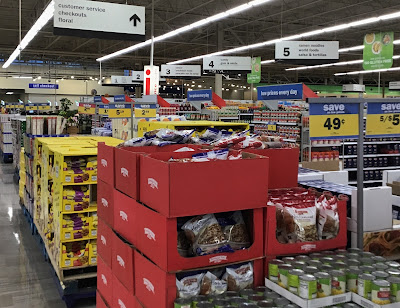
Well stocked grocery-super store after Christmas holiday


palettes of food and drink fill the extra-wide space at the end of the normal aisles
Monday after 2021 Christmas on Saturday - so much in stock
When compared to the inventory size and variety at a convenience store or old-time "mom and pop" grocery store before the 1950s, the massive scale of the Superstore - combining general merchandise (department store) AND grocery store, along with pharmacy, automotive center, garden products - is really astounding for sheer abundance. This photo shows the extra-wide space for rapidly changing seasonal and specially priced goods at the end of the numbered aisles to the right and the non-grocery (department store) aisles left of this photo. For example, the stacks of packing boxes in yellow reaching from ankle to chest height offer bags of chocolate chips that are essential to the many variations on chocolate chip cookies. A shopper need only reach into the opening at the side of the carton to pull out as many bags as the wish. Not far away are 5# bags of all-purpose baking flour. Behind the lens is an ever shifting inventory of regionally brewed (craft) beer varieties. The numbered aisle to the right still add prominent display of featured items on the "end cap," but these massive pallet loads amplify the idea of "end cap" greatly, insisting on attention by shoppers since the cubes of product reach eye-level or higher and require care when navigating with one's giant shopping cart.

With so much space occupied, so much color, so much quantity of any given item in the grocery inventory, the general impression is one of abundance. If this is a feast for the eyes, then the visual effect can quickly lead to indigestion: Too Much Inventory. Projecting the full life-cycle of a foodstuff: it goes from source (field, ocean) to manufacture or processing and packaging and palletizing. Then truckers go from factory to depot distribution site before local delivery vehicles stock the retail level shelves. Once the consumer selects things for the shopping cart and either whiles away the time at checkout lane by browsing magazines and impulse purchases of candy and savory snacks, or else lines up for a turn at the self-checkout corral with one or two staff ready to trouble-shoot some of the scanning problems (alcohol sales requiring ID verification, mislabel/prices item, coupons not valid or not machine readable, double-counting of an item incorrectly swiped across the laser field, etc). Then, once consumed in whole or in part, the package is discarded and hauled away for solid waste (landfill) deposit, or sometimes it goes into the single-stream recycle curbside service in the city or town or countryside. In other words, looking back at this photo of such masses of products concentrated here, eventually each packet of chocolate chips will end up in a household within a 5 or 10-mile radius, then all these bags -once emptied- will end up during these next weeks and months scattered through the stream of solid waste carted away to the towering landfill ziggurat.

In summary, the scale and diversity of grocery (and department store) inventory today is astounding. Carts are scaled accordingly (the reverse of portion control: go big to encourage more buying). First-time shoppers can be intimidated as they gawk and wonder at the choices and the packaging volumes. Even long-time shoppers can sometimes express a slightly weary look, knowing how many steps their personal exercise calculator will record between arrival and checkout and exiting into the sea of cars filling the parking lot. Perhaps this kind of supply chain, display method, and business transaction is here to stay, forcing out of business almost all except the biggest regional and national stores.

19 March 2020

Pandemic thoughts - stockpiling food and master narrative

When faced with unknown events, people look for precedent or analogous situations as a ready-made source of how things will play out and where one fits into the sequence of actions and also to know what to be cautious of when seeking to minimize liability and other risk from the situation. The spread of the novel variety of the Corona Virus that causes the disease the experts have named Covid-19 began at the end of 2019 in SW China. As of middle March there are more cases each day in France, Spain, and Italy than in China's epicenter.
Saturday around 6 p.m. on March 14, 2020 in Grand Rapids, MI - bare shelves.
So far in USA the news media has focused on the locations that report confirmed cases; sort of like a weather forecast about where the (known) hot-spots seem to be. Repeated instructions to wash hands and keep them away from eyes, nose, and mouth emphasize the behaviors to break the chain of transmission by water droplets exhaled or coughed onto hard surfaces (72 hours of infection possible; 24 hours on paper or cardboard surfaces). And with the shortage of testing equipment, staff, and infrastructure the message has been that testing to know each region's tally is helpful for administrators who deploy resources efficiently, but whether one's own test is positive or not, the same advice comes into play: avoid contact with other people and treat the symptoms; otherwise just let time heal the infection. If fever is high and breathing difficult, telephone for instructions rather than to arrive and contaminate the clinical settings. But what happens after a person is (confirmed to be) infected? When does a recovered person go  back to "normal life"?

If it is true that children frequently have mild or no symptoms, young and prime-of-life people normally have tolerable symptoms (unless burdened by complicating factors from underlying health condition like high blood pressure, diabetes, asthma, and so on), then why should the entire country public and private sector close any public activity and retreat to dispersed (social distancing) configurations of work space and home life? The officially given reason is not to contain the virus, but to slow the rate of infection so that the life-threatening cases can be handled by hospitals, unburdened by surges in admissions of patients. By playing the inpatients across a slower pace and longer span of time, any surges and resulting loss of life can be minimized; the disaster can be mitigated by collective action and for collective benefit. In other words, the central organizing idea for nation-wide, indeed- cross-national coordination of effort and closures and social distancing is meant to preserve life of the vulnerable, including elders (age 60 and older).

Although the public messaging is aimed at individual self-interest, in fact most people in good health are not at risk to die from contracting the virus and letting the cycle of infection run its course. Instead, the coordinated effort and urgent tone of public news briefings and analysis is about the collective dangers to the whole of society. Without an "all hands on deck" approach, including all the public livelihoods like transportation, education, entertainment, dining, worship, hobbies, and workplace interaction, the virus could very quickly inundate all segments of the population and mortally affect the infirm, weak, vulnerable, and so on. By putting on the brakes to virus transmission, many individual lives will be preserved, and all the accumulated knowledge, social capital, and emotional weight can be protected.

The cost of ceasing most all of the normal movement of people and interactions closer than 6 feet of separation is very big since so many hover at the edge of bankruptcy, debt, and so on. Any interruption in health, working hours, and income rapidly destroys social order. In the USA as of March 19 there is rapid legislative action underway to disburse money from the central government to each tax payer and worker. Precise details are not yet confirmed, but the idea is for 1 round of checks in early April and another in early May. But perhaps there is a silver lining in the dark clouds formed by suddenly idling almost all sectors of the economy for an extended period of unknown duration: more people will acknowledge the inter-relatedness of the world economy and within the US society; and that this collective effort may not directly, personally, and materially affect one's own life, but there are indirect effects that come from preserving the weakest parts of the society and paying attention to each other's needs instead of dreaming utopian escapes of news echo-chambers online and chasing after yet another consumer purchase.