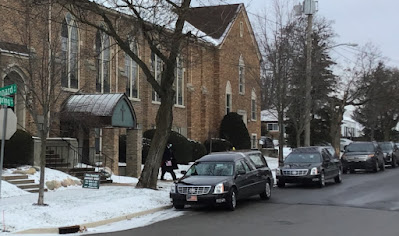
Late Wednesday morning, December 8, 2021, a funeral was getting underway. In the parking lot behind the church and the one across the street there were about 50 cars waiting to take people home or to the cemetery, if burial ceremonies were planned after the church service. In the context of 22 months of Covid-19 there is some chance that this life (or lives - since 2 hearses are positioned at curbside) was cut short directly by the virus, or indirectly that the hospital services were strained by the burden of unvaccinated people filling the hospital rooms and taking up the services there. But without stopping to talk to those present or searching for a published obituary, the cause of death is only guesswork.
The funeral hearse nearest to the camera displays the U.S. flag on the front bumper. Thinking of funeral customs for the other 200 national states, or for the many human societies that comprise the almost 7,000 languages that are spoken, surely this use of a national symbol on a personal and family-level matter is not common unless the deceased represents political leadership, national fame, or died in armed service (or veteran of military service). Without interviewing the owner of the hearse, its driver, or the company managers, along with the people attending the funeral, it is only speculation about possible significance (or more likely, multiple meanings) coming from the use of the national flag in connection with the dignified undertaking of funeral ceremonies and the safe conduct to and from the burial ground.
-Propriety (official, above-board, dignified, customary): This thread of meaning connects the person or business displaying the national flag to the country's wealth, fame, and all the life-affirming values that come with it. The darker chapters tend to fall into the shadows when the spotlight is fixed on the good things, though. In this photo, then, prominently exhibiting the flag (but not shouted loudly in oversize or multiplicity) assures like-minded people that the funeral company values and perhaps feels pride in belonging together with the present and the history associated with this banner. And for others who feel ambivalence about the mixed record of harm and healing carried out in the name of this flag, by displaying it out front, those who feel doubt will be put on notice that this vehicle and all those trailing behind it stand on the side of a positive accounting of the symbol and people connected to it.
-Authorized (halo-effect from close-association with the power of law and force): Seeing a flag in public as well as private spaces is a signifier that the proceedings are implicitly protected by the full faith and the rule of law of the land. In this photo, the presence of a national flag picture (or one made of cloth) seems to suggest that all procedures have been followed, duties fulfilled, and debts paid. No corruption should be suspected or expected or allowed.
-Conservative, button-down, standard-issue, government-conforming: Another meaning some will feel upon encountering a (USA; other countries have a different relationship of flag to citizens, no doubt) national flag is one of status quo; a sense that things will proceed as they have in the past. No erratic, strange, or outlandish behavior is likely.
-Vocation (former government work for local, state, or federal employer): Before the funeral owner opened the business, perhaps he or she was a federal worker and/or a member of the military. In that case the flag signals the person's (or the company's) organic roots with Old Glory. The flag is part of their past work.
-Avocational (proud of team USA, symbols, popularly imagined history): Even when a person or organization has no direct connection to federal or national services and products, perhaps they feel strongly about expressing allegiance to this "one country, under God, indivisible, with liberty and justice for all" (quoting the school child's Pledge of Allegiance recited many times). In that case, showing the national colors discretely in the panel reserved for a license plate in some states is an affirmation or aspirational statement.
-Personal history (recent immigrant or else a genealogy enthusiast with long roots in USA): The flag display on lapel, desk, office wall, or raised on a pole could also signify something particular for that person. For example, a "new" American may have come via career path and advanced studies, as an asylum seeker or refugee of disaster, or as family member of someone previously establishing American citizenship by birth or marriage, for instance. In that case, a sense of ownership and belonging and gratitude, among many other possible mixed feelings could be carried by the visual presence of the banner. In a related but different way, someone who has looked deeply into family histories may feel a multi-generational sort of loyalty or allegiance to the many people, places, and things symbolized by the flag.
-Personal identity (define and view oneself by the category of flag and anthem more than by local ties): Some people see themselves, and are regarded by others, as a patriot and outspoken supporter of the things that the flag stands for in that person's mind. Others downplay their national citizenship and the source of their passport and build their identity instead on a foundation of the wider planet, or conversely, on a foundation of the immediate surroundings of their town or county. However, for the person who wants to be known, and feels most satisfied in seeing herself or himself, in national terms, then displaying the flag is a particularly personal statement; a sort of credo for who they are.
This list of possible meanings conveyed by a public display of the United States flag is not exhaustive; there are probably other sorts of significance being purposefully or subconsciously expressed when making a decision to put a flag on view. Realistically, the uppermost meaning in the eye of the beholder, the eye of the one displaying, or in the mind of others just passing by will be a combination of factors rather than a single dominant meaning. And for complicated, context-dependent meanings, it may well be that much lies underwater, like the bulk of an iceberg: part can be seen and discussed, but the greater part is unseen and is hard to put into words. So, directly asking a person what comes to mind when they see the flag might only turn up a few meanings or hints of meanings rather than a fully formed verbal response.
In any case, though, for the funeral company staff their minds are focused on providing professional and personal care for the people in mourning. The attention of the family and friends participating in the ceremonies is occupied with the events as they unfold minute by minute, the feelings that come up in themselves and in those nearby. It is probably only in the mind and lens of a passer-by that such considerations about the meanings of the national flag are studied in reflection. And yet, even for the funeral workers and the mourners, at least a little of the flag's presence and the meanings it triggers will be present, whether or not they stop to imagine the many kinds of meanings that arise when personal life and national symbols meet each other.

