![]() |
| DIY book lending station at Calvin University's Hekman Library |
Postcard-sized observations taken from daily life: "When a man understands the art of seeing, he can trace the spirit of an age and the features of a king even in the knocker on a door." - Victor Hugo
CLICK photo for full-size view.
see also anthroview
Also anthropology clippings
07 February 2025
College students borrowing books then and now
30 January 2025
Prices go up for ingredients at the bakery
![]() |
| Day-old baked goods rise in price since costs are going up |
Talking with the clerk further, it turns out that certain parts of the display case of pastries sell out sooner than others, depending on the day and the time of year. But in general, the fruit tarts and the cannoli with one end dipped in chocolate sell out soonest most days. Ham and cheese croissant sandwiches are very popular, too. Turning to the bread racks, the plain loaves (San Francisco Sourdough; Country French) are in high demand, but they are also at the lower end of the price scale. Two of the breakfast breads seem to sell out quickly, too: English Muffin Bread, and another laden with dried fruit called Breakfast Bread.
The high-end bakery is in a curious position: customers are loyal. They value the full-bodied taste of the baked goods. And at least some of them are not price sensitive; they'd likely buy the same as always no matter how much the prices rise. So while the range of products spans the staple (daily bread, albeit premium ingredients and pricing) to the luxury (diverse pastries), somewhat similar breads and sweets also sell in convenience stores, big box retailers, and grocery stores. In other words, what the premium bakery sells is not so much high-quality ingredients as the care, handmade process, and smaller scale compared to factory bakers. So the loyal customers are in a relationship or community experience. They know their purchases sustain the model of high-quality baking traditions and the people busy behind the counter in the process of making more.
29 January 2025
Deep-fried tubers hit all the right notes: hot, crisp, fatty, and salty in the same mouthful
![]() |
| side order of french fries with the chicken sandwich (1/2025) |
In the feudal years of Japan it was a luxury reserved for people of certain status in the public pecking order to eat foods deep-fried in pools of heated oil: tempura (a batter and method taught by the 1500s Portuguese visiting Japan) and later other forms like Kara-age (chunks of chicken battered and plunged into boiling hot oil) and Age-dashi Tofu and abura-age (again, deep-fried). But in 2025 USA there is deep-fried food everywhere you turn; so much so that it is ordinary (not for special occasions like 1800s Japan).
When french fried potatoes seems dull or routine, some will opt for more creative forms like sweet potatoes that are cooked in the fryer. Or the slender fries from Russet Burbank potatoes may be prepared in unexpected shapes: chunky (cottage fries), with skin on (rustic), in lumps (American fries), or shoestring (thinnest of the long strips).
For people who only enjoy the deep-fried tubers once a month or so, due to dietary, availability, financial, or philosophical reasons, there is something particularly satisfying about facing off with a portion of fries recently out of the fryer and salted neither too much or too little. Thinking about the mouth experience of those freshly served fries there are several dimensions of the eating experience that intersect in that sensation of bite and chew.
First is the color and texture and temperature: tactile senses are engaged to begin with. Then there is the taste of salt and the sensation of heat radiating from the fries newly out of the oil. Upon biting the slender fries down to chewable size there is the crunch (ancestral delight in crunching on bugs?) and the contrast of crisp exterior versus soft interior. Finally, there is the sensation of the oil emanating from the cooked surface of the fries, tickling the primitive part of the brain, eager for fatty foods.
Taken all together, fresh fries combine so many dimensions of flavor that the result is particularly satsifying. And then some people will gild the lily by introducing various condiments to the fresh portions: mayonnaise (made famous by the Belgians), traditional tomato ketchup or one of the many variations, shredded cheese and gravy (made famous in Quebec: poutine). Thank the New World (Andean civilizations) for cultivating the hundreds of varieties of potato. But thank, also, the many local adaptations of the humble spud to deep fry in many ways; indeed, not only deep fried but in the myriad other forms it can be eaten, too.
20 December 2024
Exploring rural west Japan on bike: three cameras, four hours, 123 pictures.
After a week of rain and unseasonable cold, the weather forecast gave everyone the promise of a dry and sunny day before returning to the regularly scheduled program of cold and wet. So I stopped at the JR Takefu train station to find the rental bicycle services that often can be found in Japan. The electric and non-electric bikes there were fitted with devices requiring a downloaded smartphone app as well as credit card to make electronic payment. Rather than lose precious daylight on the eve of the winter solstice, on the advice of the tourist information person, instead I walked five minutes north of the station to the terminus of an electric tram company. They have fewer bikes and all of them require pedaling. But for 100 JPY (less than $1 at the 2024 exchange rate) it is how I covered many kilometers between 9:30 and 2 p.m.
![]() |
| examples from the toy camera's lens, far from high-definition or true colors |
One camera was in a chest pocket of my padded vest. The bigger one was in the outside jacket pocket. The cellphone rested in my rear pants pocket. The division of labor between each camera tended to follow a pattern. The project theme is old buildings and places of human activity. So the enthusiast camera (Canon g9x-ii) mostly recorded those subjects (see thumbnails, below). But the toy camera's strength is its lack of details (see thumbnails, above): only the main geometry and masses of light and dark, color patterns and dominant shapes can be recorded pleasingly; but not in contrasty light or low light. When there is plenty of illumination, and especially when it is indirect or comes through cloud cover, then the best results turn out. Treating the toy camera (Pieni II) as something like a watercolor brush helps to match scenes and subjects to its lens.
![]() |
| subjects for the Enthusiast Camera (1" sensor size) |
![]() |
| close-ups, panoramas, notes on lunch menu, emergence of Christmas displays went onto the phone |
11 December 2024
Putting ballet on stage in west Japan at the city's Culture Center
![]() |
| Minutes before Nutcracker Suite begins - no cameras allowed |
The Kyiv Classical Ballet Company entertained a big audience on Wednesday night with their rendition of the Nutcracker story set to P. I. Tchaikovsky's music. Since no recordings or cameras were permitted, this snapshot before the curtain rises is a writing prompt for the impressions of a newcomer to the dancing stage. In no particular order several thoughts came to mind, beyond the visual splendor, the athleticism of men and women, and the overall gestalt of High Art.
Logistics must be mind-boggling for a stage of 25 to 30 professional dancers and the supporting colleagues for costume, lighting, direction, make-up, physical conditioning/injuries, travel details for lodging and meals, and so on. And for long tours there may well be personality conflicts, entanglements, and spill-over of home and work settings. On the surface there are highly trained minds and bodies moving rhythmically around a stage, usually accompanied by music, but even without the music the visual "music" is a sight to see.
The Nutcracker and its Russian music may carry added meaning in these times of Russian invasion of Ukraine, ongoing since February 24, 2022. The military draft age of the male performers may give them an awareness that they are expressing the creative powers of the nation instead of wearing a uniform. At the end of this show on the Japan tour, the flags of Japan and of Ukraine were featured during the curtain call. And one of the scenes in the first half included a costume that mimicked the blue (above) and yellow (below) of the national flag of Ukraine. One of the backdrops had a prominent gold and blue look, as did the light pattern on the Christmas tree at the center of the stage. Perhaps the performance is so much a part of the Christmas season in Ukraine, that the Russian elements are not viewed as such. Or the way it is conducted in Ukraine may produce a locally inflected interpretation so that it has become domesticated to the Ukraine audiences and dancers, leaving little trace of the Russia connections.
When it comes to rehearsing, choreographing movements, creating the sets and fitting into the music, there are all kinds of social relationships and statuses being negotiated. The idea of "prima donna" (first woman/dancer) comes from the ballet world, where one dancer stands out from the rest. Audiences of newcomers or seasoned ballet watchers may focus on the main characters, but all the others on stage contribute to the whole, as well, even if overlooked in the passing minutes of the plot.
If the originator of the story and music and the stage adaptation from long ago could see the modern interpretation now, it would be interesting to ask about impressions of the way that ballet companies present the work now compared to before. But it would also be interesting to ask the creators long ago how the vision grew and changed between first imagining and finally drafting the version performed still today: how did it change along the way?
As for viewing the performance with the rest of the audience, an experienced ballet enthusiast will no doubt look for (and discover) things that a first-time watcher may not see or hear. And in the eyes of a former dancer seeing the new generation do the same story, it would be interesting to know how it looks.
In the end, the simplicity of dancers moving around the stage and the complexity of so many lives involved on stage and behind the scenes (now and in generations before and after the present moment) make for enjoyable viewing and reflecting on the storyline, but also on the production to make everything come together to delight audiences.
07 December 2024
Temple visit of many layers - Eihei-ji monks, tourists, pilgrims, and townies
![]() |
| Rainy Saturday in December for visitors to temple grounds |
An extreme case of interpretive lenses would be to use the "Rashomon effect" seen in Kurosawa's movie, itself an interpretation of Shakespeare's Hamlet, and tally up all the individual perspectives of the temple and its town on this day and also in a longer, longitudinal time frame. Countless experiences would fit into that kind of approach since each person's location within their own life shapes their field of view and the frame that they see the place and themselves within it. But taking a more modest layering of experiences, the following come to mind. One is surface impressions; what an observer might learn simply by watching and occasionally asking questions about the temple life and town activity, too. Another is an eye on the visitors - religious or sight-seeing or another other sort (experts of architecture, history, chanting, or traditional arts incorporated into temple lives and cycles of activity. Then below these observable patterns and practices there is a third layer; what the temple residents, staff, and leaders think about - how they use time and talent to carry out the things significant to them. Likewise for the several varieties of visitor, but also town residents; there is the layer of what this group of people understand of the place and the things they see or take part in. Finally, there is the layer involving the author of this blogpost: looking at the place from the time of arrival on the day's first bus at 10:18 to the departure on the 12:30 return, there is the layer for picking apart the previous four layers before making a statement or interpretation on top of all those others; an interpretation about the other interpretations all jostling side by side.
Clearly, there is no single interpretation of the Eihei-ji (永平寺) temple town. Whether it is a simple fact like the arrival of the 10:18 bus from Fukui station, or it is a whole day of Matsuri (annual festival), the several layers described here --and likely others by historian, journalist, novelist, religion researcher, and so on-- all figure into the total experience at hand, no matter if the reference is minutes, days, or decades. So while this short walk through the many points of view intersecting at Eihei-ji town and temple does not lead to a firm conclusion, illuminating cross-cultural comparison, or a crystal clear analysis of interplaying and evolving viewpoints, by identifying some of the moving parts in this picture, the complexity at least can be acknowledged.
26 November 2024
40 years after first setting foot in Japan
![]() |
| champon ramen near JR Hita in Oita-ken |
Summer of 1984 was the start of a year-long contract in the local school district's middle and high schools of Fukui-ken. Now in the fall of 2024 my Japan interests continue to grow and expand. Leaving aside the many changes in the world, and the ways that Japanese lives have changed in those generations since 1984, too, my own expertise in language and society has increased little by little; most rapidly and widely during the dedicated years of graduate school, ethnographic fieldwork, and writing, but also at a more gradual pace since then by meeting others working, living, and researching in Japan or about the place and lives there.
Pausing between bites of piping hot noodles on a rainy November afternoon, the passage of decades and the present moment of savoring freshly prepared champon ramen come momentarily into sharp focus. It is not as if those many hours of language study and initial model dialogues were leading up to a hot meal in this part of Kyushu. But then, again, in some ways the accumulated experiences, study, and observations do figure in to each successive moment in the days going forward. So, yes, in that sense, the 40 years did lead up to the first bite of ramen this afternoon!
The first semester college student in Japanese 101 with the Mizutani textbook of the 1980s open to see what topics and vocabulary appear is very different to the gray haired guy content in his choice of the noodles in rich chicken broth and smothered in a mishmash of vegetables and animal products. Back then the idea of traveling to a town for the first time, making all arrangements for transportation and lodging and budgeting enough cash might have been daunting. But now it all seems much less formidable. What once might have seemed strange at worst or exotic as best now feels pretty normal or even ordinary. Although far from native speaker fluency in oral skills and even weaker in literacy, generally being able to understand the speakers of Japanese and making myself understandable in return is not a big source of anxiety like it once would have been for a first semester college student. Let us hope for many more weeks and opportunities to explore parts of the islands new to me. May the learning ever continue.
18 November 2024
Web of financial complexities in consumer lifetimes
![]() |
| Advice to customers of retirement accounts, 11/2024 brochure. |
This screenshot is a simple overview to the kinds of financial decisions that many people should be aware of. There are lots of poor people for whom such things may seem irrelevant or alien to their experience. But for many others a failure to think through options, obligations, opportunities and other factors leads to losses, or at least foregoing of possible gains and costs to reduce or avoid altogether. In other words, the landscape of financial life in 2024 is altogether different to 1824 for many, many people; some more complicated than others. For the poorest, perhaps the difference from 1824 to 2024 is not as big, though. Looking in the opposite direction, not to pre-Industrial social experience of going from birth to the end of a long life but into the future, maybe the current range of complications will persist. But maybe there will be even more forms of payment and commodification of daily life needs. If that were to be true, than what today seems already too complicated, by comparison, will be viewed as "the good old days."
05 October 2024
From nature's landscape to cultural landscape
![]() |
| Neighboring images for October 4, 2023 flickr.com/explore |
When displayed adjacent to each other, these four images suggest a long arc in the changes between people and their environment. At top left is an image of artificial illumination under an ocean of stars (1-Million-Star Hotel). This could stand for human use of fire for light and heat and cooking and to modify bone, stone, ore and other materials. Next is the prominent soaring geological feature spotlighted by evening sun (Desert Drama). This is a large structure, but one not built by human hands. Compared to the first photo, this changes the scale of meaning from the campfire to something much larger to which stories can be attached and events can be referenced. Turning to the bottom right photo (St Cuthbert's), the sturdy place of worship is made of cut stone for wall and rooftiles. This is the work of architectural traditions inherited from the ancient Romans and the Greeks before them and requires not only knowledge but also logistical trains from quarry to cutter to builder, too. Lastly, there is the multi-colored, multi-storied grove of towers that hearkens to ancient trees reaching far above the ground (Singapore - Garden Rhapsody).
06 September 2024
Yard sign rhetorical style - USA Presidential race 2024 September
![]() |
| Trump (keep American great) at left; Harris (obviously) at right |
Less than two months from the national election, a display of yard signs is spreading ever so slightly; perhaps one public display per 50 houses around the city of Grand Rapids in the first week of September. Although the photo collage shows only two varieties of the basic formula of name + patriotic colors and stars, there are variations on this theme, and it does provide a good illustration for several points. One, the Harris sign is near the sidewalk and road so passersby can get a good look. The Trump sign is guarded near the resident's house, far from the sidewalk and the attendant risk of being vandalized, dabbed in graffiti, or otherwise insulted. Both put stars on their message: 7 for Trump and 9 for Harris, in this case. The message designers for Harris give equal size to both people. Trump signs (not the one here) with running mate JD Vance put his billing under Trump at a smaller size. These graphic design decisions seem to suggest non-verbally that status differs: equal status for the Democratic ticket, deference to Trump as being paramount for the Republican ticket. The punch line under the candidate names follows a different logic or taste in each case, too: "keep American great" for Trump is a riff on the 2020 pitch of "make America great again" (MAGA abbreviation), which ironically seems to endorse the Joe Biden administration in choosing the word choice "keep" American great. In other words, "let's not change the White House leadership." On the other hand, the punchline on the Harris yard sign could be heard as sounding smug or dismissive: 'obviously' suggests that no serious alternative could possibly be considered.
Elsewhere this same week there were yard sign variations, but still keeping the stars and the color scheme. "Take America Back" as a substitute punch line for the Trump sign. A letter-size (A4) Harris rebuttle gives its punch line, "Not Going Back." A normal size yard sign gives "Truth * Hope * Decency" for the Harris sign's punch line. In just about everything coming from Trump's mouth, imagination, or minions there is a strong irony - intended or baked in unknowingly: while one thing is declared about the opponent's shortcomings, very often the same words could be mirrored back onto Trump, too. When banned from using Twitter for a few years, Trump launched his own Twitter-like platform, curiously dubbed, Truth Social. By now the suspect nature of all social media and its murky flooding by bots and trolls intending harm makes the idea of "truth" and "social media" often incompatible. Appropriately, such murkiness seems quintessential of Trump's (public) life. So while the Harris yard sign declares "truth * hope * decency," the Trump campaign clings to their "Truth Social" messages, even now that Twitter's owner has dictated that Trump must be allowed to use the Twitter platform, again.
In summary, political campaign yard signs sprout in the months leading up to the primary election and a few months later, for the general election. The design elements, arrangement, and choice of words - their placement - their sequence and relationship to the rest of the elements all speak to people who glance at them while passing by. Even the placement of the signs seems to communicate a message, too. In total, only a fraction of the city residents does display signs for one or more office candidate. Whether the visual representation of candidates motivates or reminds passers by to vote or not is difficult to document or prove. But whether the signs affect the voting outcome or not, they are a normal part of the recurring election season and provide a small window into the thinking and assumptions and aspirations of candidates and the individuals and organizations supporters.
31 August 2024
Pleasures of drinking fancy coffee outdoors among others
| Downtown Grand Rapids on Labor Day weekend at 9:30 a.m. |
28 August 2024
MUGGL3, SRV GOD, FURSHR (automobile vanity plates)
Seeing personalized license plates can sometimes stir thoughts while decoding the meaning is finally solved. Many plates are simple affirmations; e.g. Bible verse (MATT3 14), college cheer ("go State" for Michigan State University's collegiate sports teams), or friendly exhortation ("smile"). Others are cryptic of personal incident or reference point, maybe a personal motto or philosophy. The license plate today in the coffee roaster's public parking lot, (MUGGL3), is a reference to the non-magical characters in the world of J.K. Rowling's Harry Potter series. Her spelling is "muggle," but often a desired vanity plate substitutes numbers for letters because another person previously laid claim to MUGGLE, for instance.
| Spotted in grocery store parking lot, "serve [your lord] God" |
Apparently, some combinations of numbers and letters are banned if profanity or another kind of provocation is likely to come from it. But that leaves many ways to arrange the letters and numbers (maximum 7 spaces to fill). And because some themed license plates (college colors and logo such as block 'S' in green for Michigan State University) allow a person to elide the vanity plate word or phrase together with that theme letter, the normal limit of 7 numbers or letters can 'borrow' that initial colored, theme letter. As an example, the resulting plate could read 'S't8is1 for "State is [number] 1 [ranked]." Also in this example is an illustration of 'borrowing' the sound of a letter or number to stand for a word such as "8" for "ate" (instead of the normal "eight"). Another common one is "for" read from the '4' and "to" read from the '2'.
The website for the State of Michigan's office of Secretary of State [for motor vehicles] gives the following advice on Personalized Plates.
Plate may be personalized with up to 6 or 7 characters, depending on plate type. All plate configurations are based on availability and are subject to review by the Michigan Department of State. The department has the authority to decline to issue a configuration, per state law.
- Only use letters A-Z and numbers 0-9 (symbols cannot be processed)
- Spaces are allowed and are counted as characters
- The letter ‘O’ is substituted by the number ‘0’
![]() |
| Phonetic spelling of "for sure!" exclamation. |
31 July 2024
Drone lens to see above the treetops
![]() |
| About 80-100 feet above ground level in downtown Grand Rapids, Michigan on July 31, 2024 |
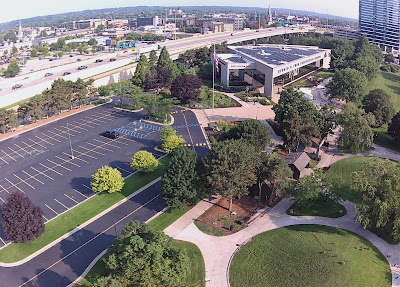
After a lifetime of composing pictures and viewing pictures from eye-level and using a viewfinder or digital screen, the experience of flying a sub-250-gram camera drone (not subject to FAA licensing; most places restricted to 400 feet or lower, according to published maps for drones) takes some getting used to. It takes time to gain reliable competence to launch and recover the pocket-sized quadcopter. And it takes time to know how to set the lens angle and the frame before capturing a photo or recording video clips. Although this model (Holystone hs175d) allows software and smartphone screen to show the camera's point of view, by flying blind with just the handheld controller and estimating the heading of the lens, there is less technology to coordinate and to slow down the set up, launch, and return to land. In addition, by not seeing what the lens sees, there is an echo of the roll-film era of photography, when it took a few days (or "1-hour photo processing" while you wait) before the resulting image could be seen.
Learning curve on this hobby drone camera
Being very light-weight with small battery, usable for 15 or so minutes per battery, and with modest lens and small digital sensor to capture the images, best results come from several tips discovered by practicing. (1) Abundant light falling from side or behind the lens puts the scene in best view to record detail and mostly accurate colors. (2) Preflight visualizing the launch site and center of the photo to compose before releasing the shutter gives more deliberate photographic results, and it reduces in-air dithering as the battery runs down. (3) Before launching (checklist): unfold controller grips and antenna, power it on. Unfold drone struts and power the drone on. According to the manufacturer steps: pair the controller to the drone, activate the compass (involves a long-press button, then rotating on two different axes), then wait for lights to change from red to lime-green (signal that GPS signal is found). During this minute or two, decide the lens position (0 to 90 degrees relative to the horizon). Since the full travel from pointing straight ahead to straight down is about 45 presses of the controller button, a landscape is best about 5 or 6 clicks under the horizon (straight ahead) position. For subjects very much in the foreground, maybe 14 to 16 clicks will frame everything best. Then reset the gyro and finally unlock the motors so they can spin and so that the auto-launch button can put the drone at a 6-foot hover position. (4) Tripod in the sky is one way to imagine the drone camera: launch and then, like an elevator, go straight up (rather than traveling laterally to hard to reach spot, say) to take pictures at different altitudes (beginner mode caps the ceiling at 100 feet/30 meters, a distance from the pilot that still allows the drone's lens/heading to be seen). Rotating the drone 2-clicks of the joystick will move the center point of the photo frame about 20 or 25 degrees, thus allowing a sequence of shots that overlap. (5) Limitations are good to know, too: wind that is able to move the treetops is too much to fly in. Rain also is ill advised. Extreme heat or cold diminishes the battery power, too. Even with minimal wind, lots of light, and moderate air temperature, though, being too hasty to pivot the lens and then shoot the picture can give tipped horizons, since it takes a second or two to regain level composure. In other words, whether recording moving or still images, it is important to turn the drone and then wait a few moments before pressing the record button on the controller. (6) Landing (checklist): Normally, the GPS launch point is faithfully homed in on, but sometimes unexpected puffs of wind, or a particularly hazard-filled site calls for extra care to ground or to catch the drone - being ready to make micro-adjustments before finally pressing the Auto-land button and then after reaching the ground and props no longer spinning, turning off controller and turning off drone, folding the four struts of the propellers and then returning to the storage/carrying bag.
Seen all together: the drone photographer arrives at preferred launch site, free of overhanging branches and wires, and so on. The person unpacks controller and drone to prepare for (auto) launch. Once in the air, the pilot quickly presses the altitude stick to elevate straight upward. Once at the chosen height and pointing the lens at the center of the composition, the photographer waits for two seconds so the drone settles relative to the horizon, rather than tipping to one side or the other. Snap a photo, then 2-clicks of the joystick to rotate away from the first center point. Wait 2-counts to settle and then snap the next photo. After enough shots are recorded, then the drone comes down the way it rose: straight down the invisible elevator shaft. At eye-level, press the auto-landing button to make a soft landing and turn off controller and drone. Elapsed time to unpack, launch, ascend, snap a series of shots and/or video clips, descend and reach the land could be 8 to 10 minutes all together.
![]() |
| looking north near the Grand River, Ah-Nab-Awen Park & the Ford Presidential Museum |
Reasons to record the land and people from above the treetops
Before the invention, proliferation, and interest in pictures and video from the air, it was only airplanes and helicopters (and hot-air balloons) that made this birdseye perspective possible, limited to those with a big budget or good connections with pilots and photographers. But in 2024 there are now many tiers in quality of drone camera available new or used, suited to a variety of purposes and abilities. Some are made to be fool-proof with pre-programmed menus of pictures to take. Others allow the pilot to make most control decisions, just automating the orientation to horizon (remaining level) and the launch/landing phases of flight. The camera itself often is similar to a "point and shoot," leaving the composition frame and altitude to the flyer, but the exposure and shutter and ISO (sensor responsiveness to light values) are auto-determined. In this article the camera is on a hobby drone of around $200 new and weighing less than the FAA license limit of 250 grams. For the purpose of learning to fly and to visualize things to photograph from the birds' point of view, this UAV (unmanned aerial vehicle) is entirely satisfactory. For profession filmmakers, though, it falls short in many ways.
Unlike the visual frame at ground level, being now up in the air the context suddenly is many times wider and deeper. So the pictures taken at 30 or 60 or 100 feet put the horizon farther away than the ground-level or rooftop window height. For face-to-face subjects or macro details, there is no benefit from a drone camera. But for big cultural terrain, large patterns and relationships, and "establishing shot" introductions to a place, the viewpoint above ground level is superior. Even large indoor spaces can sometimes benefit from a lens that is 20 or 40 feet above the activity, below.
Besides the content recorded from the air, another benefit is the comparative one: the viewer may already have on-the-ground experience of a place or a subject matter, but by layering this new perspective onto that first-hand, up-close knowledge, the person now gains a point of comparison, thus making the earlier vision become a comparative one: knowing it in stereo instead of in mono.
Some aspects of a subject or a place may simply be invisible or too big to appreciate in the eye-level scale of encounter. Only by having the (aerial) distance can the scale of a thing be understood. For example, some things can best be grasped from the air, such as a massive factory complex, port facility, campus, or site of natural (or human-caused) disaster.
Finally, there is freshness and novelty that comes from seeing something from an unaccustomed standpoint. Even if it is something as well-known as one's home or workplace, that deep familiarity can make the thing uninteresting, ordinary, and rarely perceived objectively. But by seeing it from the air, now it becomes unfamiliar and some of the contours and connections to adjacent things come to life.
In conclusion, whether it is a hobbyist keen on flying or one keen on photography (or both) or it is someone with professional interest in drone photography (city engineer, military corps, land surveyor, social scientist, historian, novelist or journalist), the practicality of having an "eye in the sky" now makes uses for drone photography relevant in day-to-day operations and routines. It can answer old questions and lead to new questions. It can be the instrumental knowledge for decisions today, but also be of value when future generations look back to explore our moment by using UAV archives like these. So, more and more drone photography should be encouraged and supported for immediate benefit and for future uses, too.
CAVEAT: like anything else human-created, this visual tool can be used not just for good, but can also be abused for bad purposes. So, infrastructure that a terrorist or far-away government may want to scrutinize with a view to harm should have special protections so that imagery is not online readily findable.
20 June 2024
Over the top - WWI ordinary men now dressed up to die
| Trench warfare (p.275, Britain at War; 2004 Richard Holmes) |
Turning an anthropological lens on the moment captured, it is possible to imagine the layers of meaning attached to the image and the lives recorded in the click of the shutter. The photographer likely waited for a lull in shooting before quickly setting up the composition and exposing the film from this position above the relative safety of the ditch. He probably had an assignment or deadline to photograph and create prints for a newspaper or magazine. In the eyes of the soldiers, the stranger was there one minute and gone the next, having stolen a few glimpses of the location and those assigned to stand in harm's way. Some readers of the newspaper or magazine may have studied the image in search of a familiar face. Most readers, though, glanced at the image only long enough to take in the overall feel of the crowding, danger, and dirt. The photo functioned as anonymous illustration rather than documentation of a dear family member known personally or more casually as an acquaintance. People in 2004 when the book carrying this archival image was published may think of a grandfather or great grandfather touched by the events of July 1914 to November 1918. Other present-day viewers may drain any personal details or meaning from the troops wearing the British uniforms and perceive only "the army," forgetting that parallel meanings and dangers persisted in the other armies entangled by the military alliances obligating them to enter the armed conflict on one side or the other at great cost.
As an exercise in meaning-making, reviving the humanity of the people recorded on the print, there are several layers to peel away from the 2004 reprint before arriving at the moment that the photographer composed the image and snapped the picture, freezing it for all time, making something viewed generations later, long after the subjects were destroyed on the mud or died from wounds soon after the attack or at a later date. One layer to remove is the 2004 book: stripping off the text that frames page 275 and the caption assigned the photo. Suppose that you have the original photographic paper showing the scene and dating to a day or so from the time the image was recorded. Holding that vintage photo paper is a tangible link to the photographer's hand and by proxy, also, to the brief visit he made to the trench to capture the scene for readers. Probably something analogous was happening in the trenches of Axis armies, too: photographers preparing images for readers back at home.
Now diving into the frame of the photo to arrive at the muddy ground itself, what kinds of meanings are mingling around the time that the photographer comes upon the view? For an outsider, maybe like the photographer, the sights and sounds and smells are anonymous of "all soldiers universally" or at least all those dressed in the British Expeditionary Force clothing. But to all of the men in the photo, there is some relationship to each other: impersonally at the level of rank and military code of conduct including rules of engagement, at the organizational level of a fighting group such as 4-man squad, personally at the interpersonal level (some joined in whole neighborhoods or workplaces as "pals" to go through training and deployment without being separated from each other, except by injury or death), and some built new friendships in the course of training or deployment in the heat of danger. Among those recorded in this fraction of a second, many would be on a first-name basis, and to greater or lesser degree they might know something of the other man's family and hometown, along with personal habits and dreams and memories. In other words, what at first glance is an old black and white photo of a faraway armed conflict leading only to destruction, upon closer consideration is a bundle of interrelationships and personal meanings mingled with uncertainty about their chances of surviving the next hour or day or week. Formal structures of control and command jostle with seismic rumbling underfoot coming from existential doubts and suspicions and worries: amplified meaning from rules are cheek by jowl with expanded perception from the meaninglessness of events. Service to the nation (or at least to one's fellow trench fellows) on the one hand and extinction of self or others on the other hand.
In the end, this photo has now been republished over the decades and surrounded by the words of various authors with or without direct, personal experience of trenches and friends killed by obliteration or gently in an instant or slowly one mustard gas lungful at a time. Depending on the placement and size of the image on the page of text, readers may or may not glimpse something of the original meaning when the men were frozen in time. Only those present when the lens clicked can give a first-person account of the time that photographer framed a shot and then was gone, but to them this scene was more of a family photo than somebody's newspaper illustration or something to add visual interest to history textbooks of generations to come.
Perhaps there is a way in 2024 to honor those in the composition, and to honor the one making the image for others to see, and tacitly also to honor the brothers in arms in the opposite trenches facing those shown here. Rather than to dismiss the old-timey uniforms, doctrine of digging trenches for defense, and deadly but (today) outdated arms, taking the time and supplying the imagination in order to give them personalities, names, humanity, and connections with others; to see them as people only temporarily installed as soldiers but in the whole as being much more than name, rank, and service (serial) number. Allowing belligerents of all sides to be whole persons instead of cardboard cutouts and caricatures restores some dignity and agency to what turned out to be for many of them a violent death and hope-filled life cut short. In this photo, it may well be all were dead or wounded only hours following this photo, or became casualties maybe within a week or two.
19 June 2024
Unhoused, homeless, or by any other name - sleeping outdoors
| Around 8:30 Wednesday morning, traffic on right, walkers on left [click for full size] |
Having no fixed abode or address has consequences large and small for people in 2024. Shelter from cold and wet and wind is one thing. Having a place to gather one's chattels is another. Personal safety, personal hygiene, personal memories/mementos also depend on having a place to call home. Being able to store food, then cook, eat, and clean up also depends on having a place of one's own. Without an address it is hard to receive deliveries and messages, as well as recharging cellphone or other electronic devices.
This picture shows somebody's private encampment on public parkland in Grand Rapids, Michigan, about a mile north of city center. The past two days have been blanketed by excessive heat (although tempered by cloud and moderated by steady wind) which is forecast to persist all of today and the Thursday and Friday, as well. It is not night chill to worry about, but distress or worse from humans, along with the burden of heat. At the moment rain is not a likely concern. But having no shelter means the weather and changing seasons dictate one's well-being.
Considering that fact that national wealth divided over the population gives a statistical "richest country on Earth" declaration, it seems unimaginable to see things like mass shootings, poor air conditions and water supply, bankruptcy by medical billing, huge illiteracy and low high school graduation rates, as well as persisting unhoused people on the streets (but also unhoused in rural counties, too). But once the "richest country" is factored by demographic segment, it is true that 1% of the population owns something like 50% of the wealth. Then perhaps the top 25% accounts for 90% of all the wealth. For the remaining 75% of people living in the USA the last 10% of the national wealth can be divided to give a figure that makes this country far from "the richest" country. Seen in that frame of reference, people living in cars and on the street and in parks or overnight shelters is not so surprising.
See also, https://en.wikipedia.org/wiki/Distribution_of_wealth#In_the_United_States
27 May 2024
![]() |
| Digital vs analog, smooth vs coarse: human vs non. |
After the night's rain showers the day breaks on Memorial Day, the Monday of the 3-day holiday weekend late in May. Rather than wait for the annual neighborhood waste collection (and electronic waste) day, somebody on this street has left the unwanted equipment at the curb as a signal that anybody can claim this, whether it is functioning or not. On sunny days it bakes, on rainy days it feels the wet.
This computer monitor is a pinnacle of human ingenuity, built from generations of high-level mathematics, materials engineering, design expertise, manufacturing and supply chains, along with the electrical engineering prowess. But seeing it juxtaposed by millennia of grass biology, rooted in its terrain and following the rhythm of the surrounding season prompts reflections about the contrast of digital thinking (all/nothing, on/off, zero/one, black/white; context mostly ignored) to the earlier and coexisting analog way (all parts connected by layers of webs; context is the foundation).
Consonant with the idea of hubris, of human overconfidence in one's own skill or the invincibility of technological solutions to any obstacle or threat, this image poses the question: will human economic activity extract life and value from the rest of the planet until, finally, human society disappears; or, instead, will humans find the ways to limit harm and impulses of advancing personal advantage at the expense of fellow humans and to the habitats of air, land, and sea where other living things exist. Excesses of extraction from natural resources, excesses of production and price reductions, and excesses of consumption (use then discard) lead to scenes like this photo: unwanted or superseded possessions littering the edge of one's property for others to claim for reuse, repair, recycling, or repurposing before the things or its leftover parts finally arrive at the final resting place (solid-waste landfill).
In the first generation of personal computers, the equipment was relatively rare, expensive, and well-cared for. Now entering the third generation of new PC users, the computing power, memory cost, and purposes that software can be applied to is much different. Universities and other knowledge-intensive sites of human activity have established 4 or 5-year rotation cycles to replace perfectly functional old equipment with new editions, so quickly do the advances eclipse the older models, much as predicted by Moore's Law. For early adopter's of home computing to see a sleek LCD monitor discarded casually like this would be astounding. By imagining a time 25 years from now with all the PC advances that go along with the passing years, perhaps even more astounding sights at the edge of streets will greet the viewer.
18 May 2024
Unneighborly verbal altercation - leaf blower sends grass cuttings onto parked car
![]() |
| Past the yellow fire hydrant two city police leave defendant to speak with plaintiff at nearby house |
A little before 10 a.m. on Friday the lawn mowing service had mown the client's grass, cut the edges, and was just about finished with the noisy, gas-powered leaf blower to dissipate the cuttings off the client's sidewalk and driveway. That is when the adjacent homeowner came striding with purpose to confront the man with the blower to express his offense at cuttings blown onto his car and driveway. The confrontation began at full volume: both the decibels and the choice of fighting words, rather than less accusatory word choice and tone of voice. So the worker being verbally attacked replied in kind, adding lewd gestures and posturing to amplify his replies. Back and forth the temperature of the verbal wrestling proceeded until the nextdoor man pulled out his cellphone to video record the worker and his vehicle before then warning him that the police would soon arrive, presumably to adjudicate the plaintiff point of view and perceived injury by lack of respect from the worker that he was aggravating verbally by assault.
This photo shows the two officers after hearing the worker's perspective. They already heard the plaintiff in his phone call to the dispatcher. It took perhaps 10 or 15 minutes from first threat from the plaintiff about bringing the police into the matter until the car arrived. First one uniform approached the worker slowly, in case the situation was explosive. Since the man was relatively calm, the second officer joined the first to listen to the account from the worker's point of view. What happened next is the two policemen went to the house of the plaintiff for further discussion. After a total of maybe 10 minutes they left the scene, the worker in his truck and trailer departing before that, having been told there was no more for the moment and therefore that he could leave for the next client's lawn.
Since the verbal bout could be heard at a distance, the experience as a spectator was worrisome. Since so many people have applied for "concealed carrying" of pistols, it is not impossible for one or both men to have been trigger happy. Nothing did happen with guns, although verbally there was gun banter. The whole episode illustrates something about city living, leaving aside its paperwork, communication snafus, and any additional procedural consequences.
In villages there are layers of family-to-family history, interrelationship, and shared stake holding. So conflict resolution by individuals or representatives for each side can typically come to some arrangement involving apology and restorative justice so that the offender makes whole the injured party or parties. But in larger urban settings the social fabric is held together by rules and ordinances and is enforced by professional law-keepers. Since most person-to-person intersections involve strangers, these formal systems and infrastructure is how problems are solved.
In the history of societies and their civilizations and languages, new words and rituals and titles and rights/responsibilities are created. In urban environments since the density of ambitions, greed, and dependence is much higher than in villages or tribes, there is a concentration of boundaries, differing opinions, and levels of experience in handling difficult topics and injuries - verbal or physical or financial. In the case featured above, one middle-aged or elder man felt injured when his property (car) was affected by the grass cuttings landing on his side of the property line. Due to this offence, he felt entitled to shout abuse at the one blowing the cuttings. Since the verbal attack was unaccustomed and unexpected, the worker's hackles were raised and he replied in mirror image by heaping abuse on the offended homeowner and then amplifying the venom for good measure. The next step escalated to requesting the services of the armed police. How the matter ultimately ended is not obvious, except that the police did indeed arrive in a timely manner and speak respectfully in word and by nonverbal communication (posture, eye contact, tone of voice and so on). Then the worker was released from waiting and the police drove away.
17 May 2024
National flag variations on a theme - speculatively
![]() |
| What looks black in this flag*could* be political expression, or maybe is simply a very new flag 5/2024 |
Without talking to the owner of this house and looking closely at the fabric, it is hard to be sure if the dark field for the 50 stars that represent the 50 states (though not territories or Washington, DC) is regulation navy blue, or instead is specially created with inky black to make some sort of statement about light-pollution and a love of skygazing, for example. For the purpose of essaying the many meanings and uses (and abuses) of the national flag, though, let us speculate with the assumption that, yes, this flag is made in red, white, and black. What are some of the possible meanings the homeowner wishes to show publicly?
From the October 7, 2023 terror assault from Gaza and continuing more than seven months to today, there is the plight of the Palestinian civilians (about 35,000 killed by Israel Defense Force activity, mainly women and children). Since college campuses in many parts of the U.S. have student demonstrations against USA contributions of weapons and intelligence and money to the I.D.F. there are also private property owners who express solidarity for (or against) Palestinian abuses in Gaza. Then there are also USA flag variations ever since the Coivd-19 lockdowns early in 2020: the monochrome flag with just one band of blue through the other white stripes to signify support and importance of (armed) police to the overall social stability. Another version swaps the blue line for a red one to signify firefighters and paramedics responding to emergencies. Once in a while a porch flies a 13-star, colonial era flag (stars in a circle, Betsy Ross design) to signify "getting back to purest, original principles of the Declaration of Independence, article of confederation and the U.S. Constitution" (implying that 2024 conditions and amendments and legal wrangling, federal budget size, etc are wrong). Much rarer are the "don't tread on me" yellow flag with the serpent made of 13 segments to show the power of the united colonies against outside forces. Also rare: flying the USA modern flag upside down as a signal of distress - not of the householder, but that person's interpretation of international headlines and domestic events.
Looking at the photo in this case, though, it is very likely to be a particularly dark fabric dye for navy blue; not a political statement or outburst of barbaric yawp that paints a dark picture against which the stars shine especially brightly. Playing with colors and symbols makes possible multiple interpretations; more than one meaning at the same time, depending on the standpoint of the viewer. This flag's condition could mean a range of figurative or symbolic meanings and also be nothing more than the buyer seeking out the deepest blue they could find for no other reason than to withstand fading of the sun in summer and winter, day after day. Still, there is some use in speculating untethered from the house owner's perspective. That is because the ocean of Internet, print, and broadcast information and entertainment intersects with education and personal reflection in any given moment's particular Public Discourse; a sea of meanings that exist simultaneously in the eyes of those expressing the matter and those reading or responding to the matter. By probing the many kinds of possible meaning, not just confined to the specific case of the particular person, the larger pool of images and words also can be joined.


.jpg)


