29 November 2019

Community Thanksgiving Dinner 2019

This year the 4th Thursday fell on November 28. Some organizations have offered the traditional Thanksgiving menu to the general public free of charge (or by donation if so desired) for dozens of years. Other organizers are more recent. The full menu includes roast turkey, mashed potatoes and gravy, squash (e.g. combined acorn, butternut, maybe hubbard varieties of squash + butter and sugar, salt and pepper), stuffing, green beans (in casserole or alone), cranberry relish and either pumpkin or apple pie for dessert.
typical plate heaped with the full menu and added relish tray vegetables
The biggest venues are able to feed diners and volunteers in the space of a few hours numbering 1,000 or more. Smaller or less well established community dinners might serve just a few dozen people. But what is common across these settings, apart from a similar menu, is that money and in-kind donations from local sources supply the materials, decorations, and sometimes the venue rental fee, if there normally is one applied. Furthermore, there is usually a great number of people or organizations keen to offer some of their time in the preparation, serving, or clean-up. The actual coordination, promotion, and soliciting of donations is carried out by a steering committee. It may well be common for one or more churches to directly support the meal with people to work, to dine, to decorate, and to clean up. Sometimes an optional (ecumenical) worship service of song, (e.g. Christian) scripture and commentary will precede the public celebration of the community spirit on the occasion of the meal, as in this case yesterday.
standing up to sing a few verses of the hymns
Depending on the community, there may be many who know each other by name or just by face. Others may be unfamiliar. Still others will be old friends of many years. In much bigger demographic spaces, there may be few people who the diners have seen here and there around the city. The atmosphere for dining is very rare; something seldom experienced outside of this setting: (1) there is no cost - unlike a restaurant there is no tipping, no assigned server to meet one's wishes, (2) there may be some familiar people sharing one's table, or it could be the others are strangers, (3) but the premise of celebration (as in an open-house for a new high school graduate; or like the wedding receptions that bring family, friends, and unknown people together) and the theme of Giving Thanks tends to set the atmosphere: to be friendly and helpful and respectful of one another. In other words, there is an expectation that partly binds everyone in the room together, despite the various degrees of familiarity or strangerness that underlies the relationships there: "we all belong to this community and can express our gratefulness in common for the wonderful food and hospitality being offered here and now." It is neither a business transaction, nor a private family gathering. Instead it is somewhat family-like and also a public good or common resource.

The photos here come from the Clinton Community Thanksgiving Celebration and Dinner, which began its first 10 years hosted at one church, then moved to a community hall, and now this year has grown big enough to fill the county 4-H fairgrounds building. In the first years the public perception was that a community kitchen or feast was characterized for poor people, individuals far from home and family, or for people finding themselves alone on the holiday. But from the start the organizers tried to promote a more inclusive meaning of the shared meal: not just a stop-gap or last resort when a home-made feast was not possible or desirable. Rather this offered a chance to feel joyful in the company of others. An analogy might be the movie theater experience versus the home theater experience. Somehow experiencing the program all together makes things different - not just bigger, brighter, louder, but also witnessed by people you know and others you don't know. But for a few emotional peaks you are part of a larger wave of feelings. Likewise, to feast with others is particularly satisfying. There is nothing wrong with dining at home or joining a few friends at a restaurant. But a volunteer driven, community supported, and publicly conducted celebration has very strong meaning and feeling: joy, gratitude, delight, surprise, satiety, memories and reminiscing, and so on.
serving line staffed with volunteers
Logistically there are sometimes too many people who want to volunteer; sometimes too much of a particular food (in-kind) donation; and sometimes a headcount that falls higher or lower than expected, and so on. Imperfect, though, the process is, somehow everyone seems to enjoy the meal, the interactions, and the achievement of the larger project. In the case of the community dinner shown in these pictures there is a strong connection to the town's food pantry. So any food that is cooked but not served will be portioned into storage containers to be frozen and offered to people who rely on the food bank to make ends meet each month. Similarly, food that was received but not prepared (in excess of the needs being planned for) also is given immediately afterwards to the food pantry staff of volunteers. So there is relatively little waste.

Some years to food preparation volunteers have reserved the peelings of vegetables to go to a local farmer's hogs. And cans and bottles can easily be set aside for the city's curbside recycling service. So far, though, paper plates and cups have been resorted to when the venue shifted away from the church and its built-in dishwashing equipment. So the feast does produce many bags of landfill waste. At the present historical moment that seems to be the price of producing a community dinner that fosters feelings of belonging together in a community. It will be interesting to see if vestiges of community spirit live on many years from now.
napkin prompts the reader to consider conservation of resources and energy

06 September 2019

Summer's final weeks - product life cycle: use and discard, repeat.

Summer arrived late and seems to be finishing early in west Michigan. The big yellow school buses are once more running in the morning and again in the afternoon. Some workers are setting aside sandals and short-sleeve shirts and donning their cool weather clothing. For the coldest mornings, outerwear is coming out of storage again, too. Meanwhile the plants and wrapping up their growing season and offering the fruits and vegetables in the harvest time. Seldom seen birds are just passing through on their cold season migration. A few people come to the fish ladder to see the migrating fish homing in on their nesting places upstream; other people want to eat the fish. (click photo for larger view)
two dozen fishers near the Grand River fish ladder angling for steelhead trout in migration
Insects, too, are getting ready for the shift from hot days to cool nights and temperate daytime temperatures. Some will escape from the killing frost by moving south; others hibernate or their eggs and larvae remain dormant until the Earth is ready for them to emerge again in the spring.
katydid collecting sunlight on dark windshield ahead of the cold season
Meanwhile, in the society of 2019 humans the habit of consuming and discarding continues. While a few people hoard things with a view to repurposing them, many more simply dispose of the unwanted item, as in this photo of an inflatable water toy. As a friend once remarked about solid-waste landfills around the country: these are not places of final disposition, but rather "long-term storage solutions" that relocate unwanted purchases, gifts, debris and refuse. The things may be "out of sight & out of mind" for the person who sets out a bag or bin for the collection service, but the cumulative clutter does not vanish in any final sense, it just moves from the consumer's curb to the city's pyramid of rubbish.
soon after the Labor Day weekend this yellow-top recycle bin shows water toy at end of its lifecycle
Tracing the lifecycle of this water toy, it began with an idea, then once a decision to produce and distribute the thing was made the next step was to design it (with or without reference to competing products already for sale), then come up with production lines of tools and workers and inputs (plastic or vinyl raw materials for molding). The stream of items coming out of the production site then needs to be packaged, promoted, distributed, and all parties involved need to be paid. Once a consumer makes a decision to own this one instead of the competing ones, then there is the packaging to dispose of, the owner's manual to study or download (for things more complicated than inflatable toys), the storage of the thing when not in use, and once no longer required, there is the matter of loaning, gifting, or discarding the thing, as illustrated here. A similar sequence can be described for food, clothing, cars, electronic products, and so on: use and discard, buy anew and discard.

Eventually there will be no place to put discarded solid-waste. When that day comes, but hopefully long before, people will find ways to extract all possible value from unwanted materials in order to reduce, reuse, or recycle unwanted things of one's own, or of one's neighbor.

29 August 2019

Beware the invasive species!

click image for full-view of small text re: wetland invasive plant, michigan.gov/invasives
On this early afternoon at the end of August in west Michigan on Reeds Lake there is a new colorful sign to teach (how to put in/take out boats), to warn (don't remove it or else it could travel), and to identify (description and photos) the offending invader, the European Frog-bit, a white flower with 3 oval petals that forms carpets of cover on the water, thus harming the native species. The state government website for the whole menagerie of invasives is given at https://michigan.gov/invasives.

 Recently a book-length account was published of Great Lakes harm caused by generation after generation of carelessness, disregard, lack of political will, greed and other human frailties. See
Lake Invaders: Invasive Species and the Battle for the Future of the Great Lakes (Great Lakes Books Series, Paperback – April 4, 2016) by William Rapai. Perhaps there have been unintended imports that had no sustenance or faced too many predators, and therefore have disappeared. But there have been many other non-native species of plant and animal that thrive in a place with the same or fewer predators to their home territory, and with ample sources of food, these have multiplied and left less food for the native species of plant and animal.

The definition of what is native and what is introduced, imported , or in-bred with local lifeforms will depend on the timescale: something that is gradual is "natural" according to one interpretation, allowing some reaction and accommodation over the course of many generations. But something that is sudden, abundant, and catastrophic in effect on local habitat and creatures is "unnatural."

While the scale and interconnectedness of the Great Lakes makes the invasion by (harmful) plants and animals more dramatic and perhaps more far-reaching in scale of consequence, given the restlessness of humans and their machines, it is likely that similar invasions are going on around the face of the planet. Sadly, most people do not take a personal interest in preventing or in addressing the harm that is ongoing at present. It is far easier to consider such things as pertaining to official authorities of city, county, state, or nation (or internationally). Individual businesses, too, are unlikely to see themselves as contributing to problem or solution, even when the mid-term or long-term results will affect their customers and clients. Invasive species, the thinning or disappearance of barriers, boundaries, and divisions is something that affects rich countries, middle-income, and the poorest governments and populations, too. It is a problem with current consequences and also far reaching ripple effects for those who follow.

Problems that are pervasive, large-scale, and slow-moving seem to exceed the ability of individuals and organized governments or corporations to take responsibility for. Besides invasive species, there are things like epidemics (or pandemics; also endemics: malaria, tropical disease, anti-vaccination), as well as climate change to contend with. How can these long and wide problems be grappled with?

21 July 2019

Pop music outdoors - legacies of The Beatles (tribute band)

collage of evening performance - Click the JPG for full-size display
During the summer there are many cities large and small where musical performances are offered, either gratis (grant-funded, normally) or using corporate sponsors to defray general admission ticket prices to pay the performers, the facilities staff, the parking team to direct cars in and off the grounds, and so on. Depending on the show, crowds can range from 100s to 1000s, most of whom have bought folding chairs to claim a spot to view the stage. People with blankets to sit on may still enjoy the amplified sound and light effects, but sometimes have a poor line of sight to the stage.

Like the open air amphitheaters of Roman and Greek and many other civilizations, the audience sits on a slope to catch the oncoming sound from stage. Small children may entertain themselves here and there when the music does not hold memories for them, or its rhythm is not attractive enough to draw them in. This particular series, Grand Rapids (Michigan) Symphony Orchestra "Picnic Pops" series begins early July and runs to the end of August. For the indoor performance season they have followed other musical companies in accompanying a feature film with their live music as the audience watches the big screen. But on this humid, breezy evening at the Cannonsburg Ski Area a few miles to the north and east of the city of Grand Rapids, the premium ticket holders sit within 50 feet of the stage and enjoy decorated tables and some light refreshments to accompany whatever (alcohol or non-alcoholic) drinks they may have brought along to rest in the ice-filled coolers prepared for their use. The general admission tickets ("lawn") is organized on the principle of first-come, first-served basis for seating. People arriving with the sun still high in the sky and hot on the ground were able to sit relatively close to the sound and the banks of speakers. Late-comers tended to sit on the slope farther away, rather than to squeeze into the gaps here and there of the earlier throng.

 
playback at youtube for full-screen video cliphttps://youtu.be/WJxITW9OtTo 

The stage presence and level of expertise of the Beatles-like group, backed by the 70 piece orchestra, made for good entertainment. Beyond the surface level of "truthiness" (resemblance to the authentic band members, circa 1969) and musicality, from the point of view of cultural meanings there were so many cues and associated images and memories woven into the show. Not all audience members responded analytically to identify the elements contributing to their experience, but some of the people may have noticed these meanings, depending on their age and relationship to the music long ago and today. Other meanings observed may have been too esoteric or attached to a social science observer to matter or to be perceptible to the general audience.

First there is the longevity of this pop/commercial music, initially limited to the youth culture of the English-speaking countries and later more widely spreading to other societies and to other generations as the youth of the 1960s carried the music forward into their 20s and 30s on up to the present, as well as introducing it to their parent's generation and to their own children. As a cultural production, the idea of tribute bands is remarkable: respectful impressionists or impersonators with the wigs of period hairstyle, with clothing similar to the original fashions, with a selection of sound-bytes from decades ago actually spoken by each of the Beatles, the Fab' Four, and lyrics intoned with hints of the accent of the Liverpool 1960s and spoken, as well, in between songs when addressing the audience. Apart from a brief moment near the end when each actor/musician is introduced by his legal name and hometown or residence claimed (NYC, Huntington Beach, California; Detroit, Michigan; ?Tuscon, Arizona). There are other tribute bands, sometimes comprised of one or more original band members - or perhaps those ensembles claim the original band brand/name when presenting their playlist and performance on stages of the live circuit (convention centers, Las Vegas, casinos, summer outdoor venues). Elvis Presley impressionists are also numerous still today, with each new generation producing yet another crooner. Considering the large number of "top ten" or "platinum" or gold records sold (large volume published) to each new wave of youth generation, perhaps it is surprising that only a few bands have a big enough following to draw fans in tribute. The fan-base for the Grateful Dead is durable and diverse. It will be interesting to see if there will be tribute bands for 'The Dead' in another generation or two. And it will be interesting to see if today's tribute bands (Beatles, Elvis, for instance) will still be performing the tuneful song-stories a generation or two from now. By then most of the people seated on the grass in the photos and video clips shown here will be deceased; the small children of this event will be grown and perhaps have children or even grandchildren of their own.


Second there is the modern and also the historical concert-going culture. During the song, "Imagine," much of the orchestra was idle, since not many Beatles songs were performed or recorded with full orchestras. A few musicians in the string section lit up their cellphone flashlights to wave slowly in time with the music so that audience members could see and respond by mirroring this motion with their own beams of light. Eventually more than 100 of the lights were flickering on and moving side to side overhead across the grassy slope. This action echoes the 1970s concert experience when disposable pocket (cigarette and marijuana joint) lighters would be ignited briefly until they became too hot to hold. When the light was dim indoors or the sky was dark outdoors the effect of the many lights flickering on and off in a large expanse was like a field of fireflies in mid-summer. Another feature of concert-going is for some people to stand up to dance at their seat or to gather near the stage-front to dance. On this night there were not too many people owhose inhibitions were low enough to overcome performance anxiety in order to move their bodies to the beat of the music. Sing-along was another thing that came up at this outdoor event; so many people know the chorus, and sometimes the verses, that quietly or loudly they hummed or sung along. During the penultimate "Hey, Jude" the band called out for all people in their 20s and younger to sing the chorus; the next time just the women (more numerous than the men); and finally the men before calling for one-and-all to raise their voices. Near the intermission (termed 'interval' in the British fashion) the band invited audience members to shop for CDs and T-shirts from the tribute players. It becomes a hall of mirrors when a musical ensemble goes beyond playing a song as a cover and actually dresses up and expresses some of the signature accessories (glasses, jewelry, hat), mannerisms, quotes, and accent to perform that cover song *as if* the musician being tributed now is present. When recordings of the cover song as performed by the tribute band are being sold, it is a reflection of a reflection; or it is a reflection that is a few steps of separation away from the year, the location, the (living) person being imitated, and so on.


Third there is the economics of this pop/commercial music production. It is a logistical wonder to bring all elements into coordination as the director's baton falls and the first note of music rises from the stage and speakers, filling the hillside slope with familiar chords and melodies that audience members may first have heard on car radio, transistor radio, a friend's 45 rpm record or a long-play (LP) vinyl album. Younger audience members might know the tunes from movie (or YouTube) sound tracks, advertising on TV or Internet, or possibly from college "music appreciation" classes. Others might have discovered some of the songs from browsing online - one song triggers similar ones for the listener to consider selecting. Logistics includes synchronizing schedules of the 70 piece orchestra members and staff (including marketing, sales, facilities), as well as the featured tribute band's travel, accommodation, stage needs (costume change, refreshment/rest space, toilets) and payment. Then there are the host venue details of security (emergency response plans and practice in case of natural disaster or human-caused terrorism, health crisis, traffic accident, robbery, and so on), stage set-up and packing up at the end, preparing the site for portable toilets, vendors, ticket sales and collection, lost-and-found, petty cash and electronic payments on debit or credit card, or perhaps by digital money associated with phone app.

looking over the ski slope concert venue - click image for full size view
Audience members themselves must coordinate their schedules to arrive in a timely way, pass the ticket barrier, claim a seating position and transporting their own picnic or other refreshments (or purchasing something from vendors on site). Since an important part of the financial support comes from corporate sponsors, well before the event itself there is a lot of effort put into attracting financial support and publicly acknowledging that sponsoring role. Reflecting on all of the behind-the-scenes preparation that leads up to the 1.5 to 2 hours of live entertainment, truly it is a wonder. Without the convenience of mobile telecommunication, digital financial relationships, desktop publishing and online promotional efforts, it is hard to imagine how it would be possible to draw an audience keen on reliving old melodies in a wide-open, outdoor space in the company of other summer music lovers. And yet the 1960s music weekend at Woodstock, New York somehow was carried through with no cell phones and Internet. Going back at least to the Ancient Romans and before that the Greeks, not to forget civilizations outside of the Mediterranean and long before that Western Golden Age, there have been outdoor drama and music performances. So modern electronic communication, amplification, and transactions are not necessarily needed to produce an event. However, the myriad details can be controlled and re-purposed more rapidly and supplely now than would be possible before the time of electricity.
final notes in the concert - click image for full size view

In summary, the experience of outdoor summer music on this scale and filled with the creative work of four young men of northwest England is much more significant than merely embracing a bit of musical nostalgia and enjoying fine musicianship. It is a sign of the times when something long ago can still be relevant to consumers who normally dwell on current fads and the Next Big Thing. This cultural production touches on history, commerical/pop genre of music, stage performance and live music traditions, lyrics embedded in a time and society different to today, and involving complicated logistics of time, technologies, resources, funding, and public appeal.

07 June 2019

Lucky penny (wishing well) - pinning hope on a coin

coins offered to the water feature of Meijer Gardens tropical greenhouse, 6/2019

What looks like a child's piggy-bank that spilled onto the rock ledge beneath the walkway bridge is in fact the accumulated coinage of many weeks in the botanical exhibition of tropical plants at Meijer Gardens and Sculpture Park in Grand Rapids on the west side of lower peninsula of the state of Michigan. Wikipedia has articles on Wishing Wells, Superstition, and Folklore regarding the concept of Luck in general and Lucky Penny in particular. Related is the idea of coin as source of power or charm. Other parts of the world have similar beliefs about the life-giving or healing power of a mountain spring, waterfall, or forest pool, for instance. The cenotes of limestone-rich Central America of the Maya heartland contain all sorts of offerings, as do some of the bogs that have filled in with peat in Europe over the centuries. Clearly there is a form of non-verbal communication or interchange between mortals and the rest of creation that lies outside the wakeful world of perception.

If one of the coin donors were interviewed or responded to a survey, perhaps they would shrug or laugh nervously in order to deny any serious intent. Instead they might say it is a quaint custom, but not a life-changing experience; something like the tradition of mocking death and distress by dressing up at the eve of All Saints Day; a.k.a. All Souls' Night (Hallows E'e'n, hallows evening, Halloween). Periodically this indoor, closed environment must be tidied up since accumulations of coins, dead leaves, or other detritus would overwhelm the natural cycle of decomposition and disposal. What happens to this legal tender is a question to consider. And could there actually be some modern-day followers of religious traditions in which such practices are normal and cherished; not as folk habits, but as methods to exercise one's belief and build a relationship to unseen forces.

Seeing hotel lobby fountains or medieval city water features that collect coins of tourists and some residents, too, perhaps is one thing. But to find an ancient tree near a forest walking path at Janet's Foss (small waterfall in North Yorkshire) that is studded with coins dating decades and decades earlier is a bit more serious - less the product of playful holiday makers and more the result of people making a journey to that site of significance to engage some force or spirit by anchoring their coin in the woody body and leaving their earnest wish there, too.

Special research methods are needed for investigating ideational subjects like religion, humor, an literary artfulness or aesthetics. Observation, participation, interviewing one or one or in focus groups can point to some of the important meanings at work or play. But still it is difficult to produce a complete picture of the concepts and practices since some of the matter is not always clear to the persons most closely involved. However, the world of beliefs and traditions is all the more intriguing for its elusiveness, both the parts that endure and the parts that adapt to modern ways and purposes.

31 May 2019

Chattels - so many worldly goods on view

This aerial photo by drone camera soon after a recent tornado in Missouri in May 2019 shows the contents of self-storage closets that people rent for long-term or short periods when they have no time or space for possessions that are not urgently needed, but which still hold value; either the money kind or the meaningful kind.
overflying the roofless storage rooms filled with excess material wealth

The image inserted here is a low-resolution screenshot used here for editorial purpose, so to respect the maker's copyright, the online original image in full-detail can be seen at https://www.flickr.com/photos/10thavenue/47962462416/


The business model for self-storage services dates back maybe 2 generations, around the time that divorce procedures were simplified, instances of separation and divorce went up, households multiplied as single families became two separate addresses that need to be equipped and maintained, stigma lessened, and the society continued to change as old way were undermined and new ways developed with sometimes good and sometimes bad results to the social fabric and to individual lives. The need for material goods to fill the ex-spouse's living environment expanded around the same time that cheap (of price and sometimes of build-quality) products came into mass markets and distribution at the retail, mail-order, and now online channels. Meanwhile, the expanding national population through natural increase and through immigration has had the natural consequence of there being more and more estate sales at time of death. All those material traces of other lives, on top of the stream of imported goods, leads to excess property with various routes to final disposition of these many things: sometimes shunted away from landfill by going to charity shops (donation), to neighborhood or individual house yard/garage/rummage sales, gifted to friends and relatives for sentimental reasons or in case of need (when new or used-retail prices are out of reach), recycled (scrap metal collectors) or left at curbside with "free" written helpfully on a nearby sign. But many people simply defer the final decision about pieces of portable property like the chattels in the storage spaces of this photo. By locking them up and paying a monthly rental fee, the things can still be retrieved but are temporarily 'out of sight and out of mind.'

Renters of storage units have many reasons to use the small, medium, and large spaces. There are sometimes stories of a person living in a kind of way in the shelter of the lockable space, although probably that violates the terms of the agreement due to liability and unsanitary aspects of living without plumbing. Having a remote location allows digital and paper backup to one's things, either near or distant from one's daily circuit of movement. At times a person is between household moves or indeed has no home and must depend on friends or relatives for a roof, and so the pieces of one's earlier residential or office world go into storage. Businesses may use the space as an extension to the office premises for storage of inventory or supplies. Estate executors may clear out a residence for sale, but hold onto the chattels for later disposition. Doubtless there may be nefarious uses of storage closets, too. And owners who no longer pay rent can be forfeited of their claim and entrepreneurs then are allowed to bid sight unseen on the contents, hoping to find valuable property to resell.

All in all this photo by drone camera shows a fully-occupied collection of rent-paying spaces. Looking from room to room, each one seems to be mostly filled. Although there are many reasons why personal or business goods end up in a storage unit for short or long periods, the changing economy and fragmenting social fabric (relying on self, not friends or family), as well as the demographic segments subdividing and scattering all contribute to the booming business in temporary use of locked spaces for rent. The idea of being deeply and firmly rooted to a place and time for one's whole life is hard to imagine in 2019: uprooted is one way to describe it, "free" is another. No matter how you interpret the social landscape, though, the roofless storage closets in the photo point to prominent facts of our times; characterized not only by the rise of extreme weather with increasing frequency that extends to places seldom touched during earlier centuries, but also the rise of social disruption, accelerated by the Internet assumption that "information wants to be free," not anchored to experts and controlled by gatekeepers. Without roots and without roofs, life seems grimmer than other times. Let the old structures for knowledge, expertise, authority, and accountability be eroded and with it also dissolves the social relationships and reliability that held a person in place, for good and for bad, along with his or her worldly possessions.

08 May 2019

More visitors come to see, smell, and record flowers and trees

click for full-size view: panorama, early April 2019 expansion of botanical gardens
With months still to go before completion of the enlarged visitor center and programming areas the Meijer Gardens and Sculpture Park continues to draw visitors from the city of Grand Rapids, Michigan and surroundings, as well as the wider state and Midwest region. Informational signage near the ticket counter tells of the current facilities' capacity being overrun, thus the need to accommodate the rising numbers at present and projecting into the future: more parking, more food and gift buying spaces, and toilets enough for everybody.

At a time when portable electronic devices tied into the Internet seem to distract and dissipate the focused activities of children through the elderly, it is heartening to see that some people make an effort to visit and admire the seasonal changes on display in the indoor and outdoor spaces around this piece of ground. There are signs of small increases in public attention and concern about human-caused loss of habitat, the rise in extreme weather events, and the responsibility borne be individuals and governing authorities. Both local and national authorities can curb or incentivize organizations and private companies to reduce the harm caused by their operating practices of sourcing, consuming, producing, distributing, and disposing of unused materials, heat, light, and waste.

The relationships that people develop and sustain with their physical environment and the spaces they inhabit in warm seasons and cold have changed over the generations and in direct consequence of available gear for dressing, getting around, and communicating over long distances. Each time people gain more control, power, and insulation from the physical facts of their surroundings, their own biological facts, and the habits of thinking that follow from the new normal, one consequence is less frequent and shallower connection to the natural world. Projecting this trend a few more decades into the future, it is possible to imagine more and more people who rarely get muddy shoes, are wet from rain, are chilled by falling temperatures, or who are bit by a mosquito or fly. What those future people know of non-human lives and cycles then comes not from direct experience, but is mediated by screens and on-demand reading, hearing, or viewing. Occasional black-outs, accidents, or deliberate expeditions "off the grid" will lead some people, sometimes to encounter places and events with relatively little human interference or administration.

The wide photo, above, stitched from two frames is a record of the new and expanded visitor entrance and related wider facilities to hold larger groups and bigger numbers of attendees. As work wraps up in the months ahead and traces of construction are tidied up, future visitors may come to believe the new, larger layout has always been at that scale. But returning to this photo is one way to remember the dynamic scale of human engagement with the many plants and animals inhabiting these grounds.

12 April 2019

Nomos and Physis, ancient tools to separate meaning from mass

One of the enduring lessons from a college freshman course on Western Civilization (fall semester, Ancient Greece; spring semester Ancient Rome) is the distinction made by Thucydides and philosophers of the time between the meaning of an event in the eyes of the participants (the insider perspective) and the cold, hard facts of the matter - things like mass, friction, destruction or creation, and so on. The humanized meaning of the situation is nomos, while the interpretation stripped of local significance and bias and historical context is physis. The line from Shakespeare comes to mind, "A rose by any other name smells so sweet." Whatever you may call it, or attach symbolic or other meaning and memories to it, still there is the unfiltered sensory impression of its perfume. Looking at the subjects below, this same distinction can be made between what a subject means in everyday recognition of meaning or importance (possibly taken for granted as no urgent significance) on the one hand, and the physis way of seeing it, stripped of those common, familiar and unexamined meanings.

click the image for full-size display
display case at nature center, Hemlock Crossing (Ottawa Co. parks) 4/2019
 In the days before electric or gas-powered tools, this collection of equipment would have comprised much of what was needed to fell trees, strip the branches, and size the body of the tree for transportation out of the forest. The power and know-how of head, hands, and muscle memory was supplied by people and draft animals, mainly during the cold season, when water and marshy ground would be frozen solid and sometimes have a cover of snow or ice to reduce the friction. Each piece of gear had its name and masterful techniques to get the best results from it. Today there are few, if any, people who know these things gained long ago by experience and word of mouth. So the nomos of this scene during the heyday of lumbering is gone, but visitors who glance at the display case of these now static curiosities at least have an inkling of the topic of chopping down tall trees. The reader-friendly display text fills in the many blanks in the minds of people today.  But how does this arrangement of once-loved and coveted gear look from the physis perspective? Removing all user-generated lore and love of the hand tools and ox or horse-harnessed hardware, what remains is a collection of iron implements, possibly forged or hammered into designs that people long ago intended and made from raw materials perhaps mined from the iron fields of northern Minnesota or Michigan's ore fields in the Upper Peninsula. The engineered precision, or lack thereof; the capacity of maximum use before wearing out or breaking; the relative cost of one piece compared to another - all these things fit into the physis way of thinking about things. Then there is the empirical question of what effect or results did these kinds of technology accomplish in the surrounding counties of this modern-day nature center for outdoor education? In other words, how many thousands of mature trees of prized species were 'logged out' (exhausted); how many wages were paid; how many injuries and deaths of workers; how many families were sustained by this enterprise; and so on? This sort of functional, bloodless, empirical, and results-oriented vision is what makes physis free from value, persuasive intent, spin or bias, or any local memory and meaning. By considering both interpretations --the culturally saturated one and the coldly empirical one --it is possible to arrive at a much wider view of a subject than from just one interpretive standpoint.

scrap yard with database of hundreds of junk cars to sell intact or salvage pieces to the public - St. Johns, Michigan
Nomos: each car has a story that begins at its conception in a design team, then manufacture and marketing, dealer and buyer, precipitating accident and disposal in auction for salvage wrecks, and then transportation to this owner and the efforts to sell pieces that together equal or exceed the acquisition cost of auction, transport, and storage here. Physis: each of the steps along the timeline above can be viewed with a cold, hard eye so that things like attractions, hopes or wishes or plans, as well as routines and expectations are all disregarded and only the existential facts of velocity, geo-spatial location, coefficient of friction (tire gripping the road; aerodynamics in all weather conditions), and similar considerations are watched until the moment of collision and what follows. For the purpose of physis interpretation the wrecks assembled at this scrapyard are sets of glass, rubber, plastic and steel, along with fluids and all sorts of oxidation from exposure to month after month of temperature changes and precipitation. The combined picture of physis and nomos presents a scene of so many collision artifacts that communicate the whole arc of human thrill and pride to horror and harm.
cardboard (recycling) collection cages, neighborhood discount store 3/2019
Household recycling at curbside and the recyclable waste from retail (here) or factories have been hugely successful at reducing the mass each day that is collected and stacked in the long-term storage provided by solid waster landfills. Some materials are readily reused or repurposed, but other things depend on companies willing to buy and make use of the stream of sorted recyclables. Ideally the recycling services receive enough income to offset their operational costs, or even better, they contribute to the county or the city general budget. But that does not always come to pass, so taxpayers have to pay something or else reduce local government services to pay for that shortfall. In this photo behind a discount store where much of the low-cost inventory travels from small and large suppliers across the Pacific Ocean around China, there is a daily pile of cardboard packaging, seen in collapsed form here. The nomos point of view attaches meaning to the value of recycling (good for the environment; good for reducing expenses paid to landfill haulers), the work of unboxing and shelving each day's shipments from distribution warehouses, and the overall tidiness or untidiness of the grounds adjacent to the store. The physis point of view includes the great distances the products have traveled and the carbon footprint involved in producing, packaging, delivering, and then disposing of the packing and eventually also discarding the product once consumed, broken, or redundant.
April 2, 2019 obituary page, Lansing State Journal
Among news service staff writers of death notices there kudos for especially well-written tributes to a person's life. Not every death results in a newspaper obituary, though. Some are supplied by the bereaved family or friends. Occasionally they are composed by the person's own hand in the time leading up to their own death. In this photo at the top left the compact list of name, age, city of residence, death date, and company providing funeral arrangements sheds some light on the situation during a springtime week in Lansing, Michigan and surrounding towns: most of the ages at death indicate full lifetimes, the mix of men and women can be seen, as well. Knowing more about how come certain people's obituary are published, but others are not would be interesting to find out. Printing requires money, the task of writing and submitting the text, but also involves the survivor's sense of propriety (*should* an obituary be part of the dying process or not) and sense of public versus private information. A few people may take into consideration the genealogists of the future who turn to obituaries to gather the names of kin and kith published in a public record like newspaper (or online archives). The nomos interpretation touches on all of these facets of published death notices. The physis view is simplified and streamlined, focusing on distribution of age, gender, home city, funeral service provider, and so on.
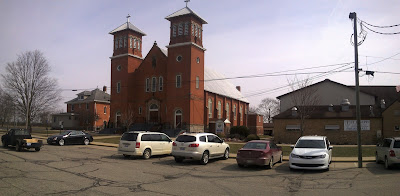
rectory (left), St. Joseph church, and community center in Pewamo, Michigan
For a very small farming town in middle Michigan like this one, the ethnic roots of many residents and family habits connect them actively or passively to this space where religious services and events of the passing years take place. Clergy have come and gone who have occupied the rectory building during their time in residence providing services to parishioners. The life cycle of the worship space at the church has gone from dream to plans to construction and consecration to decades of use up to the present and finally, one day in the future, reconstruction or demolition and rebuilding will also take place. However, the rates of participation in mainline churches has declined in the distracted age of Internet. So the amount of cooperation, concentration of money and intention needed to launch any kind of building project seems less and less likely as time goes on. Maybe this existing building will be maintained for generations to come, rather than rebuild in current technology and energy saving improvements. Years ago when large families and economic boom years created larger populations, the need to expand the indoor seating might have led to changes in the building and grounds. But as numbers stagnate or fall, the need for bigger spaces is not a concern. The nomos perspective on the subject of this stitched panorama scene is centered on the many lives touched by the making and ongoing use of the building and grounds here on formal occasions and for casual uses, too. Things like memories, intentions, credit/blame or accountability, and so on attach to these places and make it meaningful. By contrast, the physis angle is to see buildings (design, construction methods and materials, uses or functions of each room) and the schedule of weekly or yearly uses, along with the range in participants involved, as things to study: ignore the local meanings and intentions to emphasize instead the presence or absence of certain actions and the changes in behavior caused (or catalyzed) by a person's involvement with others and the teachings that take place under the worldview of Christians attending.

radio station transmitter tower, west bank of river in Grand Rapids, Michigan
Like the wind that sometimes whistles through the cables securing the transmission tower the conversations and music coming from this radio station are so ephemeral; they simply exist for an instant and then are quickly followed by something else, leaving little trace in the mind or heart of listeners as the motor down the road, sit in their living room or work desk tuned to the radio station, are busy with dog-walking or dishwashing or house painting, or they are lying awake in bed. And yet the ability to communicate over wide areas offered many benefits over print newspapers when it came to public information, (breaking) news, opinion and entertainment. Nowadays some people are experimenting with home radio stations (ultra low-power signals for neighborhood span of service), and digital radios and signals allow ever more concurrent uses of narrower and narrower wavelengths, even as the wireless spectrum of wavelengths is crowded more and more by cellphone transmissions. The nomos interpretation of radio programs, their stations, and their listeners involves content and what it means, why it appeals or irritates, and the kinds of changes it might bring to some listener's lives or, by extension, to the lives of people that listener is engaged with. On the other hand, the physis view focuses on the technical facts of transmission distance, cost, resilience (able to withstand power loss, etc), and the results to people's lives who tune in: does a song, conversation, or piece of news materially or emotionally alter that person's path in life, or at least in that day or hour?

In summary, all these examples captured in photos can be viewed in many ways. On this page just the contrast of nomos and physis are studied. By considering things like meaning and purpose on the one hand, and things like material change or effects caused by the subject in the picture on the other hand, it is possible to produce an expanded understanding of the significance of the people, places, and things that occupy one's ordinary environment and the routines taken for granted there.

20 March 2019

Government of the numbers, by the numbers, for the numbers

This play on President Lincoln's phrase about government of the people, by the people, and for the people can be illustrated from this Tuesday late morning photo outside of the offices for the secretary of state in rural Michigan, formerly a retail outlet in a 1970s-era indoor shopping mall that went out of business and has been leased for this organ of state record-keeping and fee collection since the late 1980s or so in this location. Around that time the functions of voter registration were merged with motor vehicle administration (the so-called motor-voter law) in order to keep a person's address up to date for both purposes.
"no photos or electronic recording allowed inside" the door sign says, 3/2019
There is a self-serve kiosk in the foreground for some routine transactions, but updating a driver's license photo, transferring the title of property, and other tasks must be done in person. Many times the business can be handled via the online portal or with the postal service, too. The sign near the floor at bottom left in large letters says that once per week there are evening hours available for those who are unable to come during ordinary business hours from 9 a.m. to 5 p.m.

Inside the office are three rows of 8 or 10 chairs so that a person can take a number from the dispenser at the doorway and keep track of how many customers are waiting ahead of one's own turn. There is a ceiling mounted video display that alternates between announcements of services offered, new state requirements, weather, sports, and news headlines. For people who did not bring their own reading material or who are content to stare at their phone screens, this ceiling mounted screen seems to occupy their attention.

Seldom is the administration of motor vehicles in the news headlines, although voting rights regularly crops up due to the extreme manipulation of voting precinct boundaries (Gerrymandering). There are also ongoing efforts to make vote-by-mail and deployed armed-forces voting more convenient and secure. On balance, however, most residents with voting eligibility and those who operate some form of motorized vehicle do seem content with the system of keeping records in order, up-to-date, and paying no more or no less than they owe. Perhaps the bureaucratic organism of 100 or 200 years ago would be amazed at the present standard of practice, thanks to telecommunication and vast record-keeping, searching, and interpreting data.

16 March 2019

Largest neighborhood association in the city of Grand Rapids - Pancakes

The annual community pancake breakfast was organized by the Creston Neighborhood Association, CNA, covering almost 2 miles east-west by 2 miles north-south, a couple of miles north of the city's downtown center. Volunteers collected $7 per adult unless that household pays the annual $25 membership fee, in which case there was no cost for the breakfast of scrambled eggs, sausage, bacon, blueberry and plain pancakes, french toast, and beverages (water, apple or orange juice, coffee).
This video clip was soon after the 9:30 a.m. brief presentations were made to introduce the exhibitors at the edges of the large dining hall in the lower level of the Second Congregational Church, the venue hosting the event. Things started at 8:30 and went on for about 3 hours. Table covers were paper and boxes of crayons encouraged children and everyone else to doodle directly on the table tops.
In the age of Internet, fragmented lives and overscheduled children in multiple activities, it is heartening to see people get out of their speeding cars and away from their ubiquitous portable electronic devices to meet one another face to face, exchange small talk, and find out about opportunities to get involved in a few of the common interests in keeping the area safe and satisfying. This is a pretty good glimpse of Civil Society in 2019 in West Michigan, although the neighborhood email bulletin board is a living tissue that contributes an important layer to community sense of place and problem solving. It has many viewers and posters who ask or answer questions for newcomers and old-timers.
Exhibitors included the county solid waste and recycling program, the medical services for uninsured and underinsured residents, fire-fighters and a uniformed policeman, the low-income housing agency, the neighborhood association itself, among others. As the biggest of the city's neighborhood associations perhaps it also is among the most vigorous in supporting and encouraging innovations and business successes. There were breakfasters of all ages around the tables, so it looked to be a success for volunteers and visitors.


11 March 2019

Polluting the public discourse - "Don't Pee in the Pool"

After naively supposing that the myriad of fragmented arenas for discussion online in Facebook would go well for everybody, it has become clear that abuse is easy and harmful. For a few people it is a source of entertainment or heady facsimile of (fake) power, too. Witness the genocide of Rohinga Muslims near the Myanmar - Bangladesh border state; witness the student to student bullying in many countries via FB and the several other prominent forms of social media.

At present there is a built-in way for people who are offended themselves, or who foresee harm to others they care about, to flag a posted message or article so that the human reviewers at Facebook can scrutinize the instance. This screenshot shows the most frequent types of offense to flag.
pop-up menu item available for any given Facebook posting: reader warns FB team
Stepping back to an analytic viewpoint, this typology is a kind of mirror that reflects the historical moment that our societies occupy during times of change in the environment and our relationship to the ecosystem and to each other; indeed each person's relationship to the sense of self also may be subjected to changing foundational assumptions and scope of imagination for dreaming a future self.

NUDITY is an invasion of private/intimate/bodily space.
VIOLENCE is an excess that also concentrates on a body; ditto SUICIDE or SELF-INJURY.
HARASSMENT can be words or deeds, again a body-centric infringement of boundaries.
HATE SPEECH and TERRORISM may differ in degree, but have a family resemblance; pertaining to individual persons/bodies, but also with a mass or communal scale of consequence, too.
FALSE NEWS has some commonalities to HATE SPEECH, but normally is less personally specific.
SPAM and UNAUTHORIZED SALES have a falseness about them, too.

In the most abstract sense, all of these types of violation consist of breaking boundaries that separate and define one person or group or truth from another. Perhaps this stems directly from the catch-phrase for the ever greater connection of people, ideas, records, and locations through the Internet, "Information Wants to be Free." However, by providing answers to any search engine for the Internet, no matter how poorly formed the question or statement, the searcher is given a facsimile of expert knowledge, mastery, or confidence that they have solved a problem, simple or complex, with the touch of a few thumb-buttons on a portable screen or a keyboard or voice dictation. When all information is reduced to a uniform sameness, the distinction of reliability or accountability is ignored in the rush to arrive at an answer. The knowledge landscape is collapsed from 3 or 4 dimensions into just a flat 2-dimensional world, making all answers look and sound the same.

By this logic of sameness that makes information the same thing as knowledge, or its long-distilled form of wisdom, then the traditional boundaries between bodies of knowledge, experts, and institutions gradually erode. This typology of Facebook offenses therefore presents itself as each infraction flares up. Thankfully there are people who refuse to accept the normalization and bland sameness to make all things (falsely) equivalent to each other - truth as just another alternative to the other imagined or hallucinatory realities in a person's mind.

From another standpoint, in the eyes of a person never part of the Internet Age, these warning types perhaps seem odd, or as something belonging to shared propriety, community standards, and their customary Common Sense. Since everyone knows these boundaries, there is no reason for breaking them and no cause for offense. So Facebook has brought forth many things, both good and bad. This set of Feedback Flags is a rich country problem; it only belongs to societies riven with the social media juggernauts.

03 March 2019

Camouflage blight - taking the theme in too many directions

cellphone to capture indoor tropical garden scene, dressed in warm camouflage
The most common color scheme for camouflage on the clothing racks for discount shoppers is the temperate forest palette: browns and greens. But sometimes there is all-pink, as in this photo, or a wintry scheme of whites and grays. The other color palette that comes to mind is the one in shades of blue. The same pattern of color blocks is reproduced, no matter the overall color scheme, though. It appears on overclothing like coats, insulated snow pants, hats, gloves, boots. It appears on shirts and pants. It appears on undershirts and underpants and socks. But when did this proliferation of fashion begin and how come the popularity is sustained?

One way to speculate is to consider the long wars of S.W. Asia, mainly Iraq and before that Afghanistan. Even though a relatively small fraction of the US citizens and resident aliens have enlisted in the all-volunteer military services, the circles of family and friends extends pretty far. So maybe one theory for this piece of the popular culture pie has to do with some kind of passive support for those in uniform now and before; sort of like fans of sporting teams who dress in the colors or merchandise of the team.

Looking from another point of view at the widespread wearing of the camouflage pattern on newborn babies to retirees,  maybe another connection to the field of meanings has to do with the functional nature of all things military; a no-nonsense approach to complexities and frivolities. By sticking with camo. themed backpacks, toys or playing cards, the person is expressing at least two messages - (1) ignoring bothersome considerations of fashion, propriety, status symbols, and (2) identifying with the all-action, results-oriented way that military operations are executed.

Related to this functional interpretation is the earlier expansion of denim jeans, shirts, jackets, backpacks and so forth in the late 1960s onward. Blue jeans - new or worn in/worn out - was the anti-"dressed up" clothing. Originally these durable textiles were limited to manual labor settings, but during the protest years and times of social change many people who were not manual laborers also expressed resistance to white shirts and polyester pants by putting on jeans in more and more settings. Gradually the dress code at public schools began to allow jeans that were not soiled or damaged to be worn; later the fashion for 'distressed' clothing pushed those boundaries further. In summary, at a time when social standards, aspirations, and expectations are changing, one way to reduce the confusion and lack of clarity is to reach for symbols that are functional and not tied to fashion. In the 1960s and 1970s that was blue jeans. At the turn of the 21st century that seems to be camouflage.

19 February 2019

Eating fish on Fridays

menu reminder of weekly fish dinner in the six weeks before Easter (click image for full size view)
There are places and times and groups of people for whom a main dish of fish, rather than customary habits of eating meat, is considered a minor expression of personal sacrifice. Sometimes this is practiced all year in communal dinners or at the private household level, but other times this is undertaken as a group experience or private dietary habit only in the six week period leading up to the Christian celebration of Easter, when the resurrection of the rabbi Jesus Christ is commemorated every year in springtime (northern hemisphere) around the time of the Jewish commemoration of Passover.

School districts, particularly when there are many Catholics in the surrounding catchment area, as well as other public institutions like elderly care facilities, or hospitals, for example will also commonly include fish on the menu in acknowledgment of those dietary practices for those who wish to follow the fish on Friday custom.

Deep-fried foods like french fries (FF abbreviation in the miniature menu card, above) and battered fish (very often perch and/or smelt and/or cod - at least here in the Midwest of USA) once were rare treats because of the amount of oil needed to do the frying, and for the rich taste of fatty and crunchy food. But with the public education of dietary health and concerns about high cholesterol and heart healthy foods more generally, the public dinners like this one advertised, often provide baked fish as an alternative to the batter-dipped and deep-fried entree.

Leaving aside the nutritional & ecological dimensions of sustainable fisheries and humane harvest of live natural resources, there are the many historical and cultural associations of the fish among followers of Jesus of Nazareth. For example, there is the phrase quoted in the Bible from Jesus that speaks of "making [his disciples] fishers of men." And there is a story of a meal for 5,000 men along with their women and children (loaves and fishes). Another story describes an ancient Christian code to identify fellow believers: it took the form of two curves in mirror image to resemble the head, body, and tail of a fish. Scenes like the stormy Sea of Galilee that Jesus commanded to become calm; the small businessmen who ran fish catches there who Jesus counted as some of his disciples; and the word-play of the ancient Greek word for fish, ICHTHYS, as an abbreviation for "I" + "CHristian" also can be attached to the fish. Finally, since according to tradition, Jesus was executed on Friday before sunset and the start of the weekly Jewish Sabbath, by serving fish on Friday instead of ordinary meat, the penitent follower is signaling a dim echo of the suffering that Jesus went through before and during his crucifixion. Dissertations and books probably discuss the meaning of fish for Christians at great length, but for now these scattered meanings give some of the sense of the context for "Fish on Fridays," as seen in this picture, above, from middle Michigan, USA on February 19, 2019.

18 February 2019

Library books to suit many tastes in reading

Fiction section, grpl.org 2/2019 (click image for full-size image view)
The top of every other bookshelf end row has a large signboard telling the genre collected on those shelves, along with a playful slogan or tag-line that fits that category of literature:

Give thanks with a great INSPIRATIONAL read
Find a ROMANCE you'll love
Unearth great MYSTERY books
New game, new voices, URBAN FICTION, real expressions
Boldly discover new worlds - SCIENCE FICTION, FANTASY & HORROR

With the advent of cable and satellite TV in the 1980s and then the home use of Internet in the 2000s, the hours available each day for a person to seek answers, information, entertainment or diversion have not grown, but the choices and perception of interacting with the materials has expanded. As a result, the volume of books loaned to residents has not increased with growing population size; in many cases even as titles published electronically and in print have increased, sales and library lending has declined. One commenter suggested that maybe 5 or 10 % of the US population reads for pleasure (not work-related or assigned in courses of study), but that those people have slightly increased the amount of reading that they do as choices of format has expanded to included audio download (while commuting, dog-walking, or dish washing, for instance) and e-books to carry on cellphone or dedicated e-reading device to fill the time spent waiting in line, or in-between tasks when there are 5 or 10 minutes available.

Public libraries serve many functions in the age of Internet and mobile computing and communicating. The act as places of warmth to those without a home, and places of cooling during hot summer days to these same people. Job seekers and people lacking Internet at home or work can use the public terminals for set daily time limits when they login. Library staff organize a range of events and programs each month to suit all the populations - children, retired, care-givers, parents and working-age people, teens, and so on. A large collection of music CD and feature film (and non-fiction) DVD is available for loan to residents or to people far-away who make a request though the state-wide interlibrary loan system.

In the time of the Information Economy and Knowledge Workers, it is especially important to be able to speak with a trained reference librarian to solve a problem, seek an answer, or make a strategy to gather needed information and make decisions. Like the rest of the society and economy, the public library and its branches continue to look for ways to be of most service to those it serves.

08 February 2019

Digest of January: beer, international exchange, dentist office, science matters, worship

As an expedient to catch up and display some scenes that drew my camera, several topics will comprise this digest of early February 2019. Click images for full-size view.
"Beer City" is one nickname for Grand Rapids, MI (microbrewries)
Full 16 oz. pints of beer from the menu of maybe 20 varieties locally made are reduced in price during the 3pm to 6pm Happy Hour from Monday to Friday to attract patrons who are free then, or for whom the list prices are too dear. Along with tasty food that fits in with the range of beer flavors (spicy or fatty or salty or deep fried) the business encourages and enables local community events, including performing arts (music nights, mainly). James and Deborah Fallows, Our Towns, observe that microbrewries are a sign of urban vigor in US regional cities now.
afternoon thaw at Fairplains cemetery after last week's days of snow and sub-zero weather - history in (head) stones
In the distance the straight rows of gravestones stands out against the blanket of snow. Each name carved onto the polished stone face tells a story and is rooted to a span of years, in this case mostly from the tumults of the 20th century. Back in the 1980s in Japan there arose an amateur history that can be translated as "Self as History" (自分史) in which a small group of family members become the lens to view the larger events of the decades at the national, regional, and sometimes international scale. In the same way,  the mortal remains resting here can be regarded as a library of stories. In principle there should be enough documentary information to form the outlines of a life course for each person here.

Currently engaged in 5 sister-cities on 3 continents
A very great proportion of all active exchanges and interactions between municipalities date back to the time of global conflict ending in 1945. Many of the origin stories have to do with specific individuals who felt particularly motivated to initiate the process that resulted in formal acknowledgement of each other's cities and societies. From that acceptance and honoring of one city by the other comes a variety of activities, much of which is volunteer-driven, or otherwise requires little capital expense by the local governments. The most active partnerships might involve annual visits by students or city officials or citizens. In other cases there is a commercial or corporate or cultural component to the communications and ongoing conversations about promoting the relationship and making it better known among the residents of each other's city. Seen in the aggregate, the many individual stories created and lives touched contributes to the social fabric between languages and societies. It is hard to know the tangible and intangible effects of these ongoing efforts that ebb and flow, according to interest level, ambition, and personalities driving things forward. Hopefully, curiosity expands and ignorance diminishes in the process, though.
state of the art dentistry has come a long way since...
A visit to the dentistry gear and office from 100 years ago in the upstairs of the Paine-Gillam-Scott local history museum shows the changes and the continuities from then until now in this view. In the days before electrically powered highspeed and precision-tipped drills and other implements, dentistry sometimes was an ordeal - in the original meaning from the days of witch trials and tests of physical endurance. Now there are x-rays that are all digital, never using chemicals or film to produce the view of dental decay. Special wavelength lighting illuminates cracks in teeth and dental work, too. Software like the one on the screen show the status of each tooth, with room to add notes or pictures that document the changes and recommended dental treatments. However, then as it is still today, this profession is a highly personal service, with hygienists and dental docs working inside one's mouth with sharp instruments and powerful, industrial strength bonding agents, etc. What historically may have been a side-job for a barber (pulling teeth rather than to repair, restore, or replace) now is something very different.
front yard declaration at a time of voices that protest the fake truth value of news and similar "ALT" (alternative) claims
This black sign with brightly lettered writing can be seen here and there from time to time around the city since early 2018 or maybe before that. In the time since DJ Trump's presidential inauguration the tone of the commander in chief has cast aspersions on things like fact, science, peer-reviewed publication, thoughtful analysis, public debate, and the transparency and civility and accountability that has been customary during the previous 44 presidents of the USA. One result is this sign this several direct contradictions to Trump's imaginary vision of reality: "Science is real," for instance. Click the image to see full size image and read all of the text on this yard sign.

annual orchid show in the coldest part of winter

Every winter the Frederik Meijer Gardens hosts the orchid fanciers' organization and their exhibition and sales of the warm weather plants in their diverse shapes, sizes, colors, and habitats. This photo with orchid in foreground and fancier bending down for closer look in the middle distance. At the top left is someone with flowers bundled up to take home, perhaps. A sign in the hall said that due to the abnormally cold temperature that new purchases would be delivered to the address of the buyer. The video clip, below, documents the tide of visitors moving in and around the hall, panning from left to right across the hall just before lunchtime on Saturday, January 26.


the many lives of this section of land: pre-contact, oil, leisure
On this cold bright day a few of the oil pumps were in motion, but most were idle since crude oil prices are low and don't cover the costs of producing the fossil fuel at the moment. Since around 2000 all this land that had been mined for sand and gravel left by the glaciers 10,000 years earlier was repurposed for area residents to park and enjoy the beach, water, boating, bike riding along multiple paved pathways, jogging or walking with or without dogs. Before its life as Millennium Park to the west of Grand Rapids, Michigan, this gravel pit supplied the many road-building projects around the west part of the state Before that traces of farm buildings show that early land owners tried to make a living in this region along the Grand River on the sandy ground.
     Going back in time pre-1830s, when Joseph Campau and other trappers and traders began settling in the river vicinity, the cultural landscape was dotted with place names, memories, and significant locations for seasonal harvest of foods and animals and medicines, as well as for trading and for ceremonies to mark life events of birth, marriage, (alliances) and death among the resident Odawa (Ottawa) Indians. Before them, perhaps a different mix of people - resident or mobile/itinerant knew the land. Still today there are spots respected by descendants of those Native Americans of 250 years ago and before.
opening morning of the 32nd annual Worship Symposium, hosted at Calvin College in Grand Rapids, Michigan USA
At the end of this morning's worship service in the College Chapel one of the event organizers gave a thumbnail sketch of the proceedings: more than 30 countries represented, over 1400 registered participants, and themed tracks for the workshops and seminars of interest to church musicians, preachers and teachers, lay leaders, and all other followers of Christ's Way of the heart.
     By clicking the photo, the full-size image file displays and some of the details of the focal point in the middle of the worship space can be seen now in the 15 minutes before things begin: there is a lectern for the preacher's notes, the installed bank of organ pipes, as well as seats and music stands, including piano to the back of the lectern and raised dais. The long table and chairs to the front of the lectern hearkens to the Last Supper of Jesus and his disciples, made famous in various paintings. It is used in some of the dramatizations with worship leaders silently acting out the scenes read from the Bible passages at a few points. Out of view to the right at the back wall is the bank of sound engineering controls to allow optimum balances of voice and music, including the various mic'ed speakers. The worship is live-streamed for those unable to attend, and is recorded for online release 3 weeks later. The black ball suspended in the air above the lectern has a dozen lens to allow video editors to cut between the various angles of view during recording.
entryway to worship venue on Thursday morning
The entryway to the college chapel 20 minutes before the morning worship begins shows the wide and welcoming space that greets people coming in from the cold. The artificial light renders a warm tone, making the outdoor natural light appear bluish by contrast.
     For a person attending a Christian worship service for the first time, perhaps there are many first impressions that stand out. The architecture, interior details of decoration, and effect of lighting and sound design all make some sort of impression. An electronic kiosk in the distance above most people's height gives scrolling set of messages and announcements. Probably 99% or more of the worshipers are very experienced in the Order of Service and no printed program or bulletin guides the congregation in when to stand, sit, sing, or verbally respond. It all seems to happen telepathically with only the slightest direction given by the worship leaders by gesture or brief verbal direction. To an outsider, perhaps, that mass experience in synchronization may seem strange; a sort of tide of mass emotion ebbing out or flooding in all together. The mix of music, dramatization, reiteration of Bible passages translated into modern day English, and commentary or teaching interpretations touch various parts of the worshiper: head, heart, spirit, and body. It is a social-public experience and also a personal-private one at the same time; something to which all can agree and affirm to some extent, but also permitting vigilance or critical distance from blindly accepting a view.