In the fading afternoon light the bright nylon inflatables catch the eyes of passers by, complete with their own blowers to keep air pressure, along with lights to internally illuminate to figure. In this case the figure of Saint Nicholas (a.k.a. Santa 'claus) astride a motorcycle stands out for its juxtaposition of jaunty biker culture with kindly bewhiskered gent in red. Then there is the giant teddy bear, quoting the Santa costume trimmed at sleeve and hat brim in white fur. Lastly at the far right and sheltering under an evergreen, there are Mary and Joseph surrounding a cradle, pressed from solid plastic and set glowing with bulbs inside the figures. Perhaps they date to the 1980s whereas the inflatables come from the 2000s. In addition to the range of scenes or characters from popular (Santa) and commercial (Mickey Mouse in Santa costume) culture of the year end holidays, manufacturers also have a selection of inflatables for late November (Thanksgiving Day in USA; the 4th Thursday of the month), and perhaps most of all for the end of October (Halloween). So there are a few households that put up a display in October, November and December, while others do none of this public lawn display.
If asked about reasons to add the electrification and increase their energy bill, perhaps they would respond in one or more of these ways: it is for my (grand)children (or neighbor kids), it brightens the December darkness, I got this on sale after last year's holiday season ended, it is fun to set up and look at each night, it is my contribution to my street's community spirit. But, of course, without actually posting the questions to a cross-section of residents, the list of suppositions is little more than imagination of just one writer.
A symbolic interpretation might go like this: The Santa figure is suited to a nation of immigrants, since strangers can be a source of unexpected benefit. The biker reference seems to bring the story out of the land of reindeer and onto the streets of a motorized society where people can be together and still be separate or isolated. The bear hearkens to the original Teddy Bear - something fierce and dangerous that now is cuddly and suited to childhood reveries. Meanwhile, dwarfed by the blower and big dimensions of the inflatables (just so much hot air?) there the figures going back to the 2000 year old story and the holy scripture that has conveyed it generation by generation. I wonder how well these relative proportions mirror the larger patterns around the regions of the USA, both in rural and urban places, among the many varieties of ethnic groups comprising the society at the moment.
Postcard-sized observations taken from daily life: "When a man understands the art of seeing, he can trace the spirit of an age and the features of a king even in the knocker on a door." - Victor Hugo
CLICK photo for full-size view.
see also anthroview
Also anthropology clippings
22 December 2015
18 December 2015
Daily ebb and flood of young eaters wasting food
![]() |
| the menu for hot lunch is turkey with gravy on mashed potatoes; pizza option (R) |
Long gone are the times of war time rationing and recycling of fats, fiber, bone, tin, and so on. The slogan of the 1990s onward at the municipal level has been "reduce - recycle - reuse" but school buildings and their districts typically are preoccupied with convenience and lack of complication since their attention is taken up with educational outcomes measurable by standardized tests, not necessarily the more intangible results of eating habits and other lifelong attitudes that students take from grade level to grade level until at last they reach the age of majority, vote, earn money and consume what is necessary for livelihood and also what may be unnecessary but fits into the large sector of Discretionary Income.
This picture from the food server's standpoint looks across the heated serving line to the cafetorium (dual use as dining space and stage front seating for performances and other school or community events, with overflow space when the folding wall connects to the adjoining gymnasium). The logistics have been tweaked in the 16 years since the building opened in 1999. Recess was a big attraction to many and so they'd tip much of their lunch into the bin before excusing themselves to play. To respond the school changed the sequence so that recess begins the sequence and lunch concludes it. Minutes have been calculated to line them up and move them through the serving line with barcode scanner to track choices longitudinally (brown bag is a cold lunch option, but comes on a Styrofoam tray - no bag in sight; pizza is a daily menu item -alternating from triangle slices to rectangle cheese stuffed crust; and the day's hot lunch - 15 menus that rotate daily; almost no students carry a lunch pail or bag from home and come through the line merely for a choice of white, chocolate, or strawberry flavored milk).
Usually 3 or 4 dining room monitors hover like a pit crew, ready equipped with spare packets of plastic flatware and straws for those dropped or lost, and armed with scissors to snip plastic containers open. They catch spills, tamp down rising voice levels, coach the slow eaters along, and at the end they give a 2 minute warning with a call-and-response rhythmic clap (1-2, 1-2-3) and hand gestures (finger to lips or the raised hand showing the universal, school wide code for voice level 1 - the lowest).
It would be instructive to mount a time-lapse camera above the waste bins to gauge each grade level's rate of non-eating in general, as well as patterns specific to each of the 15 menus in the rotation. This daily ritual, five times a week during he 180 day school year, is a powerful and mostly non-verbalized lesson in (lack of) respect for food, the pressure of time to eat something, and the need to get along institutionally (not getting out of hand for the sake of the whole assembly there dining). And among a few of the food line servers there is a routine to instill the rudiments of giving and receiving, as in "would you like a roll with your turkey and gravy on mashed potato?" (the menu for the photo here) : Yes, please? No, thank you? You know what to say.
In summary, an important part of schooling happens outside the curriculum, lesson plans, desktops or LCD projector screens. A few decades ago a seriously injured writer turned to his classmates who'd graduated from high school maybe 20 years earlier to ask them what parts of their learning mattered still today; or what things they'd discovered to be truly useful and important in life that *should* be broached during the growing up years. Apart from literacy and numeracy, the survey responses included things like: what is normal development of one's body (range of normal), ways to find and keep a job, how to get along with difficult people, what pitfalls and advice concerning personal finance and the world of investments should one be familiar with, what are some of the sources of contentment and meaning in one's life. In the case of the 20-25 minutes allowed for eating at the elementary school, pictured here, there is socialization going on, but also great material waste and habits to accept and continue to do the same uncritically and unconsciously. Surely there must be other, better ways to carry out this important and pleasurable activity around the school district and indeed the entire country.
24 October 2015
Thinking about Halloween in small town middle Michigan, USA
There on the corner is a house that stands out from the maybe 10-15% of homeowners who make an effort to create a display or express Halloween themes. Whereas some will erect inflatable nylon creatures with light and fan running internally, and others put window decoration or a lawn ornament that references death, creatures of the night, and fright - typically in colors of black (night) and orange (fall leaves, pumpkins and other colorful gourds), a few houses include lots of detail and wordplay (false tomb stones with pun-like names such are Herbie Lowe, a play on 'here below').
Question: what is the appeal or aspiration being expressed in these tableaux for the passersby to view? There is no contest or competition in any formal sense. But for some perhaps the motivation is an annual activity for family participation that celebrates a curious day - knocking on the doors of neighbors and strangers with the expectation of being given free candy that is safe and desirable.
---3rd annual zombie fun run, "Run for Your Life" in city park to raise money for new Spray Park.
![]() |
| click image for full-size view |
Labels:
48879,
clinton county,
halloween,
lawn decoration,
st. johns,
tombstones,
yard decoration,
zombie
20 August 2015
Native Americans - online in the state of Michigan
Bicycling on one of the streets in Traverse City, the logo on one of the SUVs parked on the side displayed the logo for the Grand Traverse Band of Indians. Census-wise there are relatively few who classify themselves as Native Americans or Pacific Islanders in the USA (less than 1%, although specific counties will have concentrations; for example in Oklahoma, New Mexico, or Arizona). So except for casino billboards on the highways, airwaves, and Internet there is relatively little visual presence of Indian persons, property (like the truck parked on the street), business products and services, or issues important to Native people.
In a word, for people living around the state of Michigan, at least in the southern, most populated parts of the lower peninsula, the subject of Native Americans can be summed up with the word ignorance; sheer lack of experiences, first-person connections, public discourse and news media, textbook presence and so on.
[caption: screenshot taken from webpage - URL at top left of the image]
See also album of images on this subject at https://www.flickr.com/photos/anthroview/albums/72157673270576798
In a word, for people living around the state of Michigan, at least in the southern, most populated parts of the lower peninsula, the subject of Native Americans can be summed up with the word ignorance; sheer lack of experiences, first-person connections, public discourse and news media, textbook presence and so on.
[caption: screenshot taken from webpage - URL at top left of the image]
See also album of images on this subject at https://www.flickr.com/photos/anthroview/albums/72157673270576798
Labels:
chippewa,
michigan,
native american,
odawa,
ojibway,
ojibwe,
ottawa,
potawatomi
30 July 2015
Streaming recyclers among the consuming public
This unwelcome bin began showing up early July 2015 under the 3 year contract with the town government to replace the recycle tubs (18 gallon capacity). Whereas the tubs could hold a week or more's worth of plastics, glass, paper products and metals, these new 96 gallon behemoths may well fill up only every 4-6 weeks. Having fewer stops to make on the route saves the company time and personnel costs, but it falls to the householder to put the eyesore someplace in the meantime. Around this same time a radio talkshow with recyclers in Washington, DC and in Seattle came to the conclusion that the move to supersize the bins did not produce savings as planned because residents grew more careless about sorting and preparing things for the curbside pick-up. As a result, the sorting facility had to filter out the contaminants (non-recyclables). The upshot is that what once just about paid for itself (value of materials equaled the costs to run the service) now ended up costing more to run than the original tub-based system. Going bigger just seems to mean less care, and more consumption.
Labels:
48879,
clinton county,
curbside recycling,
recycling,
st. johns
walking through Clinton County 4H Fair, July 27-31, 2015
This walkthough of the fair grounds mid-morning and mid-week (Wednesday) shows a quieter scene that one might have seen 15 or 30 years earlier when summer vacations consisted of local kids looking for interesting things to say, do, or watch.
Highlights include passing glimpses of the dairy pavilion (left hand side) and the viewing stands (right hand side) while the young people in the ring are showing their quaffed and cleaned animals to the judges for comment and evaluation.
Labels:
4-h fair,
48879,
agricultural show,
cattle judging,
clinton county,
county fair,
st. johns
18 July 2015
Early July scene mid-week along highway M-115 in Cadillac, Michigan at William Mitchell State Park.
To join the others under the trees and walking distance from the two lakes that straddle the isthmus most people buy, borrow, or rent a camping trailer or RV (recreation vehicle). The section reserved for tenters (people sleeping under nylon or canvas) is relatively small and hard to see by comparison to the wheeled, portable living spaces shown here. The convenience of having a familiar place to sleep, cook, and take care of some personal grooming gives campers reason to haul their trailer north from time to time on the weekend or for whole weeks at a time. It is hard to beat the feeling of certainty and security with light, heat, water and electricity all in one place, especially when the outdoors is less than glorious. And yet there is the view that your means will affect your ends; that is, the manner in which you conduct your life affects the kinds of things that are visible or audible in your experience. By analogy and using the "life is a journey" metaphor, the person traveling on foot v. noisy motorbike v. biplane v. jumbo jet will all have different experiences of a place. So too of camping - the more gear that separates you from the elements, the less of those textures and rhythms will you perceive. Thus to live in or a few steps away from a camper which is neatly parked next to other ones is bound to be a different experience to living out of a tent with few tenters nearby.
Labels:
cadillac,
camping,
michigan,
rv,
state park,
tent,
william mitchell state park
27 June 2015
Golf and tennis? Forest succession and water tables? - it's a matter of time horizon
Looking toward the outdoor seating of the clubhouse at the golf and tennis country club with a view of the long narrow Lake Leelanau, there is a certain feeling of contrast between the business of leisure sport on carefully tended grounds and the therapeutic separation from one's working routines on the one hand, and the rhythms and structures that organize the rest of the plants and animals that share these spaces on land and water. The humans live one golf or tennis season to the next, concerned with providing a level of service and model for business that keeps things solvent from one generation of owners and members to the next. But in the much longer sweep of time, in geological or glacial age time frame of 10,000 years, the daily business decisions and the weekly grooming of grounds and buildings have little impact on the shape of the land and the flow of water, the action of freeze-thaw cycles and the prevailing pattern of winds that deposit the next generation of seed in shade or sun, leading to another cycle of birth and decay. And so, when looking at the pleasing care of the grass and pavement, as well as savoring what is offered on the menu, it is salutatory to zoom out to a wider point of reference and see that the life cycle of the trees and the generations of fish and frogs operate by entirely different directions, all the while intersecting the concerns of the people who keep the golf and tennis facilities in tip-top shape each outdoor season.
Labels:
club house,
golf course,
lake leelanau,
leelanau county,
leland,
michigan
15 June 2015
Sign of the times? Call up the experts - consultants for bankruptcy
As seen at the intersection this evening, heading east.
The public discourse, popular culture, peer to peer conversations all contribute to reproduce the dominant worldview of consuming goods and services; the more the better. But the results of easy credit (short term indebtedness in fact) can confuse or disorient a person into the self-image of unlimited means to satisfy desires for more stuff. This roadside advertisement is a symptom of "Affluenza," as the documentary named this sickness of consumer society that has run amok.
11 June 2015
thar she blows - wind turbines of Gratiot County, Michigan
As seen Wednesday, June 10, driving north on US-127 (click image for full size view with turbines on horizon, above the road line.
In this flat landscape of steady winds the renewable source of wind power makes sense, although for local and migrating birds the moving blades are a worry. And for residents downwind the sound carries. One person spoke of wintertime ice building up under certain conditions and then potentially launching off the swinging propeller to land like some sort of modern-day catapult projectile.
| towering wind turbines on the horizon |
In this flat landscape of steady winds the renewable source of wind power makes sense, although for local and migrating birds the moving blades are a worry. And for residents downwind the sound carries. One person spoke of wintertime ice building up under certain conditions and then potentially launching off the swinging propeller to land like some sort of modern-day catapult projectile.
25 May 2015
mass migration on Memorial Day 3-day weekend

The busiest roadways in USA are the end of May (the northbound stream of cars on M-115 near Cadillac on Friday about 2:30 p.m. pictured here) for the 3 day weekend of Memorial Day; the traditional end of summer vacation season on the 3 day weekend of Labor Day (itself the first Monday of September; and the 4 day weekend of Thanksgiving (3rd Thursday) in November.
The urge to spend some happy hours among those one knows best, whether relatives or friends or both, drives people to their cars. For most people the roadways are the single biggest risk factor in their lives. And being more heavily trafficked on the start and the end of the holiday weekends, the danger is that much higher. In the recent decade or two the state police in Michigan, together with volunteers, have offered coffee at the highway rest areas to help ward off drowsiness or at least to demonstrate to those stopping that the problem is worthy of care. This widely dispersed pattern of social bonds comes from the ease of transportation, personal or by commercial services of rail, ferry and motor coach. So for the past 150 or more years, to pack up and visit others for a weekend has not been out of the ordinary. But in the grand scheme of human experience, it is not the norm, either. It would be interesting to peer into each of the cars in this stream to know what fills the compressed social space: silence, audio book or music or talk radio, conversation, cellphone or other mobile devices, print materials occupying the minds of those aboard? Multiplied across all the highways filling up in the afternoon of the holiday, the sum total of engagements is likely staggering.
Labels:
cadillac,
highway traffic,
m-115,
memorial day,
michigan,
national holiday
12 March 2015
Swampers (livelihood in Okefenokee Swamp until 1937 national wildlife refuge designation) and Strangers - local knowledge
| Tour service near east gate to the national wildlife refuge (10 min. west of Folkston, GA), 3/2015. |
On a recent trip out of state to the Okefenokee Swamp far from the familiar climate of snow and ice, the contrast of being a local resident with insider knowledge to being a sojourner, just passing through, became clear. While enjoying the mild temperatures of Florida, the street organization and the design of traffic flow were unfamiliar. The names and faces also were strange. Of course the English (and Spanish) language, though sometimes accented to varying degrees, and many of the franchise business were the same or of a recognizable category (regional chains of grocery or hardware or convenience store, for example). And being a tourist meant setting each day’s schedule with little or no routine, responsibility, or recurring commitment. This lack of daily or weekly structure lent a sense of freedom and feeling of being unencumbered. But it also meant lack of connection to groups and individuals nearby, except for ones based on commercial transaction of hotel, restaurant, fuel for the rental car or any other purchases made along the way. In other words, being out of one’s element tends to leave on on the sidelines of local life; a spectator to the rhythms of the day and cycles of the season. What remains open to engage on equal terms to long-time residents with their layers of local knowledge, then, is the natural world outside of human affairs: bird watching, eco-touring, botanical observations and insect sighting. Then there is the historical and archaeological perspective: imagining what stood in a given location before the present scene, either the Big Events marked by brass plaques edited by historical commissions, or ones unmarked by label text but narrated in history pamphlets or detectable to someone with an eye for material culture and traces of by-gone times before gas-powered automobiles (e.g. narrow streets and no built-in garages; no parking lots), before telephones or electric power distribution, etc.
After a few days of living in hotels and eating at recommended restaurants with some local ingredients or styles, it was time to make the transit back home. What things constitute “home”? What connections and meanings are available in a place long lived in, compared to the meager meanings one can extract in a few hours or days spent someplace? Whether it is out of state but in the same country, or it is abroad in a place based on different language and culture, the defining elements of “being a local resident” are much the same and set apart those with many days lived in the spot from those with few memories layered there. Knowing a place by “face and by name” means that the streets and landmarks are familiar old friends or at least acquaintances. Naturally a person’s habits, work, or leisure make some places more familiar than others. So there may be corners of a town or city that remain unknown or only dimly familiar. A stranger may see only the surface elements of a spot, while a local may have personal memories either good, bad or indifferent tied to the same place.
Next to knowing a location “by name or at least by face” there are the responsibilities (school and clubs, work, family and friendly interactions) and recreational involvements of hobbies and community that introduce structure and shape the schedule of one’s day, week and each season of the year.
Then there are is the “local knowledge” of being able to identify what a person, place or thing signifies; what meaning there may be in a given piece or news or local happening, or indeed opportunity for business or civic undertaking. The analogy to foreign places is “cultural literacy”; that is, recognizing what something or someone means as well as knowing what something means. Also analogous to foreign situations comparing insider and outsider experiences, there is “social proficiency” in knowing how to go about solving a problem, whether it is mending clothing, purchasing a specialty item, or finding the answer to a complicated (social or material) problem. Strangers would bring their own toolkit of methods, but locals would have a much wider range of immediate solutions. The third analogy from foreign experiences besides cultural literacy and social proficiency is linguistic fluency; that is, being able to express oneself as well as to interpret the meanings of those who are all around. When the comparison is between local and outsider of the same nation-state or at least the same (native) language, then regional differences of inflection, accent or (local) vocabulary are relatively small and do not overly lead to different experiences of the local terrain. Whether one’s spoken signature style was learned in the north, south, east, center or west does not greatly set apart local and outsider at the onset. However, because locals can hear that “you aren't from around here” then they can take extra interest in assisting you (the host-guest function of ancient times), or on the contrary dismiss you as being inconsequential to the local affairs that most interest them.
In summary, being an outsider in a warm, sunny place for a few days, where the language is about the same as home, but everything else is unfamiliar, the reasons for feeling like a spectator became clear: the bases for engaging in meaningful schedule and purposeful interchange were limited to commercial transaction for traveler services (food, transport, lodging, guiding), to observation and inquiring into the natural environment and seasonal cycles, and to some study of historical events and the observable material traces of bygone times. Then in turn the return to home ground quickly restored the familiar routines of the day and week: preparing meals, keeping house and yard and pets, answering mail and email, and catching up with work left temporarily aside. Knowing one’s life space “by name or at least by face” (as people normally say of those they recognize) is what makes a place familiar, day by day, as new memories and projects and envisioned possibilities take shape, layer upon layer, making meaning of one’s life.
31 December 2014
God and? or? nor? Country - Christmas creche in plastic and internal lights; veterans memorial in road center
In the cold light of the last calendar day of 2014 we observe the permanent display in brick, metal and stone for the veterans memorial and the seasonal display of figures to represent a scene at the Bethlehem manger about 80 generations ago when the VIPs from the east arrived to behold the baby Jesus. For someone who has never seen either of these things, there is a lot to reflect upon: origins of these forms of memorializing, the undertaking of designing, funding, securing permissions and building, then maintaining and using the sites. For someone who sees the Christmas ensemble year after year, it is easy to glance briefly enough to identify what it is, but then go no further and study the meanings of the original language and society, much less the meanings over the centuries as the Bible meanings intersect with the World.
09 December 2014
Spreading the wealth - Christmas gifting customs in 2014 rural Michigan, USA
So much material wealth - Christmas bags for families short of spending money
03 September 2014
a little library
Corner of Spruce and Sixth St. in Traverse City, MI 49684; the vicinity of Munson Hospital
During the pre-Industrial times, paper was made by hand and printing would be also by hand, possibly on the prepared skin of sheep or veel (vellum?). As a result books were of value for their scarcity, craftsmanship and ornamentation. The force of the argument or the vigor or the prose were secondary to all but those who could read. When paperbacks broke on the shores of mass literacy around the time of WWII the physical worth of a book was now less important in many instances that was the flow of the story or skillful mastery of words. Now we see steady increases in non-print books for screen reading on portable device or computer workstation. Yet even in late summer 2014 there is a space for a small library for passers by and curious drivers by.
The top-most text reads: Kids Creek LittleFreeLibrary
The bottom-most (blue panel) text reads: Kids Creek Neighborhood Little Free Library, Learn more at www.tadl.org (traverse area district library), where the following story appears.
| Drive-through fast food for thinking - late summer 2014 |
During the pre-Industrial times, paper was made by hand and printing would be also by hand, possibly on the prepared skin of sheep or veel (vellum?). As a result books were of value for their scarcity, craftsmanship and ornamentation. The force of the argument or the vigor or the prose were secondary to all but those who could read. When paperbacks broke on the shores of mass literacy around the time of WWII the physical worth of a book was now less important in many instances that was the flow of the story or skillful mastery of words. Now we see steady increases in non-print books for screen reading on portable device or computer workstation. Yet even in late summer 2014 there is a space for a small library for passers by and curious drivers by.
The top-most text reads: Kids Creek LittleFreeLibrary
The bottom-most (blue panel) text reads: Kids Creek Neighborhood Little Free Library, Learn more at www.tadl.org (traverse area district library), where the following story appears.
11 July 2014
exurban still life - Walmart summer evening
Morning, noon or night the parking lot has a few dozen cars at the Superstore (grocery + general merchandise Walmart) in St. Johns, Michigan 48879. On this occasion about 30 minutes before sunset early in July, there was a pleasant westerly breeze and majestic cloudscapes on all sides. Such is the intersection of timeless meteorological beauty and the "everyday low prices" luring spenders through the worldwide retailer. On one side of the automatic doors the calculus of small profit margins and Least Cost decision-making rules. And on the other side of the doors the ancient world of ecosystems and planetary rotation with diurnal cycles of day alternating with night is what matters. Perhaps once upon a time the man-made world of transactions, production and distribution was not so distantly separated from the bigger world of life forces and geological time. But today and very likely tomorrow this gap will remain the same or grow even bigger.
07 June 2014
celebratory parade of affirmation - Sikh religious communities of Michigan come to Lansing
Looking up from the bookstore/cafe at Lansing Community College one spring day in 2014 (4/26), the lines of people of all ages in ethnic clothing and ordinary clothing walked by en route to the state capitol building one Saturday morning. Generally there is not a lot of public visibility of Sikhs on the airwaves or public spaces, so this event was a good chance for those walking to affirm their place in the state; and a good chance for those passers-by to see them, as well.
How might the role of public visibility differ in a society other than USA, where such public statements are allowed, routine and perhaps expected as a way of self-assertion and existential expression?
Labels:
ingham county,
lansing community college,
lcc,
mid-michigan,
parade,
sikh
Voting culture - high school civics classroom podium (poster)
Rural high school classroom podium in history/civics class lists a series of consequential decisions that happened by a margin of one vote. Since the youngest tend to be the least politically involved; instead self-involved or friend-involved, it makes sense to dramatize the power of a single vote to decide the outcome of a proposed law.
01 June 2014
flag avenues
![]() |
| Evening view of Mt. Rest Cemetery on May 30, 2014 in St. Johns, Michigan 48879 |
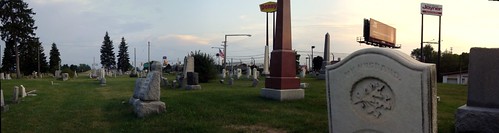
So far there are 570 flags at the city cemetery, “Mt. Rest,” in St. Johns, Michigan. Four times a year the poles and flags are unfurled: Memorial Day (not the 3 day weekend that varies its date each year, but rather the May 30 date of the traditional Civil War holiday), Independence Day on July 4, Labor Day (the first Monday of September), and Armistice Day (the World War I cessation of hostilities, November 11). This panorama stitches 2 photos to show the view south and east from the paved road that runs along the west side of the 1919 era mausoleum located at the center of the present grounds, but at its beginning it was near the eastmost edge of the burials made between the early years of the city in 1856 and 1919. Tombstones of that early time often were large, while those of the recent generations are normally more modest. Some burial grounds specify flush to the ground must be made to facilitate easy lawn mowing.
What will future observers and inquiring minds think about the ceremonial handling of the national flags, the Memorial Day speech-making and frequent references to “freedom” [but whose? and under what terms] and “freedom is not free” (but rather has been paid for in the blood of the draftees and volunteers and career soldiers and sailors and aircrews).--see also video clips from the remembrance ceremonies
--see also the July 2016 display:
Avenue of Flags - set of cemetery festooned with U.S. flags
[at Memorial Day and again at Independence Day the hundreds of flags are placed]
http://miserybay.usanethosting.com/indylite/archives/3460 =article
https://www.youtube.com/watch?v=lywSMljkiTU =slideshow of scenes
23 November 2013
hotel lore - no 13th floor, Gideon and Bibles
Chicago's Fairfield Inn by Marriott at river north location on Illinois Street.
This screenshot from the computer shows two photos taken at the hotel to show two cultural features.
In hindsight the breakfast selection --choices and arrangement-- would be another worthy facet to consider through the lens of cultural analysis, too.
By comparison to Japan's numerology and the inauspicious overlap between pronunciation of '4' (homophone to 'death') and of '9' (homophone to 'hardship' or 'burden'), in USA and perhaps other anglophone societies, it is 13 that is inauspicious. Places like hospitals, where one's health is vulnerable or at risk, and schools (where one's life chances are in development), and hotels (where one is sometimes far from familiar social networks of support) all seem to skip from 12 to 14 in order to bypass the unlucky number 13 in naming of floors. It would be interesting to consider a complete range of tall buildings to see if more types avoid the number 13 in naming floors and rooms, for instance. Perhaps the same occurs after 100 floors, too; skipping from 112 to 114?
As for placing of Bibles in hotel rooms, that is wide-spread; but I don't know the moment that the society of Gideons (named for the figure of Gideon in the Bible) began the practice, or whether all chains of hotels permit this service. Nor do I know when the Mormon Bible began to accompany the Gideon one, or how widely both Bibles are distributed. One interesting feature, at least of the Gideon bibles, is an index to some of the generally known stories and lessons found scattered through its pages. And I seem to recall also a Question and Answer section to a few dozen complaints and sources of distress of the human heart and social relationships for which a person in a hotel room may turn to the Bible for advice: "what the Bible says about…" (some examples could be things like adultery, betrayed trust, friendship, money troubles, suicide and murder).
This screenshot from the computer shows two photos taken at the hotel to show two cultural features.
In hindsight the breakfast selection --choices and arrangement-- would be another worthy facet to consider through the lens of cultural analysis, too.
By comparison to Japan's numerology and the inauspicious overlap between pronunciation of '4' (homophone to 'death') and of '9' (homophone to 'hardship' or 'burden'), in USA and perhaps other anglophone societies, it is 13 that is inauspicious. Places like hospitals, where one's health is vulnerable or at risk, and schools (where one's life chances are in development), and hotels (where one is sometimes far from familiar social networks of support) all seem to skip from 12 to 14 in order to bypass the unlucky number 13 in naming of floors. It would be interesting to consider a complete range of tall buildings to see if more types avoid the number 13 in naming floors and rooms, for instance. Perhaps the same occurs after 100 floors, too; skipping from 112 to 114?
As for placing of Bibles in hotel rooms, that is wide-spread; but I don't know the moment that the society of Gideons (named for the figure of Gideon in the Bible) began the practice, or whether all chains of hotels permit this service. Nor do I know when the Mormon Bible began to accompany the Gideon one, or how widely both Bibles are distributed. One interesting feature, at least of the Gideon bibles, is an index to some of the generally known stories and lessons found scattered through its pages. And I seem to recall also a Question and Answer section to a few dozen complaints and sources of distress of the human heart and social relationships for which a person in a hotel room may turn to the Bible for advice: "what the Bible says about…" (some examples could be things like adultery, betrayed trust, friendship, money troubles, suicide and murder).
| elevator keys (no 13); bedside drawer (Bibles) |
16 May 2013
Cemetery for Civil War Veterans (& spouses) in Grand Rapids, Michigan
Graves continue up to the present day. The original design has expanded, according to the historical plaque at the east gate, adjacent to the Grand Rapids Home for Veterans, just south of River Park (on the Grand River) and west of I-196 and the Plainfield exit [photos as of May 15, 2013; playback time 1:56].
view this clip at 640x480 pixels at youtube, http://www.youtube.com/watch?v=IWomtYQ9ESA
19 July 2012
reverse culture shock-predeparture
After 5 weeks in far west China I made a short week of visits with friends in Japan. It was refreshing to move from a position of almost total benighted ignorance of languages (Uyghur, Kazakh, Chinese) and society (Urban Urumqi, campus culture, autonomous Xinjiang province distant from Han majority eastern China) to a position of semi-ignorance in Japan, where I can hold a conversation and accomplish much of what I need to do for daily life. Suddenly the signs and spoken announcements are clear and understandable for meaning and for culture (expectation of what is being intended, precedent and why one should find value in such). But then as I begin the return path from Japan to the trans-Pacific leg out of Beijing, I begin to think ahead about the USA, where I have not striven to keep current on headline news, people or places.
Three vignettes cause me to think about who are the U.S people that I hear about from the people around me.
1. (photo) On the platform at JR Osaka I begin to see people who are visibly foreign to Japan (of European, S. Asian or African descent). I reflect momentarily: probably their experience is like mine recently in China. They only barely skim the cultural and linguistic surface, managing to get from point A to point B thanks to the alphabetic subtitling of public transportation signage. But the vast ocean of meanings and individual lives and aspirations is out of reach. Upshot: foreigners have their own rich universe of meanings, but there is little interconnection to the society and language outside their own. And among the people raised in the USA there is even less likelihood of ability, interest or exposure to other languages and lives. Reverse culture shock: most of my people (if those on the train platform are such) are monolingual and are poorer for it individually and collectively.
2. Airport check-in line includes so many visually non-Japanese bodies, voices, and faces (well maybe 10-12 all together). I reflect: here is only the second person of African descent that I have seen in the past 7 weeks (one here, once in Urumqi at the university), and here the bodies seem too tall, too heavy and altogether too big, bulgy and pointy-nosed. The posture or presentation of self makes gives me the impression of aggressive, confident, entitled to own their own destiny. Reverse culture shock: identity of self and in the eyes of others has much to do with surface appearances. One's point of reference gives a relative scale of what is the range of 'normal' so that when one's world has relative uniformity, then those people who are outside that boundary stand out extraordinarily. Probably the reverse is true, too: when you see diverse range in skin, hair, clothing, body-type then the experience of a place of relative uniformity must seem restrictive and the fine-tuned differences may get lumped together as "all the same."
3. Food hall at International Youth Hostel at Hagoromo (Hamadera Koen/park) in Takaishi: 20 somethings with N. American accents are somewhere behind me bemoaning the lack of clean clothes and need to line up for using the coin laundry facilities down the hall. The talk goes to employment woes and apartment living, college experiences and career interests. The trigger to my reverse culture shock is the flat, slightly nasal voices (Midwest?), and the shared script; that is, they seemed to be in the same boat, paddling the same pace and riding the current in the same direction. There was an unspoken oneness of monolingual, monocultural conversation that feels suffocating after the opposite extreme of Urumqi, where it is routine to hear or speak several languages from one moment to the next, with the accompanying cultural narratives that go along with each. Reverse culture shock: the mainstream, single current, one directionality of consumer culture and brand name living that I associate with those young people's voices. This dirth of social and linguistic diversity is stifling, unproductive (of qualitative variety, but productive of quantitative scale: mass markets) and maybe dangerous.
Three vignettes cause me to think about who are the U.S people that I hear about from the people around me.
1. (photo) On the platform at JR Osaka I begin to see people who are visibly foreign to Japan (of European, S. Asian or African descent). I reflect momentarily: probably their experience is like mine recently in China. They only barely skim the cultural and linguistic surface, managing to get from point A to point B thanks to the alphabetic subtitling of public transportation signage. But the vast ocean of meanings and individual lives and aspirations is out of reach. Upshot: foreigners have their own rich universe of meanings, but there is little interconnection to the society and language outside their own. And among the people raised in the USA there is even less likelihood of ability, interest or exposure to other languages and lives. Reverse culture shock: most of my people (if those on the train platform are such) are monolingual and are poorer for it individually and collectively.
2. Airport check-in line includes so many visually non-Japanese bodies, voices, and faces (well maybe 10-12 all together). I reflect: here is only the second person of African descent that I have seen in the past 7 weeks (one here, once in Urumqi at the university), and here the bodies seem too tall, too heavy and altogether too big, bulgy and pointy-nosed. The posture or presentation of self makes gives me the impression of aggressive, confident, entitled to own their own destiny. Reverse culture shock: identity of self and in the eyes of others has much to do with surface appearances. One's point of reference gives a relative scale of what is the range of 'normal' so that when one's world has relative uniformity, then those people who are outside that boundary stand out extraordinarily. Probably the reverse is true, too: when you see diverse range in skin, hair, clothing, body-type then the experience of a place of relative uniformity must seem restrictive and the fine-tuned differences may get lumped together as "all the same."
3. Food hall at International Youth Hostel at Hagoromo (Hamadera Koen/park) in Takaishi: 20 somethings with N. American accents are somewhere behind me bemoaning the lack of clean clothes and need to line up for using the coin laundry facilities down the hall. The talk goes to employment woes and apartment living, college experiences and career interests. The trigger to my reverse culture shock is the flat, slightly nasal voices (Midwest?), and the shared script; that is, they seemed to be in the same boat, paddling the same pace and riding the current in the same direction. There was an unspoken oneness of monolingual, monocultural conversation that feels suffocating after the opposite extreme of Urumqi, where it is routine to hear or speak several languages from one moment to the next, with the accompanying cultural narratives that go along with each. Reverse culture shock: the mainstream, single current, one directionality of consumer culture and brand name living that I associate with those young people's voices. This dirth of social and linguistic diversity is stifling, unproductive (of qualitative variety, but productive of quantitative scale: mass markets) and maybe dangerous.
15 August 2011
music, crafts, food festival
The stage also featured sign-languge support so the lyrics and introductory comments could be picked up by those in the audience who can sign. The range of listeners went from in-utero to elderly fans.
Looking over the rows of music lovers the common delight unifies them. Yet when the applause ends and they move back into their individual lives, all the abiding concerns cover them again: financial worries, job insecurities, interpersonal anxieties or comforts, rising or falling self-confidence and spirits heavy, average or light.
Labels:
48823,
detour band,
east lansing folk festival,
live music
29 July 2011
band camp, day 4
at www.kettunencenter.org on Thursday afternoon: about 150 musicians from grades 10-11-12 preparing for the fall season of half-time entertainment for the home football games in September and October. The choice of Union Jack among the flag carriers is meant to go with the theme of British rock music.
Labels:
48879,
band camp,
kettunen center,
marching band
30 April 2010
talent show of 12 performances
From a yearly contest of numerous high schools in middle Michigan, here are images from each act. The young people have plenty of amateur talent and sometimes pour a lot of time and money into their love of expression. For the mostpart the audience of peers was quiet and respectful, with occasional chit-chatting or hub-bub breaking through the spell of the performers. Students on stage came from Ovid-Elsie, Breckenridge, St. Louis and Birch Run schools.
And here are a couple of video clips from the same event.
28 April 2010
church selling second-hand goods
For dozens of years this Congregational church has helped raise funds for projects by inviting donations of used materials to organize, assign prices, advertise and open for sale to the public. The past 15 years, though, some things (such as clothing) have been excluded and the quality of donation is supposed to be a little higher than a typical residential Yard Sale, Garage Sale, Rummage Sale or Porch Sale.
Most years the proceeds total a couple thousand dollars. So this big effort is valued for the results in addition to the shared work and fellowship it creates among the volunteers who organize and the people who offer their donated things for sale.
Labels:
48879,
charity sale,
clinton county,
garage sale,
rummage sale,
second-hand,
st. johns,
yard sale
lobby of high school - highest levels of competition
![]() |
| entrance lobby at high school in the morning before classes begin |
Students and parents are greeted in springtime with the special decoration at the main entrance to encourage teams and clubs that rise above peer schools to reach regional and finally state-level competitions.
"farmers' market" at newly rebuilt Lansing City Market
24 April thronged with the great and small: a slight consciousness about knowing one's food sources and makers is growing. And the conversations along the way are an added quality of life issue for more and more people who make time for driving, biking or walking to the City Market in Lansing, Michigan. Credit Michael Pollan in large part for this public interest, www.michaelpollan.com, with his several books about food and society these days.
big box foodstore takes local business away
Local grocery chain of six supermarkets closes another of its locations in middle Michigan, USA.
Across the road is a Midwest chain of really big stores that buys in greater volume and negotiates with vendors more stringently than the locally based food stores. Perhaps shoppers will one day deliberately do business at small but more expensive places for reasons other than price tag, such as supporting local owners and workers: less automation may appear less economically efficient, but then there are other factors in a person's livelihood than dollars and cents.
![]() |
| closed for business |
27 April 2010
menu this week at rural high school
Monday: chicken nuggets, green beans and mushroom soup
Tuesday: bacon cheese burger, curly fries
Wednesday: pasta bar, garlic bread, Caeser salad
Thursday: Scalloped potatoes and ham
Friday: 7 inch round pizzas
Menu reflects the continental scale of food production, promotion and distribution.
Little of the elements will ever touch human hands along the cycle from seed to digestion.
Tuesday: bacon cheese burger, curly fries
Wednesday: pasta bar, garlic bread, Caeser salad
Thursday: Scalloped potatoes and ham
Friday: 7 inch round pizzas
Menu reflects the continental scale of food production, promotion and distribution.
Little of the elements will ever touch human hands along the cycle from seed to digestion.
University community changes on campus
While attending a performance at my alma mater, the University of Michigan, I picked up the on-campus list of events and communications (not the student newspaper, The Michigan Daily, but the university source, www.umich.edu/urecord). The overall impression, compared to the middle 1980s, was of status consciousness and displays of hierarchy fading; of established routines and expectations eroding, and of a general increase in the amount and variety of campus events outside of classroom instruction.
Perhaps this impression comes from my middle-age vantage and my collection of life experiences in various organizations and projects where the Ivory Tower has become shorter and less rarefied. And perhaps the diffusion of personal computing over the Internet has supported and indeed stimulated diverse small interest groups and projects. Whatever the origins, the impression stands out at the periphery of my vision and understanding: present but not quite focused.
16 March 2010
Iconography - This is USA (passport watermark landscapes)
Printed on my new passport book. Try to identify the date and location of these showcased scenes. Then consider the cultural production: what Presentation of Self, or collective representation is shown (not too many people are featured, certainly).
14 November 2009
national anthem before music event at high school
| faces turned to the flag, standing, and some with hand on heart |
Seeing the many families loyally in support of the outdoor marching band season finale here in the school gymnasium, I began to imagine all the statistical facts reported in the news headlines and in feature stories by investigative reports, documentary film makers, and so on.
Among the 300-400 people gathered this evening, we can imagine such things as:
-jobless rates (and those under-employed; those working without benefits)
-single parent households
-people dependent on social services for food, heat, health, transportation
-debt loads vs net assets/worth
-per centage of un-insured (and under-insured) for health care
-fraction of the adult population who smoke (a generation ago almost 40%, now 20%)
-number of people with serious health threats
-public health problems: flu, obesity, lack of fresh food (not refined or highly processed)
-educational attainment levels (those completing 2 years of college; four; advanced degrees)
-income stratifications
-abuse: substance abuse and addictions (including gambling), DV, TV-video gaming
-personal development difficulties: adjustment, self-esteem, lack of (wide) perspective
-learning difficulties (emotional, physical, mental)
-generational preoccupations: each season of life has distractions and worries
08 November 2009
high school contest to decorate classroom doors - Hallowe'en
around October 28 the judges went round the halls of the school to award top rank to best decorated doors: this one is far better than most (in fact it appeared that fewer than 1/2 the rooms participated), but not the top place. On the Friday (10/30, last day of school before the actual day, Oct. 31) a number of students and a few teachers also dressed in costume or parts of costume in keeping with the halloween theme. I was not at this school on the Friday, but at a different high school instead.
23 October 2009
traditions of marching band (high school days)
After a week of summer practice the 150 musicians, band leaders (drum majors) and flags (only one male this year) perform at the football game half-time (15') interval during the fall when the game is hosted locally. When the team is away, the band there will do the halftime show. As the sun sets earlier week by week, for the final performance in middle October they have decided to end with a "light show" in which small lights attached to uniforms and shoes accompany the moving formations under cover of darkness. Somehow the sound seems all the bigger when this eerie twilight surrounds the marching band.
Two scenes from the Friday, September 11 game in 2009.
see also a short thumbnail movie from the Monday night rehearsal
Labels:
48879,
clinton county,
football field,
half-time show,
light show,
marching band,
st. johns
death and dying - stone grave markers
The stone cutter across the street from the burial ground must have supplied most of the markers, since the ones from many of the active years of burial are the same granite source material. Some of the early 20c stones are very large indeed; solid, no-veneer. As in life, so also in death the addresses are neatly arranged.
[East central Saginaw, Michigan (USA)]
[East central Saginaw, Michigan (USA)]
Compare also the much smaller graveyard that was once beyond the city of Kalamazoo, but now finds itself at the exit ramp to the interstate highway there at the edge of the city.
Labels:
burial ground,
cemetery,
death customs,
funeral customs,
grave stone,
tombstone
Flags and feelings
Commemorating public safety workers directly affected by rescue and later recovery from 2001 terrorist attacks of September 21. Pictured here is an oversize US flag on the end of the ladder truck at the front of the town fire station in rural middle Michigan
, looking east at the intersection of Main Street.
Seeing this prominent public display got me starting to think about all the things the flag can stand for - individual memories, shared experience, layers of historical resonance, abstract national-ness (essence symbolized); as well as the meanings contained by critics of the US present or past actions and way of handling things. Some of these feelings and ideas may be similar in scale or degree for other flags and other peoples, while other elements may be particular to the US experience as an immigrant society of relatively few generations since its foundation.
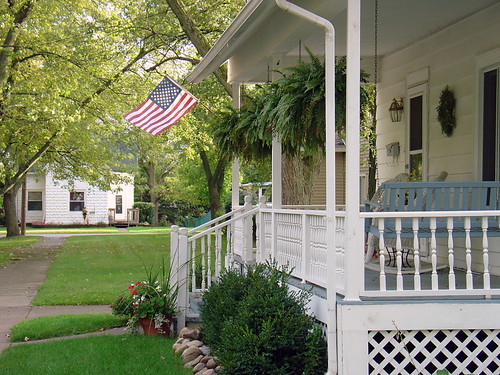
Another flag display, this time on a private house, got me thinking more about the flag & ways that people use it to stand for one or more expressions.
Here's a first look at a list of possible connected meanings, http://www.flickr.com/photos/gpwitteveen/3985554820/
--see also 2014 video clips from the remembrance ceremonies
--see also 2016, the July 4 display:
Avenue of Flags - set of cemetery festooned with U.S. flags[at Memorial Day and again at Independence Day the hundreds of flags are placed]
http://miserybay.usanethosting.com/indylite/archives/3460 =article
https://www.youtube.com/watch?v=lywSMljkiTU =slideshow of scenes
see also https://www.atlasobscura.com/articles/flag-desecration-laws
18 October 2009
Waiting for 'flu shots 2009
Annual "healthy families" county-wide health fair. With official figures for unemployment in Michigan at 15% and underemployment also high, the chance to receive a few health services and lots of free information was very attractive this Saturday morning (8:30-noon): vision & hearing tested, blood tests (sugar, cholesterol, pressure), online self-test for risk of heart disease and so on.
elementary school classroom (management)
Managing the minute to minute flow of student interest, questions, reference points
1. Reference: weekdays in which students go to special teacher outside the classroom (art, music, physical education, library).
2. Selecting one student at random: flat wooden sticks with student name written.
3. Behavior codes: students warned about own behavior (green >yellow >red). Students are meant to record this at end of day in parent communication folders.
4. Day & Date: hand-written at top-right of whiteboard (like orienting one's work papers by recording one's name at top-right).
5. Schedule for day (sequence of activities to aid in transitioning and retrospect).
6. Delegating responsibility/status (day's helper: distribute or collect papers, select order of dismissal).
7. Attendance (self-serve): students move own name magnet to the lunch heading: hot, cold, pizza, milk only.
8. Pencil, please: jar of loaner pencils scavanged (likely also set for "self-serve" will be paper: scrap, drawing, lined)
9. Numbers in daily life: calendar, weather, time (yesterday was..., tomorrow will be...), number of instructional days [or days left in the school year]
10& 11. Discretionary time: wide selection of levels and topics and series for reading (or listening) in 10-30 minute times
Not pictured:
a. Tangible rewards - letter O's given to students to collect (trial month, giving out 10 per day; then 5 per day). Gathered in public view. Traded for prizes.
b. Workflow - student "mailboxes" for accumulated daily work produced that students (self-serve) dutifully carry home at end of day.
c. Timeflow - morning meeting to do routines of calendar, weather, day's schedule; end of day "afternoon meeting" as recap & reminder moment.
Subscribe to:
Posts (Atom)